
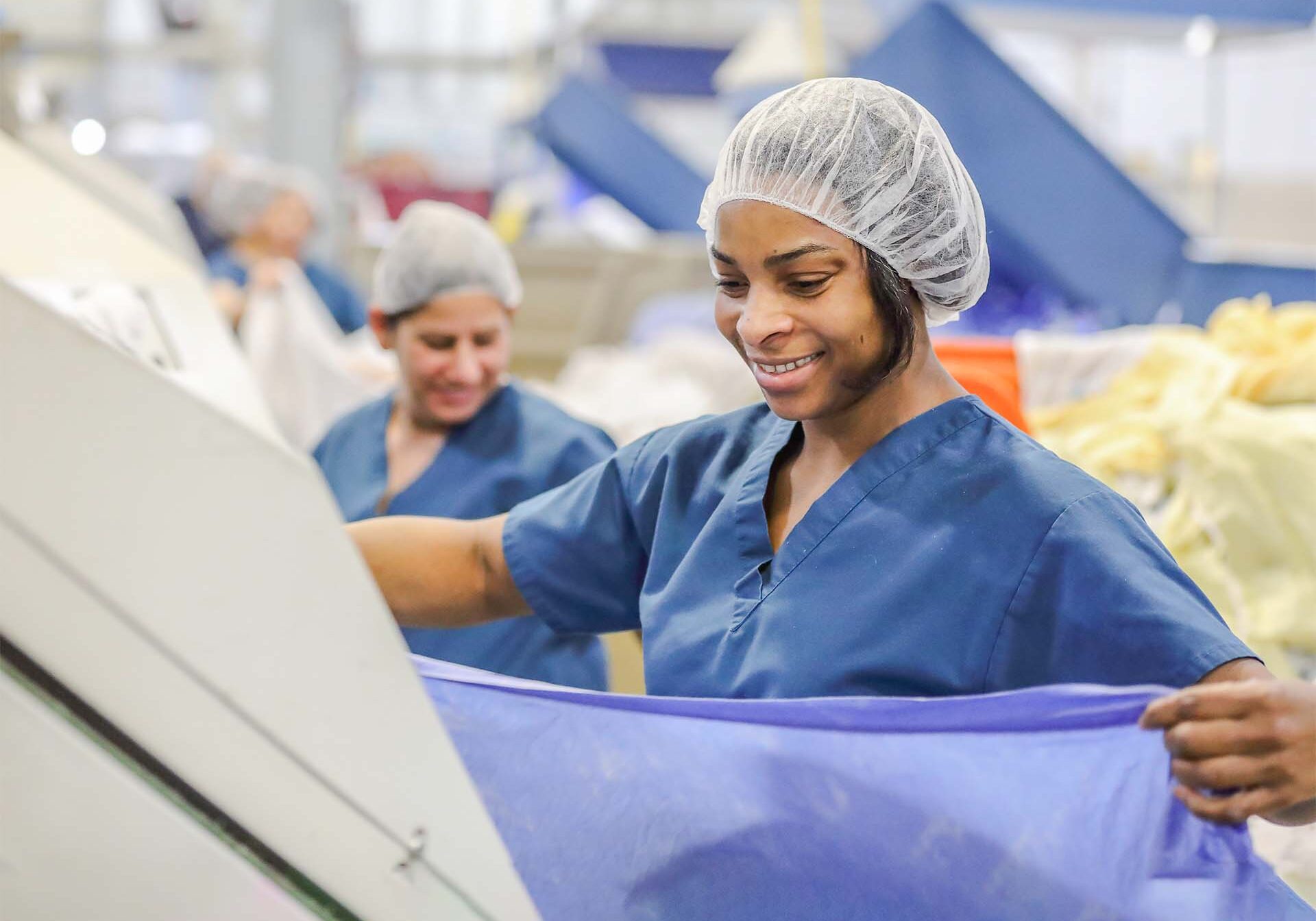
Healthcare launderers are navigating a period of change and uncertainty as hospitals and outpatient-care centers work to improve patient outcomes under tight budgets and ongoing questions about hygiene and textile policies in the post-COVID-19 era.
Healthcare Checkup
“Demand for healthcare services remains strong,” says Bryan Bartsch, president and CEO of Ecotex Healthcare Laundry Service, Vancouver, BC, Canada. “However, healthcare providers continue to face significant financial pressures arising from labor shortages, inflation, aging infrastructure and funding constraints. This will drive further growth outside of the acute-care setting, more urgent-care centers, more clinics, more day procedures.”
Brian Kradjian, president, Bates Troy Healthcare Linen, Binghamton, NY, adds that while the economy has performed better than some had predicted, last year’s tax and spending bill has put pressure on healthcare providers. This, in turn, has complicated the work of the laundries that serve them. “The economy has strengths and weaknesses, but remains surprisingly resilient,” Kradjian says. “There seems to be a lot of different economic forces occurring simultaneously. There remains uncertainty as wars continue, which will hopefully not escalate. Nominal GDP is quite strong, unemployment remains low, oil and interest rates remain elevated and inflation persists.”
He adds that nationally productivity and corporate profits are up, but Kradjian expects that artificial intelligence (AI) could spur layoffs in the overall economy. At the same time, aging baby boomers (born 1946-1964) and others are entering retirement, even as immigrants who previously were legally working over the past four years now face deportation. The U.S. is also politically divided. Meanwhile, hospitals are feeling the impact of reduced government aid. “The One Big Beautiful Bill Act, or H.R.1, is impacting long-term care customers and rural hospitals and likely beyond just rural,” Kradjian says. “We hope, sooner rather than later, there can be a legislative patch or solution to this. Medicaid reimbursement rates for the long-term care industry have not kept pace with costs. Overall, demand for healthcare and linens remains strong, coupled with continued growth of ambulatory care clinics, and consolidation on both the provider and laundry side.”
Ecotex founder Randy Bartsch, who is Bryan’s father, notes that healthcare demand remains strong. It’s driven by an aging population, even as medical institutions face increased fiscal pressures. This reality poses a challenge for policymakers across North America. “Overall, demand for healthcare is structurally strong because of demographic trends and the increasing complexity of care,” says Randy, who is also chair of TRSA. “The challenge is not demand; it is how healthcare services will be funded, organized and delivered in the future.”
Joe LaPorta, president and CEO of the Healthcare Linen Services Group (HLSG), St. Charles, IL, adds that healthcare consolidation is a phenomenon that’s likely to continue. Laundry operators will have to adjust. “I would say we are moderately concerned about these global dynamics as our business/volume follows the patient,” he says. “So, the need does not disappear if a hospital closes. However we may dislike this reality, consolidation has been an industry dynamic in healthcare, and it will continue to be, as this is a fundamental strategy to sustain and grow.”
A related issue, stemming from the pandemic of 2020-’23, centers on the need to ensure that should a similar crisis arise, hospitals will have a sufficient number of textiles, especially protective items such as isolation gowns for staff, to meet the prospect of another spike in demand.
Supply Chain Security
While the recent memory of shortages—particularly of iso gowns and other personal protective equipment (PPE)—lingers in the minds of many healthcare professionals, we commonly hear that most U.S. hospitals and clinics have reverted to the pre-COVID status quo of relying primarily on disposable PPE. Kradjian says his team has responded by working on its own to prepare for the next emergency. They’ve taken several steps, including increasing the plant’s stock of reusables. “The pandemic taught us and the industry a lot,” he says. “Some of which one can prepare for and some of which is not always economically feasible to do, depending on the length and breadth of the unknown future disruption.”
Dealing with tariffs initially posed a challenge as Bates Troy worked to stockpile supplies in case of a new spike in demand for reusable PPE. They’ve since made progress in securing additional goods. “We developed an Emergency Preparedness List which we revisit from time to time,” he says. “We have a lot of PPE: reusable isolation gowns in stock.”
Bryan notes that in Canada (Ecotex operates plants there and in the U.S.), the pandemic reaffirmed the important role that reusables play in Canada’s healthcare system. “In Canada, the pandemic response highlighted the importance of reusable textiles,” he says. “Ecotex significantly expanded its reusable gown-processing capacity during the pandemic, dramatically increasing the availability of AAMI Level 2 reusable isolation gowns for Ontario hospitals and ultimately supplying more than 42 million gowns through March 2022.”
He adds that pandemics aren’t the only threat to textile supplies that operators ought to consider in their emergency-planning protocols. “The healthcare-textile supply chain continues to experience disruptions from weather events, policy changes, transportation challenges and global events,” Bryan says. “As a result, we remain intentional about maintaining appropriate inventory levels and strengthening our readiness across the organization.”
Suppliers, of course, play a key role in this process as well. Adam Frankel, VP North America for Healthcare Sales at Standard Textile Co. Inc., Cincinnati, says diversifying production capabilities and having a robust network of distribution centers can help keep laundry operators—and by extension healthcare providers—in good stead regarding their needs for PPE and other textile goods. “U.S. manufacturing is a big differentiator for us,” Frankel says. “Combined with our global manufacturing footprint and multiple distribution centers, it gives us the flexibility to navigate today’s challenges, including supply-chain disruptions and changing customer needs.”
Frankel credits Standard’s diverse supply base with keeping iso gowns available to customers during the pandemic. “When others were out of isolation gowns, we were able to continue supplying them because we manufacture both globally and domestically,” he says. In addition, keeping supplies of pre-laundered textiles available allows customers to distribute those goods to healthcare providers immediately, with no need for processing. This can make a real difference in a crisis. “During times like COVID, hurricanes, or other emergencies, that speed matters.”
Laundry operators also must take the risks of supply-chain disruptions seriously to ensure that their services aren’t interrupted. Close monitoring of textile trade flows is critical, says LaPorta. “Our team has weathered these dynamics over the years very well. We stay close to the markets, geopolitics and our supply-chain pathways to ensure customer expectations are met.”
Ensuring infection control in the healthcare space is another area that’s raised heightened concerns from healthcare providers in the post-COVID era, according to our sources.
Trust but Certify
Bryan says the pandemic fueled additional fears among healthcare professionals about the need to do everything they can to avoid hospital-based infections. “Infection prevention has always been fundamental in healthcare, but COVID-19 significantly increased scrutiny of every step in the reusable textile process,” he says. “Customers now ask more detailed questions about process controls, separation of soiled and clean operations, employee practices, environmental controls, testing and contingency planning.”
Randy adds that this enhanced scrutiny has benefited third-party certification efforts, such as TRSA’s Hygienically Clean program for laundries. “That heightened focus reinforces the value of credible third-party certification,” Randy says. “TRSA’s Hygienically Clean Healthcare program combines documented best practices, independent inspections and microbiological testing. Certification is not a substitute for a laundry’s quality system, nor is it a claim of sterilization. It does, however, provide objective evidence that recognized hygienic processing practices are consistently followed. As healthcare systems strengthen risk-management and procurement requirements, independent verification becomes increasingly valuable.”
Some healthcare providers talk about infection prevention, but don’t necessarily follow through on the steps needed to make that goal a reality. “Some long-term care customers still do business with non-certified laundries,” Kradjian says. “Although for hospitals, Hygienically Clean and other accreditations are certainly still important for whom they consider for their linen-service provider,”
As for promoting the cause of reusables vs. disposable textile products to healthcare providers, success may require more than simply persuading hospital/clinic managers to convert to reusables for economic or environmental reasons. Lobbying government officials is viewed as an effective way to bring about change, our sources say (see related article, pg. 30).
Advocacy & Action
Randy notes that laundry operators should emphasize readiness when calling for greater use of reusable textiles, especially PPE in healthcare settings. “Reusable PPE should be viewed as an important component of healthcare preparedness,” he says. “Properly designed and processed reusable isolation gowns can improve supply security, reduce waste, lower total cost of ownership, and lessen dependence on imported disposable products.” He adds that advancing reusable PPE isn’t an “either or” question. Rather, hospitals need a mix of both to safeguard patients and staff in case of another emergency. “The discussion should not be framed as reusable versus disposable in every circumstance,” Randy says. “Healthcare systems need both. The goal is a balanced PPE strategy that reflects clinical requirements, while recognizing that domestic-reusable processing capacity is itself part of critical healthcare infrastructure. TRSA is well positioned to advance this through research, education, procurement guidance and public policy advocacy.”
Kradjian agrees that TRSA should serve as the industry’s voice to policymakers on reusables. “Yes, absolutely, we believe the TRSA is best able to advocate for the increased use of reusable PPE,” he says. “It localizes the supply chain, increases domestic employment, reduces the waste stream for the hospital/landfill, and provides better protection in the end for staff and patients alike.”
LaPorta says more work in this area is needed because hospitals typically are reluctant to diversify away from disposables. “Advocacy certainly can help,” he says. “However, healthcare customers need to be open to such solutions, and it has been a slow go so far in general.”
As noted, sustainability is another factor that favors the use of reusable PPE over disposables. Randy says healthcare clients want their laundry partners to document their impact on the environment. “Healthcare customers increasingly expect measurable performance rather than broad environmental claims,” he says. “Reusable textiles represent a practical circular-economy model, and the industry should continue improving how it measures water use, energy, greenhouse-gas emissions, textile life and avoided waste so purchasing decisions are based on full life-cycle performance.”
Frankel says laundries are ideally positioned to work with hospitals to benefit the environment. “Sustainability is becoming increasingly important across healthcare, and healthcare laundries are the perfect partner to assist in that,” he says. “As regulations evolve, it’s becoming even more important to provide healthcare providers with practical reusable options. That means providing products that perform better than disposable products, while helping reduce waste.”
Kradjian adds that while his company and other laundries are sustainably focused, not all healthcare providers are fully committed to sustainability, often due to fiscal pressures. “Environmentally friendly practices are important for our company, company culture and industry,” he says. “It’s often just good business to conserve resources and utilities, while helping the planet and its environment. Our customers care to differing extents, but unfortunately in the end, their decisions are more financially based and often, sustainability takes a back seat.” LaPorta adds that the interest among healthcare providers in sustainability varies from system to system and by region. He says the issue is critical to HLSG, and in many cases the laundry industry also takes sustainability seriously.
Bryan agrees that sustainability is important, but it also represents a win-win for laundry operators across North America. “Sustainability is not a separate initiative,” he says. “It is part of operating an efficient healthcare laundry. Water, energy, chemistry, transportation and textile utilization all have environmental and financial consequences. The best sustainability initiatives improve both operational performance and environmental outcomes.”
As technology advances, particularly with the rise of AI, tracking environmental performance and other aspects of laundry operations is likely to generate significant progress in the near term. Below, our sources offer their take on what directions they see AI taking for their companies and the industry.
AI Implications
Broadly speaking, the industry leaders we interviewed for this article see AI as having its biggest impact on data management. That, in turn, can help laundry operators make better decisions. Artificial intelligence is also expected to spur additional moves to automate operations.
“In the near term, AI applications will primarily improve operational decision-making through better forecasting, reporting, data analysis, inventory management, accounts payable automation and routing optimization,” Bryan says. “I expect the industry will see a steady evolution, rather than a sudden revolution on the equipment side.”
Frankel agrees that AI can do much to help laundries plan inventory use and improve customer service. “Artificial intelligence has the potential to help healthcare providers and laundries make better, data-driven decisions by improving visibility into inventory, utilization and operational trends,” he says. “As AI continues to evolve, we expect it will play an increasingly important role in areas like forecasting, inventory planning and helping customers optimize their textile programs.”
Kradjian says his company is using AI in a limited fashion today, but he expects Bates Troy will do more in this area, including on the equipment side of the operation. “This is an evolving aspect of our industry,” he says. “We have only deployed AI in a limited fashion with fleet management. But we are going to use it more in our management team, data analysis, maintenance, and inventory management. We think AI will play an increasing role with equipment automation in the future.”
Randy cautions operators against getting carried away by the hype surrounding AI in some quarters. “AI should be viewed as an operating tool, rather than an objective in itself,” he says. “The greatest value will likely come from hundreds of incremental improvements that help organizations make better decisions every day.”
One source of trepidation about AI, particularly among hourly employees, is that this technology will lead to job cuts. That’s widely disputed, particularly given today’s labor shortages. The common response that we get from operators is that no, they won’t be laying people off. But they will likely move staff into more value-added jobs. Skilled positions typically are the most difficult to fill and retain, our sources say. “Human Capital represents close to 50% of our revenues,” says LaPorta. “It is very important and maybe most important of all. Today, it appears the hardest roles to find and keep seem to be drivers.” Bryan concurs with this view, but added that laundry operators can boost recruitment/retention of skilled employees by ensuring that workplace conditions and the overall environment are positive. “Recruitment and retention of leadership talent and skilled trades remain among the industry’s most important priorities,” he says. “Skilled maintenance technicians, automation specialists and commercial drivers continue to be among the most difficult positions to recruit and retain.” Competitive pay alone isn’t enough, he adds. “Compensation matters, but long-term retention depends equally on workplace culture, safety, leadership, training, career development and employee engagement.”
Kradjian left no doubt that workforce considerations are a top priority for his company, particularly for skilled positions. “Recruitment and Retention remain vitally important in today’s labor market,” he says. “Finding qualified maintenance technicians remains the largest challenge.”
Healthcare Today & Tomorrow
Like much else in the economy across North America, healthcare is changing rapidly. We’ve noted above the challenges posed by supply-chain fragility, post-COVID infection-control issues, the need for reliable supplies of reusable PPE, enhanced resource conservation, staffing challenges, tech advances and more. Yet, for operators that can meet the demands of today’s healthcare providers, these challenges also have an upside: those that overcome them are well positioned to grow their businesses through the 2020s and beyond. Almost no one is predicting lower patient counts. What’s more, the recent shift from inpatient to outpatient care is widely viewed as a plus for laundry operators (see related article, pg. 26). “We see this as very positive for our business as we are able to service both hospitals and clinics, and in most cases hospitals are moving their outpatient volumes to HLSG because they only want to deal with one company,” LaPorta says. “So, we expect growth in both acute and nonacute to continue as our population ages.”
Randy adds that the evolving mix of inpatient/outpatient care represents an effort by healthcare providers to serve a diverse range of patient requirements. Laundries can grow by accommodating both types of healthcare venues. “We expect both hospitals and outpatient facilities to continue growing, each serving different patient-care needs,” he says. “Healthcare laundries must increasingly follow the patient, rather than the building, delivering consistent quality, reliability and accountability across an integrated continuum of care.”
Bottom line? To succeed in today’s healthcare market, laundry operators must effectively navigate a range of technological and other changes. Those that do can expect to grow as healthcare itself expands to meet rising demands for medical care. TS
JACK MORGAN is senior editor of Textile Services. Contact him at 540.613.5070 or [email protected].