
Key areas of focus for TRSA’s new chair include nonmember outreach, advocacy, technology, certification, member training, educating customers/prospects on the sustainability of textile services and nurturing global ties. It’s also crititcal that we get the industry’s message out—clearly and consistently—to all internal and external parties of interest.
Why do you want to be chairman? What motivated you to do this?
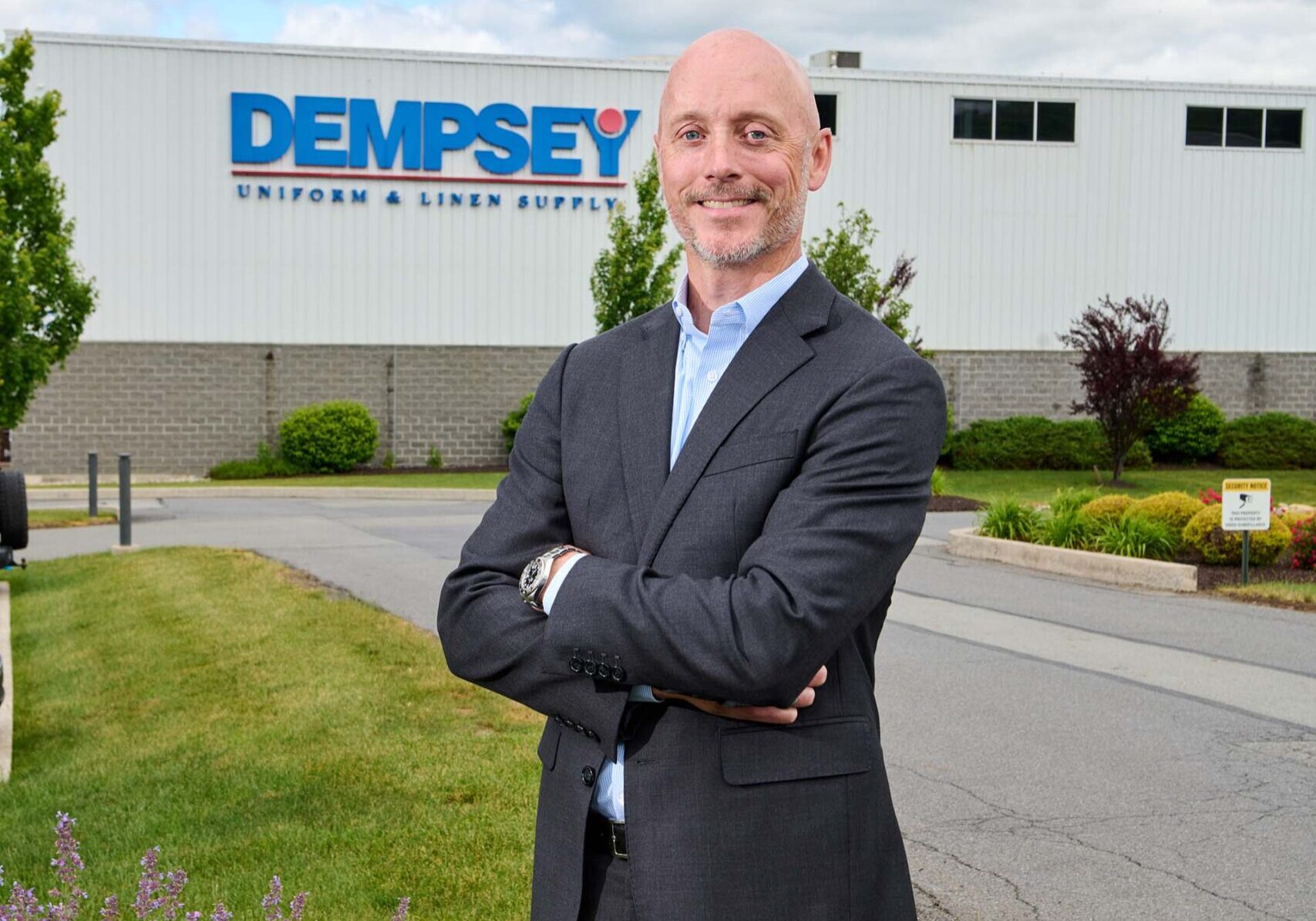
My motivation starts with my father (Patrick J. Dempsey). He was deeply involved in TRSA (Textile Rental Services Association), even when it was still called LSAA (Linen Supply Association of America) prior to a 1979 name change, and in the CSC (Central States Corp.) Network. Some of my strongest early memories are of traveling to conferences with him when I was barely a teenager. He seemed to know everyone, and everyone knew him. When I entered the business in 1998, he made sure I engaged in industry events immediately, and we traveled to meetings together regularly.
What I observed during those trips changed how I think about this industry. So many of the ideas my father brought back to Dempsey came directly from conversations with peers and colleagues at association events. My father declined the chairmanship, repeatedly. Not because he didn’t want to serve—he did—but because his commitment to my mother, his six kids and a growing business made the time investment impossible. Today, Dempsey is orders of magnitude larger, and paradoxically easier to run, because of the team we’ve built. The constraints my father faced no longer apply to me in the same way. I believe his encouragement for me to engage in association leadership was his way of saying: when the time comes and you can do this, you should. That time is now. Beyond the personal dimension, I have a strong conviction about what this chairmanship needs to accomplish. I want to keep independent laundries independent: vibrant, growing and competitive. Sitting on both the TRSA and CSC Network boards, I’ve seen firsthand that smaller operators often have misconceptions about TRSA: that it’s built for the nationals and that it doesn’t speak to their reality. That’s wrong, and it’s a problem worth fixing. Making that case to the broader independent community is one of the most important things I can do as chairman. I also think independent operators benefit from being active members of both TRSA and the CSC Network.
How does TRSA help foster relationships between operators and suppliers?
TRSA provides the platform that brings operators and suppliers together at conferences, institutes and specialized events throughout the year. These gatherings are distinctive because of the quality of access they create. An operator from a regional company can sit down with the CEO of a major supplier partner in a way that simply doesn’t happen in a normal commercial context. Supplier partners bring new information, emerging technologies and practical solutions directly to operator members. That knowledge transfer is valuable, and it only happens because the association creates the structure for it. The commitment of supplier partners also matters in a way that goes beyond the obvious. When supplier partners pay dues, sponsor events and show up at our Legislative Conference to advocate alongside operators, they’re signaling that they’re invested in the long-term health of this industry, not just their next sale. That commitment is noticed, and it strengthens the entire ecosystem.
Can you describe any examples of how you and your colleagues have benefited from networking with other TRSA members?
A recent example comes to mind immediately. I ran into an old friend at a TRSA event, and we ended up in a conversation about RFID technology, comparing notes on the progress each of our companies had made. That conversation led to a two-day benchmarking visit where their team came to Dempsey, and we learned from each other in depth. That exchange never happens without the association creating the context for it. Peer networks like this work because of the specificity of the shared experience. That peer intelligence is irreplaceable. You can’t buy it from a consultant.
As chair, what role do you expect to play in fostering greater member engagement with TRSA programs?
Here’s what I hope my legacy as chairman looks like: increased membership and engagement, particularly among smaller independent operators. The launch of the Independent Operators Network (ION) is the most concrete step we’ve taken toward welcoming smaller single-plant operators into the TRSA tent. This committee exists specifically to focus on the challenges and needs of operators that larger company resources often obscure, and that TRSA is uniquely positioned to address. That’s the right idea, and I intend to champion it. The argument I make to every operator who says they can’t find the time or justify the expense to attend, and to every larger company that doesn’t send people from its leadership team, is simple: I don’t know anyone who makes the time to participate in this association who doesn’t get back more than they gave. My job as chairman is to make that case loudly and repeatedly, and to make sure the programming delivers on the promise.
What are some key goals you’d like to accomplish in areas such as advocacy, certification and training?
Advocacy is foundational to everything TRSA does. At its core, the association exists to protect and promote this industry, and we are fortunate to have Kevin Schwalb, who deeply understands both our operational reality and how Washington works. For most independent laundry owners, their business is their single-largest financial investment. TRSA membership is what protects that investment from burdensome and unnecessary regulation. That framing, TRSA as the protector of your life’s work, is something I want every operator to internalize. We have wins to point to. The recent Texas legislation that TRSA championed changed the state tax code in ways that will save some Texas members more than the cost of their annual dues. That’s a quantifiable return on membership. I want more of those wins, and I want them communicated aggressively, so that operators understand exactly what their membership is doing for them. Along those lines, I’d like to see every operator/owner and C-suite executive contributing to the TRSAPAC, at minimum at the level that TRSA leadership does. Advocacy requires resources, and the industry needs to fund it proportionally to the stakes. On certification, our position is straightforward: the TRSA Hygienically Clean brand should be the defining standard in this industry. We at Dempsey have participated in Clean Green since its founding, and we hold Hygienically Clean Healthcare and Food Service certifications. These programs represent serious rigor, and I want to see the marketplace recognize them as the gold standard. For EMI (Executive Management Institute) and PMI (Production Management Institute), specifically, I see the ION as a significant opportunity. Smaller single-plant operators don’t have the leadership-development infrastructure that national companies take for granted. EMI and PMI were built precisely to fill that gap, but enrollment among independents has been far too low. Bringing ION members into those programs can deliver immediate, tangible value to that segment of the membership.
How will you approach balancing the diverse needs of national chains with those of regional groups like your own company and one- or two-plant independents?
The first thing I’d point to is the work Joe Ricci and his team have done in building a board of directors that represents the entire industry. We have voices at the table across every size, from single-plant independents to multinational chains; every ownership structure, family-owned, publicly traded and private equity-backed; and every segment we serve, healthcare, food and beverage, hospitality and industrial. Every board member’s perspective carries equal weight in determining the direction the association takes. That structure doesn’t happen by accident; it reflects a commitment to inclusivity at the governance level. My own view is that the tension between the consolidators, national chains and PE-backed groups alike, and the independents is real, but it’s also overstated when you look at what TRSA actually delivers. Advocacy, Hygienically Clean certification, and our conferences, summits and institutes all serve the entire membership, regardless of the number of plants or ownership structure.
Broadly speaking, how should TRSA work to increase membership during your term?
It’s worth putting the opportunity in context first. TRSA already represents more than 90% of the industry by volume. That’s a remarkable market position, and it means the growth conversation is different than it would be for an association starting from scratch. The nonmembers at the larger operator and supplier level are known quantities. Joe and his team maintain regular contact with virtually every significant nonmember company in the industry. The question isn’t awareness. It’s conversion. And I don’t believe conversion at that level will come from staff outreach. It will come from a personal invitation. Someone reading this article almost certainly knows one of those nonmember operators. They’re your peer, your friend, your former colleague. The most effective thing any of us can do is invite them to the next event, not to pitch them on membership, but to let them experience firsthand what participation in this association feels like. That’s how most of us got here, and it’s still the most powerful recruitment tool we have.
Are there ways TRSA could provide more value to Supplier Partners?
The most important thing we can do for our supplier partners is keep TRSA valuable enough to operators that they show up in force. That’s the core of the value exchange. Supplier partners invest in this association, through dues, advertising, event sponsorship, volunteer leadership and educational presentations, because it gives them access to owners and decision makers from member companies in a setting where real conversations happen. If operator attendance is strong, that investment pays off. If it isn’t, the whole equation breaks down.
How can TRSA do more to help the industry adopt advances in technology?
Technology is changing faster than at any point in my career, and I expect that pace to accelerate. This is a leadership opportunity for TRSA, because the technology gap across our industry is wider than most people acknowledge. We have facilities today that would look familiar to someone from the 1960s, and we have facilities at the cutting edge of automation, data analytics and process control. That gap is not sustainable for the operators on the wrong side of it. TRSA is uniquely positioned to close it, not by telling operators what to buy, but by keeping the membership continuously informed about what’s possible and what peers are implementing. Every event on our calendar is an opportunity to incorporate a technology dimension specific to that discipline. The Annual and Healthcare conferences, the HR & Safety and Marketing, Sales & Service summits, and regional meetings: each should have a thread running through them that answers the question: what is technology doing to this part of our business right now? The European laundry tours that TRSA has organized are an underappreciated model for this. European facilities frequently operate technology that hasn’t yet reached the American market, and those tours give our members a 3–5-year preview of where this industry is heading. I expect that gap to close quickly, and TRSA should keep our members ahead of it. I’d also push us to think about technology more broadly than equipment. The most transformative near-term opportunities for many of our members aren’t on the production floor. They’re in artificial intelligence applications for marketing and customer management, advances in recruiting and applicant-tracking systems in HR, CMMS platforms for maintenance operations and route-optimization tools. Every area of a laundry business is being disrupted simultaneously, and our programming should reflect that reality.
How can TRSA do more to promote sustainability?
I’d actually push back on the premise of this question. TRSA doesn’t need to do more to promote sustainability within our industry. Sustainability is already foundational to what our members do every day. The reusable textile model is inherently sustainable. Reduce and reuse aren’t aspirational goals for us; they’re the core of our business model. The challenge, and the opportunity, is external. The industries we serve often don’t fully understand how partnering with a textile rental company advances their own sustainability objectives. Many healthcare systems, hospitality groups and food service operators want to demonstrate environmental responsibility to their stakeholders. We are a direct, measurable solution to part of that problem, and too few of their procurement and sustainability decision makers know it. TRSA’s role is to carry that message outward. That means continuing to invest in research and data tools that give our members the ability to quantify and communicate their environmental impact to customers in terms that those customers can use: carbon reduction, landfill diversion, water efficiency. It means engaging proactively with the trade associations and purchasing organizations that serve the industries we sell to, so that textile rental gets built into their sustainability frameworks from the start. Our story is compelling. Our job is to make sure the right people are hearing it.
How about TRSA’s global outreach?
I think it’s essential. The way I think about international association partnerships is similar to how I think about our industry cost groups, where non-competing independent operators meet regularly to benchmark operations, share challenges and learn from each other’s experience. The value isn’t competitive intelligence; it’s the collective wisdom of peers facing the same fundamental problems from different angles. International association relationships work the same way, just on a larger scale. The regulatory dimension is particularly compelling. Environmental and labor regulations that eventually reach the U.S. frequently appear first in Europe or Canada (see pg. 24). California often follows, and the rest of the country follows California. Being plugged into what ETSA (European Textile Services Association) members are navigating today gives us a preview of what our members will face in five years, and the time to prepare advocacy positions, operational responses and member guidance before the regulation arrives. That early-warning function alone justifies the investment in these relationships. The opportunity that runs in the other direction is just as interesting. When it comes to education and certification, TRSA is well ahead of most of our international peers. The Hygienically Clean program, EMI, PMI and Clean Green represent decades of investment. There is an opportunity to strengthen TRSA by exporting that expertise to international members, thereby expanding the reach and relevance of the TRSA brand globally. That benefits our members as much as our international partners. TS
JACK MORGAN is senior editor of Textile Services. Contact him at 540.613.5070 or [email protected].