

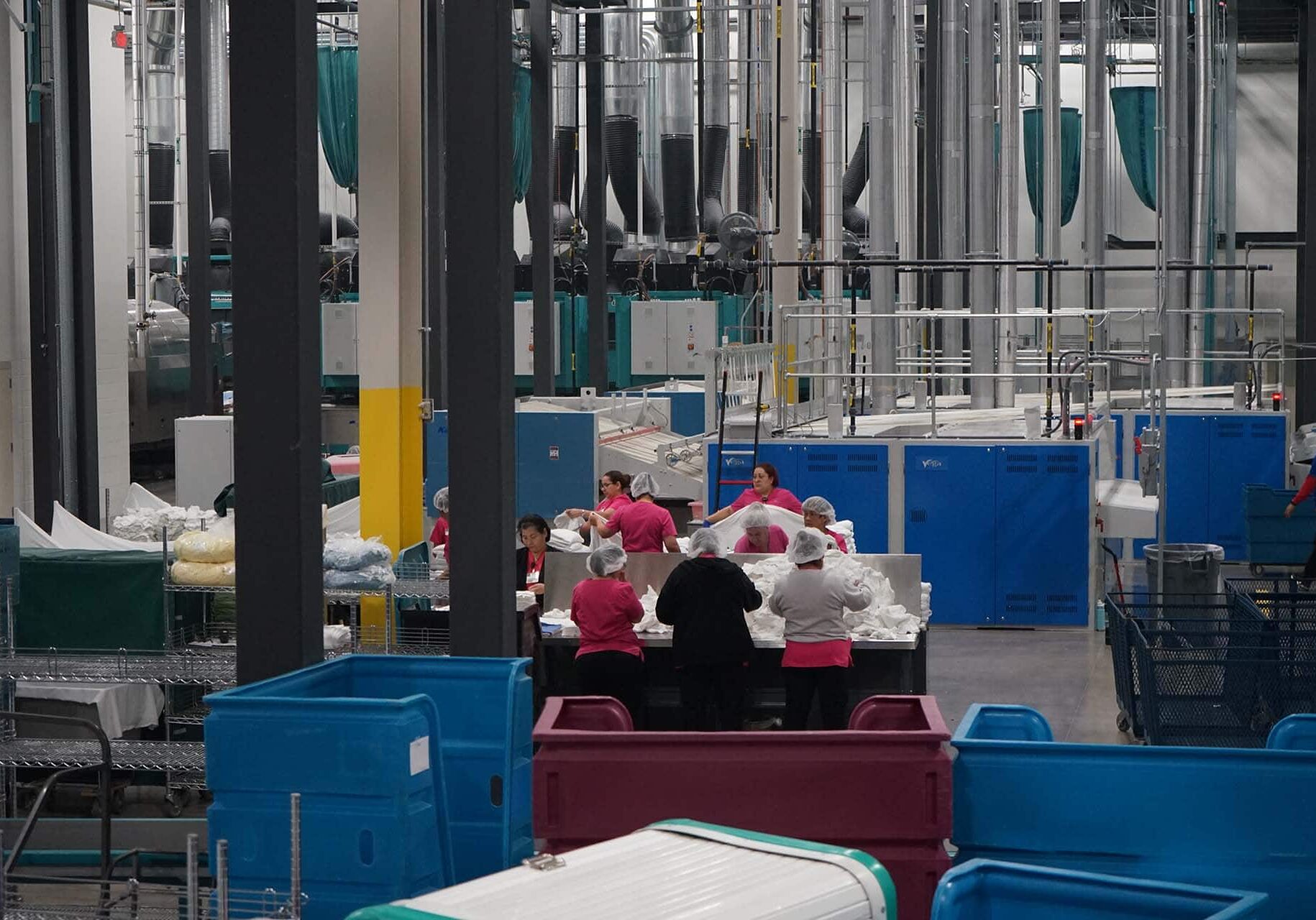
Mario Villarreal, system director for the Saint Francis Health Systems (SFHS) Linen Service, a healthcare facility serving Saint Francis Hospital in Tulsa, OK, sees a bright future of growth thanks to a new plant and equipment upgrades, including sorting, finishing and material-handling systems that are boosting throughput.
“We’ve become more efficient,” says Villarreal. “The FTEs (full-time employees) have more automation. The equipment is lined up better than it was at the old plant. It’s easy to get the product from one end to the other. Yes, it’s a better flow…a stronger flow.” Before the plant opened in June 2025, the laundry’s main production engine was a 30-year-old tunnel with 12, 110 lb. (54 kg.) compartments. That tunnel was running 15 hours a day.
Late last year, we toured the new SFHS plant that ARCO/Murray built. We learned that today’s focus is not just on quality and getting the hospital’s work out, but also on reaching out to other nonprofit healthcare groups to encourage them to join the SFHS on a co-op basis for their healthcare laundry needs. “We are in the process of finding out if anybody wants to join us, so that we can grow,” Villarreal says. “Or if somebody else wants us to do their laundry for them. What Saint Francis is doing is they’re trying to tell everybody that what we want to do is share what we’ve got with the communities, so that they become part of the laundry system here. And they can get the benefits of lower costs.”
The old plant was an on-premise facility. The new laundry at 5402 S. 129th E Ave., Tulsa, is roughly 6.4 miles from the Saint Francis Hospital at 6161 S. Yale Ave. The new 40,000-square-foot (3,716-square-meter) plant is currently processing 320,000 lbs. (145,149 kg.) per week. Its services meet not only the flatwork textile needs of Saint Francis in Tulsa, but also those of its branch hospitals in suburban Tulsa, Muskogee and Vinita, OK, plus about 20 clinics across the region, Villarreal says. “We are the big dog,” he quips, speaking of Saint Francis Hospital. “We are the largest hospital in Oklahoma. I believe we’re the 11th largest hospital in the nation (Becker’s 2024—Largest U.S. Hospitals by Number of Beds).” The hospital has 1,112 beds, and Saint Francis’s leadership is eager to expand its laundry services. “The thing is, Saint Francis wants to grow,” Villarreal says. “I can see in the future, Saint Francis doing the laundry for all the local health systems and saving them money in the process.”
Founded in 1960, Saint Francis is a Tulsa-based independent Catholic health system. It grew out of the philanthropy of the William K. Warren family. Warren (1897-1990) founded the Warren Petroleum Co. in Tulsa in 1922. He was a prominent developer of oil and natural gas resources in the early 20th century. In 1952, he sold his company to Gulf Oil Co. At that time, this was the largest cash acquisition in U.S. history. The proceeds fueled Warren’s philanthropic efforts, including the establishment of Saint Francis Hospital, which has grown into a regional healthcare provider in the Sooner State, including the aforementioned hospitals in Muskogee and Vinita.
While Oklahoma’s economy isn’t the fastest-growing in the U.S., it has steadily advanced, with a 4.1% expansion since 2020, according to U.S. Census data. The latest available estimates show 0.84% growth in 2025, making Oklahoma the 24th-fastest-growing of the 50 U.S. states.
Several commercial laundries are vying for a share of the healthcare flatwork textile sector in Oklahoma. These include plants operated by Ecotex Healthcare Linen Services Corp. in Oklahoma City; Division Laundry in Muskogee; and Linen King (a part of the Healthcare Linen Services Group) in Midwest City. While the market is fiercely competitive, Saint Francis has good working relationships with these companies, Villarreal says. When the old plant was operating, if there was a problem, they would help Saint Francis get their work out. “Yes, I would say it’s competitive,” Villarreal says. “But in reality, when we went down, we took it to Linen King and Division, to help us get by.”
Operational challenges helped convince Saint Francis officials of the need for a new plant. “When a washer went down, it would take two facilities to help us,” Villarreal says, noting that these companies had to juggle the processing of their own customers’ rental goods as well as those of the hospital laundry. “Therefore, Saint Francis figured out, if we build our own plant big enough, we won’t have to worry about this,” he says. We saw the fruits of Saint Francis’s labor during a walk-through of the newly built facility.
In the Plant
Soiled goods from the plant’s three routes arrive at a loading dock at the rear of the plant. One route centers on goods coming from the Saint Francis hospitals in Tulsa and Vinita. A second route services a local university hospital, which is managed by Saint Francis. The third serves clinics and the Saint Francis Hospital in Muskogee. Employees roll the carts of soiled goods up to a cart dumper supplied by WSP North America. The bags drop onto a conveyor. Staff members remove the bags and send the loose textiles up a ramp to the soil-sort aisle. This “sort-in-bag” system from WSP is designed for plants like Saint Francis that have up to two tunnel washers. The soil-sort system is engineered for maximum productivity. Employees on the sorting line stand in front of chutes fitted with slings for 12 categories of goods. This system brings goods directly to the employees. The chutes are close enough together that each employee can easily drop soiled items into four different slings without taking a step. On the day we visited, three employees were staffing the entire line.
Once the slings reach a set weight, a computer dispatches them via an overhead rail system supplied by WSP to a nearby storage area in the ceiling. Next, they’ll move to one of two tunnel washers from Lavatec Laundry Technology Inc. One tunnel has 12, 110 lb. (50 kg.) compartments. The other has 12, 240 lb. (108 kg.) compartments, Villarreal says. Both tunnels are processing textiles at roughly 0.5 gallons per lb. or less. Goods are laundered using Ecolab Textile Care Division wash chemistry. We watched as clean goods emerged from the press as “cakes” of clean wet lines with minimal excess water. The tunnel with 110 lb. compartments moves clean goods to any of four 292 lb. (132 kg.) dryers. Goods from the tunnel with 240 lb. compartments move by conveyor to any of six 292 lb. dryers.
The plant also has three 150 lb. (68 kg.) pony washers and one 75 lb. (34 kg.) washer, plus several small dryers. These are used to process stain-rewash and small lots of textiles.
Stepping into the mechanical room, we saw a shaker screen for removing lint and soil from wastewater and a heat-reclamation system—both from Thermal Engineering of Arizona (TEA). There also was a 300 HP boiler that provides steam for the wash aisle and finishing areas. Stepping back onto the wash floor, we moved through a door in a floor-to-ceiling wall and entered the clean side of the plant. The walled separation—coupled with negative airflow from clean to soil—is designed to ensure that microorganisms in soiled textiles don’t enter the clean side of the plant.
The finishing department is equipped with a clean-side rail system from WSP. This equipment brings goods directly to the plant’s finishing department staff. This group comprises a significant portion of the plant’s 51 employees. As with the soil-sorting system, the goal here is to minimize employees stretching and pulling tangled linen out of carts—a practice that poses ergonomic risks and hampers their productivity. Instead, the clean side area has a WSP batch separator. It’s located in the center of the floor of the finishing area. We watched as a light-blue colored sling bearing Lavatec’s name approached the batch separator. It then dropped a load of textiles into an opening at the top of the batch separator. Once inside, a combination of conveyors and paddles helps untangle the goods. This system, combined with floor conveyors, brings untangled textiles directly to employees for quick, easy feeding into any of three large-roll ironers. These include an ironer from Braun and two from Vega. The batch separator reduces physical strain, ensures a consistent workflow and improves efficiency. Each ironer is also fitted with a front feeder and a folder/stacker at the back.
The slings throughout the plant carry the Lavatec label because the company served as a distributor for all the equipment purchased or transferred to the new Saint Francis plant. A few items, such as the Braun ironer, that were in good condition, were relocated to the new facility as part of a $17 million project. Other relocated equipment includes a Braun towel folder. The laundry also purchased two new towel folders from Kannegiesser North America.
After folding and stacking, employees moved stacks of flatwork to a series of conveyors that take them to the packout area. Here, employees inspect and load goods onto carts, which are then covered with sheets of plastic. A piece of paper is attached to each cart. These indicate the types and quantities of goods and which hospital or clinic will receive them. Staff then load the goods onto trucks for delivery to healthcare facilities.
Villarreal commented on the labor savings generated by the new plant. This includes both the soil-sorting and clean-side systems. In addition, 10 staff members are now based at Saint Francis Hospital to prepare “exchange carts” of textile goods that go directly to patient areas for distribution. “Part of our job when we were in the hospital was to deliver the exchange carts daily throughout the hospital,” he says. “We went from 61 FTEs (full-time employees) to 51 FTEs. All those employees stayed at the hospital.” This group also delivers soiled items to designated areas of the hospital for pick up and return to the laundry for processing. That speeds up the process of returning soiled goods to the sorting area. “So now we get right to work,” Villarreal says. “Also, the way the equipment is laid out, we have room, and with the new equipment, we’ve eliminated a few jobs.” For example, the plant no longer needs an employee to unload dryers or pick up towels, gowns and other small items and place them on shelves or carts. “So they are able to work straight through without having to stop for those tasks,” Villarreal says. “The same goes for the ironing lines.”
Having a more efficient plant with less downtime has made it easier for staff to tackle another issue: reducing linen losses in the plant’s hospital and clinic facilities. Now more than ever, linen conservation is a critical focus for Villarreal and his team—especially in today’s era of tight budgets.
Protecting People & Textiles
As a nonprofit institution, the notion of charity is deeply ingrained in the Saint Francis Hospital staff. After all, the hospital takes its name from Saint Francis Xavier (1506-1552), a prominent Jesuit missionary known as the patron saint of all foreign missionaries. Today’s Saint Francis Hospital also embraces the charitable values of its namesake. That mindset likely contributes to linen “shrinkage,” Villarreal says. “We’re a Catholic hospital,” he says. “And they’re nice to everybody. You know what I mean?” Villarreal describes seeing a homeless man near the hospital, asking for money. “He had two blankets on,” Villarreal says, noting that he recognized the blankets as those used by the hospital. “One was around his waist; one was around his head. You see them at the hospital, people wearing blankets, going home. Everybody that goes in that hospital, they give them a blanket. So I will tell you at this point, I replace over 1,000 blankets a week. That’s just to stay even.”
To help reverse these losses without undermining the hospital’s charitable mission, Saint Francis formed a linen committee to examine the issue. “We’re trying to save money,” Villarreal says. “So we built a linen committee, and everybody’s cutting back on their pars at this point.” He adds that the organization is making significant progress on linen conservation. “Where we were averaging Monday through Friday, 58,000 to 60,000 pounds a day. We’re down to 52,000 pounds a day. Therefore, we are getting better.”
The laundry staff also takes a rigorous approach to addressing incident prevention in the plant, he adds. “We started a safety program,” Villarreal says. “We started training. Fridays are training days. Although we’ve always trained employees on the equipment, now we’re doing it a bit differently. So we do emergency shutoffs, what to do, evacuation routes, everything else, because we’re in a totally different facility than we were before.”
Ensuring that the textiles processed by the laundry are free of microorganisms that could cause illness is another priority for the linen service staff at Saint Francis Health Systems. Villarreal says that when he started at Saint Francis, the emphasis was on the proper washing of goods as the main method of ensuring hygienically clean textiles. He’s pushed for higher standards. “I came in from the outside world and sold everybody on infection control, so that we can get the linen hygienically clean,” he says. “So now we have it tested. Every month, we have a test to make sure that it’s all clean. And that’s been a plus for us.” Villarreal has 35-plus years of experience in laundry management, including consulting work for Superior Linen Service and stints as an operations manager for Sodexo in Phoenix, as well as 27 years in progressively responsible posts, including serving as a general manager for Mission Linen Supply in El Paso, TX.
Villarreal is also familiar with TRSA’s Hygienically Clean Certification program. He recently began a dialogue with Samlane Ketevong, TRSA’s senior director, certification and accreditation, to prepare a Quality Assurance Manual as a first step toward meeting the Hygienically Clean certification standard. “I told my boss, ‘We will go with Hygienically Clean because I want everybody to know that Saint Francis does good quality, especially if we plan to be a co-op.’ Other hospitals need to know that we’re going to be Hygienically Clean.”
Frugal Future
Saint Francis’s focus on safety, quality, efficiency and cost control reflects a drive to keep pace with trends in healthcare. Villarreal anticipates a future of fierce competition and dwindling resources. When asked about funding trends, he says he’s bracing for shrinking revenue from government programs, such as Medicaid and private insurers. Saint Francis is responding by working to save money without compromising patient care. “We’re trying to keep costs down,” he says. “Because we do understand about the need to be good stewards with our costs.
“Right now, everybody’s looking at efficiencies in every department,” Villarreal says of the hospital as a whole. “They’re looking at budgets more now than they ever have in the past. ”
One element of that drive pursued by the Linen Service of Saint Francis Health Systems is to leverage the “stronger flow” of its new plant to encourage co-op laundry agreements with other hospitals. The goal is lower their costs, while providing them with excellent quality and reliability.
Expanding the laundry client base for Saint Francis could accelerate return on investment in the new plant. When asked if he anticipates a 3-5 year payback on their $17 million investment, Villarreal answers that “It all depends on how quickly we can generate revenue. If we can start generating revenue within the first 12 months, I think it shouldn’t take long for us to do it. But it all depends on bringing in clients.” TS
JACK MORGAN is senior editor of Textile Services. Contact him at 540.613.5070 or jmorgan@trsa.org.