

Today’s laundry operators face a world of uncertainty. Those that survived COVID-19 and the inflation that followed, now face shifting costs stemming from U.S. tariffs on goods from various countries that supply the bulk of textile products to operators across North America.
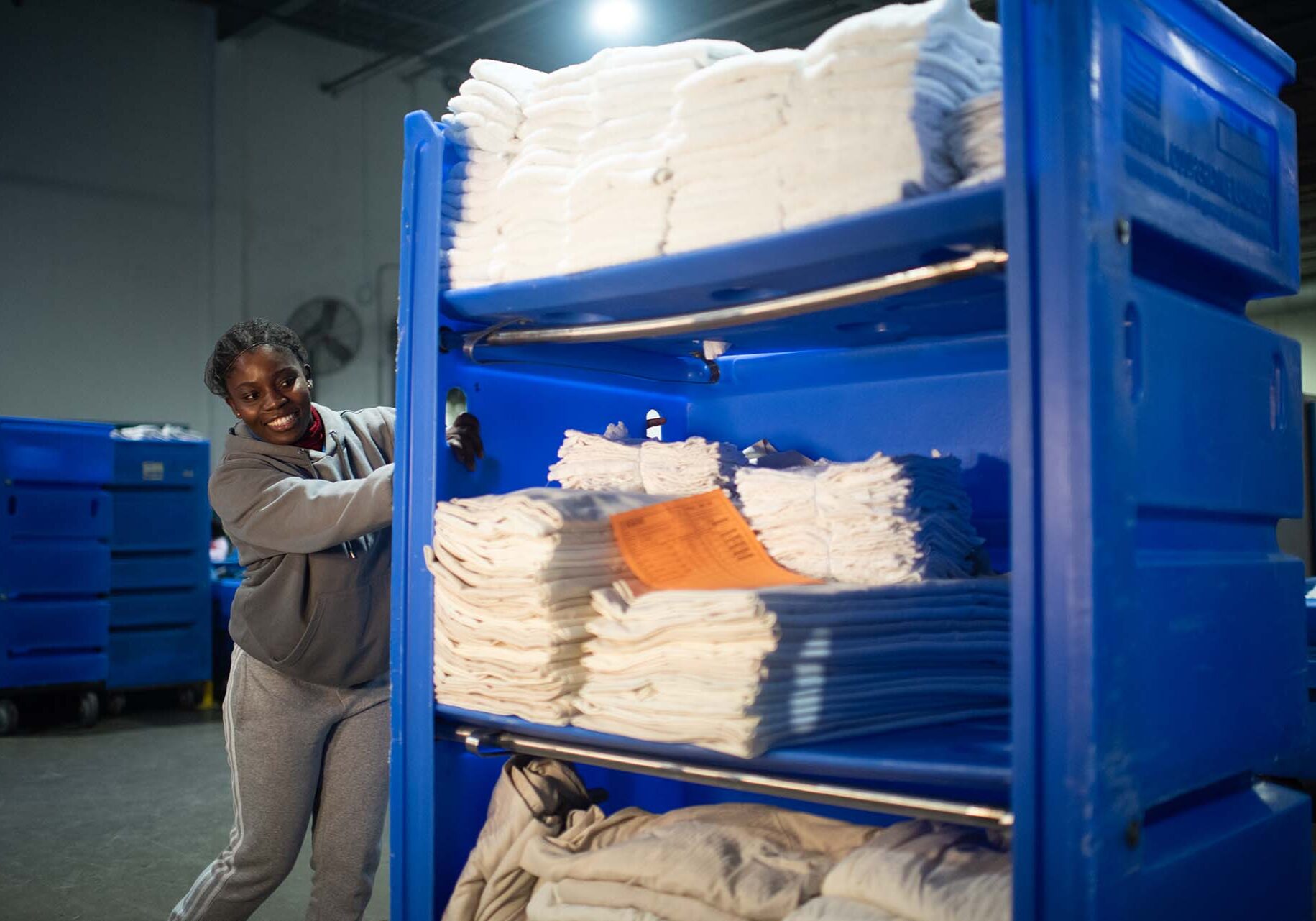
To thrive in these times, laundry operators have to prepare for the unexpected, says Cecil Lee, general manager, Metropolitan Detroit Area Hospital Services (MDAHS). He suggests stockpiling 2-3 months inventory as a hedge against the prospect of either supply-chain bottlenecks or higher tariff costs. “You need some inventory stored some place, so you can get through a period of time,” he says. Whether that is one or two months, it just goes against the grain because it goes against efficiency and everything we’re built to do.”
In fact, the Motor City co-op that employs Lee maintains a three-month supply of healthcare textiles. The goods are stored in an off-site warehouse operated by Medline Industries LP. For Lee, a senior executive who joined MDAHS last year after 11 years with Standard Textile and a quarter century at Sodexo, this approach is a throwback. “Back in the day when I started my career, we kept two months of inventory in a warehouse in the plant,” he says. “That was the old-school way.” Later, his company moved to a “just in time” supply model for enhanced efficiency, although Lee adds that, “I’ve always kept specialized items and surgical goods in the plant.”
Supply-Chain Dynamics
Jenny Shi, senior supply chain manager, Alsco Uniforms, Portland, OR, offered another take on how President Donald Trump’s imposition of tariffs on China and other countries have affect her company’s textile planning efforts. She outlined a three-step response that includes:
- Diversification: “Alsco is aggressively reducing China exposure to less 10% and accelerating shifts to other countries,” (see related article on pg. 20).
- Inventory Stockpiling: “Alsco Uniforms is working with suppliers to reserve inventories to preempt tariff deadlines.”
- Market Compression: “Importers are facing more cost pressures than the exporters. Alsco Uniforms is working actively on renegotiating contracts to avoid industrywide cost shocks.”
David Cole, vice president of procurement for the Healthcare Linen Services Group (HLSG) St. Charles, IL, also cited concerns about rising costs stemming from tariffs. He adds that supply-chain delivery times for textiles, as well as machinery, remain slower than they were before the pandemic began in March 2020. “Lead times are five months today,” he says. “Pre-COVID lead times were five weeks for textiles.”
Lee says he’s experiencing minimal delays on textiles, and machinery parts often come within a day or two. “Any issues I have had have been totally domestic and very short term,” he says. “I’ve had no supply-chain issues.”
However, rising costs and the unpredictability of Trump’s tariff policy remain a concern. “It’s been minimal so far,” he says. “But my main vendor kicks in this month. I think it’s 4% increase of a tariff tax. And then we have next year. So, I was in a situation where the bulk of my contracts went through December anyway. And if the tariffs hadn’t happened, I would have experienced no increase.
“But the other thing regarding how it’s affected me going forward is strategy. For example, you have supply chains in place. And wherever you go, they’re going to be factoring in tariffs. So the prices that we have, which are really good, and then we have that addition, and it sort of isolates that. The other thing is even though I have a prime vendor, I think I’m committed to 80% with them, and I can ‘buy out’ otherwise. So our job is still the same: to shop. But the tariffs affect everyone similarly. Most of my vendors say that they’ve been ‘eating it’ up to now. They say that’s been up to 8%. Now they’re forced to share it, and I think that’s probably what you’ve been hearing.”
Diversification Moves
A common tactic for avoiding tariffs and controlling costs is to diversify your textile sourcing base. A frequent theme we heard is that laundry operators are reducing their ‘spend’ on goods from China. Instead, they’re looking to countries that can provide quality goods at competitive prices—irrespective of tariffs. Cole says the process of broadening his company’s supplier base beyond China began before last year’s election. However, tariff policies today are having an impact on sourcing decisions. “Textile vendors were in the process of moving from China to lower-cost countries before the last election and talks of tariffs began,” he says. “However, because of tariffs, these lower-cost countries are not as attractive from a cost perspective. For example: Indonesia has a 19% tariff and Vietnam has a 20% tariff.” The pace of deliveries is also a factor that supply-chain specialists weigh when considering options for textile purchases. “These lower-cost countries add as much as one to two weeks additional lead time and because of tariffs, pricing is not as attractive as textile providers were planning.”
Lee says his main vendor, Medline, has already diversified its base of suppliers, although it still gets a significant share of its imports from China. “They’re diversified so that they don’t get caught,” he says. And China’s probably the one that’s affected the most, but the president just extended tariff negotiations another ninety days (30% through Nov. 10).”
The next move on tariffs that will affect operators like Lee, is how they influence budget planning for 2026. “That will almost get me to the end of this year,” he says of the current tariff plan. “But it still presents a problem for next year because I’m already in my budget cycle. My fiscal year ends on Oct. 31, and the next year is the question. And the question is: What am I going to budget? I’m probably going to budget 10%, just for cover.”
The Trump administration’s trade policy is aimed in part to reduce U.S. companies’ reliance on imports, and thereby boost domestic suppliers. In the case of textiles, however, the industry leaders we contacted don’t expect any major move back to the U.S., and limited progress elsewhere in the Western Hemisphere. Cole says he’s seen little or no movement to shift textile sourcing away from East Asia.
Lee noted that his former employer, Standard Textile, already manufactures textiles in three U.S. plants located in South Carolina and Georgia. These factories produce primarily hospitality items, he says. Reflecting on his time as a supplier partner, Lee notes that even if there was a move to expand textile capacity in Colombia or Mexico, it would take several years before those facilities could serve the market. “I wouldn’t expect to reap benefits from that for five years,” he says. “You have to build it. You’ve got to be efficient. You have to hire people and all that.”
Beyond the issue of timing to develop new manufacturing capacity, there’s the question of labor costs in western countries and the prospect of tariffs on any goods from outside the U.S. “I don’t know if it’s going to be cheaper,” he says, even if operators could save on freight costs and obtain shorter lead times. Another factor is the cost of producing goods in countries such as Mexico, as opposed to those in East Asia. “The labor costs supposedly are higher,” he says. “I believe that it’s more expensive to produce goods in Mexico than it is in Bangladesh.”
Tom Baron, director of medical & institutional products for textile supplier Vara Home USA, Charlotte, NC, says that both China and Mexico have seen economic growth that’s raised wages. In some ways, this has made them less competitive in the global textile market. For example, Baron cited a textile-sourcing operation that recently moved from Mexico to Bangladesh, largely due to lower costs. “Their labor rates have just gone up,” he says of Mexico. “It’s kind of like China. They’re building a middle class, and so is China, which is making them become a little less competitive.”
Operators north of the U.S. border in Canada face their own set of supply-chain challenges because, until recently, most of their textiles were coming through U.S. distributors. With the rise in tariffs on items from countries such as Cambodia or Pakistan, they’re likely to get hit with duty-related surcharges if the goods come to Canada through U.S. warehouses. Rocco Romeo, CEO, HLS Linen Services, a healthcare co-op based in Ottawa, says the guesswork associated with U.S. tariff policy has encouraged his organization to take steps to minimize these added costs. He’s doing that by seeking purchases of textiles—often from East Asia—that aren’t shipped through the U.S. “We never really purchased a lot from the U.S., so a lot of that has been alleviated. But we are a little bit more cognizant. We deal with American vendors now, and that is one of the questions we ask because any of the stuff that’s coming in, is it going to be subject to tariffs? Some of it hasn’t been; some of it has been. So that also seems to be a constantly moving object, for lack of better words, in terms of, where and when they choose to apply the tariff. So if you had a contract with, say, ADI or Standard, or somebody like that, but they were sending the goods direct from, say, India or Pakistan, you would escape tariffs.”
Vendors are aware of these concerns and have worked to accommodate their Canadian customers, Romeo says. “What ADI has done, for example, is they have a warehouse in Calgary. So they’re just shipping stuff right to the Calgary warehouse.” Romeo pursues the same strategy on equipment purchases from Europe. He gets the goods, such as Kannegiesser machinery, shipped directly from Germany. The exception is for parts available from Kannegiesser North America’s facilities in Grand Prairie, TX, or Minneapolis. “Sometimes it is coming from Kannegiesser USA (North America),” Romeo says. “Those are critical parts, you know. If we need something, we need it. So that that’s the only area that we don’t really have a lot of options on.”
Transportation & Quality
Aside from the “roller coaster” ride of regular shifts in U.S. tariff levels for Canada and other countries in Europe and Asia, Romeo says the Canadian economy today has recovered from the shortages and port tie-ups that prevailed during COVID. “Like anything else, there’s always problems with ports from time to time that present themselves,” he says. “I know the Port of Montreal had some short-term problems. But again, nothing, major. It’s caused a couple of weeks to wait from time to time for certain products, depending on what’s going on. But nothing substantial that’s outside of the norm of what may happen at a port.”
As for the U.S., Cole says the backups that plagued the Ports of Long Beach and Los Angeles similarly have dissipated. “Lead times are back to pre-COVID status, he says. “Freight costs fluctuate constantly.” Lee offered a similar take, saying his organization has had few if any problems getting goods delivered. As for quality, Cole says his company hasn’t had problems with imported goods. “Our business has not experienced an increase in quality issues,” he says. For Lee, as a co-op GM, the issue of finding the right goods centers on building a consensus among his team of board members and medical professionals to strike a balance between quality, cost and efficient use of resources. “I have some favorite products,” he says. “But if something’s working, why upset the apple cart? And it’s not all my decision. You have committees, you have boards. Sure. I could be involved in some of that. But we do things that make financial sense from a quality and quantity perspective.”
Speaking of the latter, for better or worse, the hospital clients that Lee serves have largely reverted to disposable isolation gowns and other personal protective equipment in the post-COVID era. “We do very few reusable isolation gowns, he says. “It’s amazing how few. As a matter of fact, they told me (I wasn’t here when that happened) how many they were doing. They basically went from 100% (reusable) to down to 2%.” Lee says the situation could always change, but for now at least, disposables win out over the cost-savings and supply-chain benefits of reusable PPE. “There’s no surgical pack room here,” he says, adding that MDAHS uses no reusable surgical products other than OR towels and scrubs. “We supply certain gowns for a few customers that request them,” he says. So there’s opportunity there, but in this town, they’re not ready for it yet.”
Expect the Unexpected
A common issue in supply-chain planning is the need to act forcefully on issues on which you have control, while keeping at arms’ length those that you can’t. Of course, U.S. tariff policy is an area in which laundry operators have little or no control. However, as this article went to press, Trump’s use of the International Emergency Economic Powers Act (IEEPA) of 1977 to impose tariffs when and where he chooses is facing a U.S. Supreme Court challenge. A court decision potentially could limit Trump’s ability to impose tariffs unilaterally as he has in recent months.
Two areas that laundry operators can exert control include: 1) diversifying your sourcing strategy to balance the risk of tariff-driven costs; and 2) modifying “just in time” delivery policies in favor of maintaining a backup supply of textiles—housed either in your plant or at a supplier’s warehouse. Having a two-month stockpile was the norm among the operators we spoke with, but others are doing more. For example, NOVO Health Services’ Nashville plant (see related story, pg. 28) maintains a three-month supply of textiles on-site. These goods are kept in large boxes placed on heavy-duty shelving units to avoid taking up floor space.
Another reason to keep ready access to a supply of stored textiles is the possibility of supply-chain problems associated with flooding or other natural disasters. As Americans mark this year’s 20th anniversary of Hurricane Katrina, disaster-response planning strikes us as a valid reason to prepare for any weather-related contingency that could threaten your ability to serve customers.
A similar argument for diversifying your sourcing based rests on the fact that if natural disasters or civil unrest strike countries such as Pakistan or India, laundry operators in North America should avoid putting all their textile-sourcing “eggs” in one basket.
Finally, Lee advises operators to speak regularly with suppliers and anticipate emerging supply chain disruptions. “They need to be in close touch with the suppliers,” he says. “Just make sure they’re covered. Know that you have to get honest answers from them and know what their plans are. Here’s the deal: We’re not in control. It’s kind of like COVID, when you couldn’t get the supply. You planned it, and it still didn’t happen. And it keeps changing. You have to be ahead of the game.” TS
Jack Morgan is senior editor of Textile Services. Contact him at 540.613.5070 or jmorgan@trsa.org.