

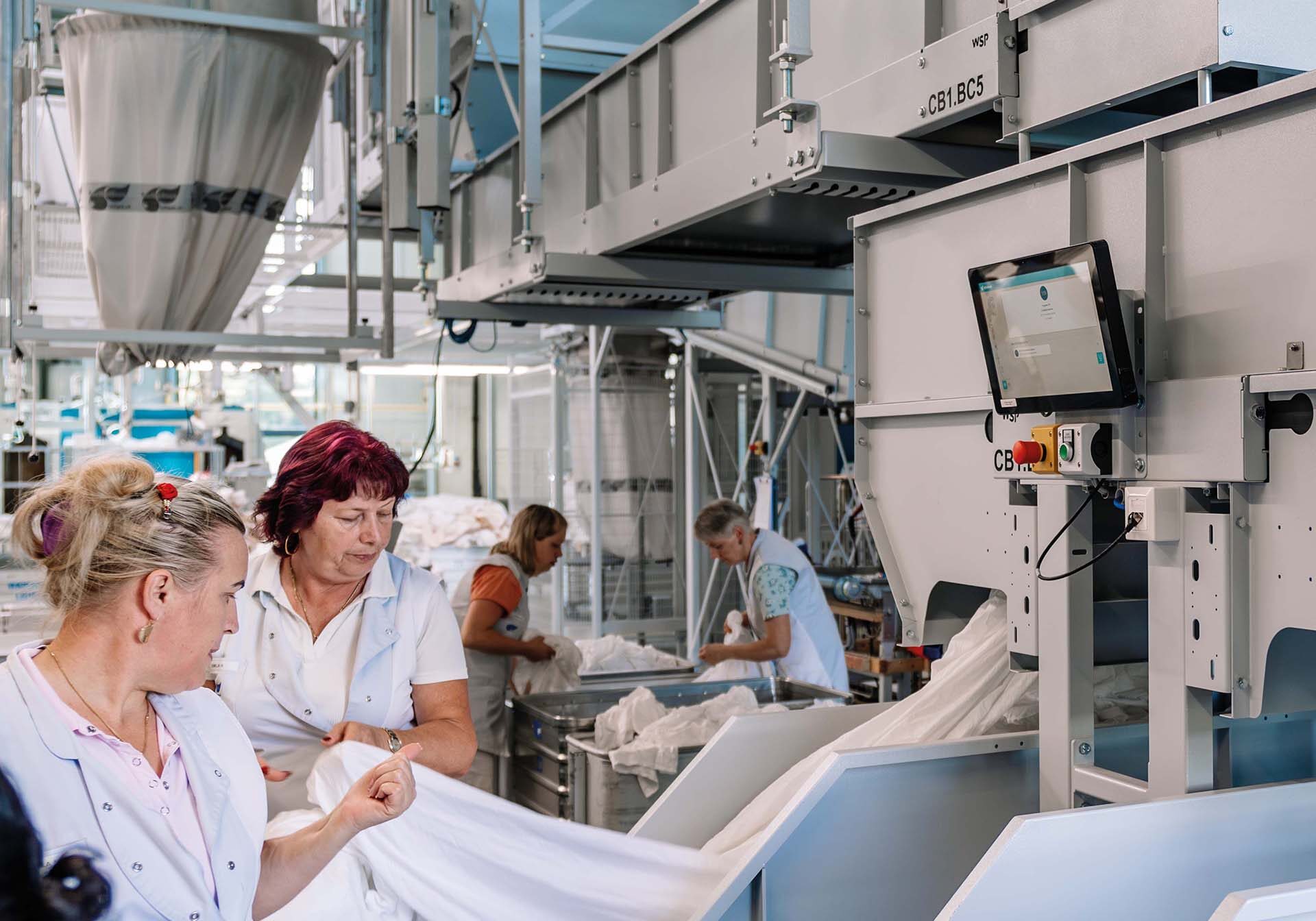
Expanding a laundry operation to serve a new sector requires an across-the-board review of your operations—from wash chemistry to equipment, inventory management/tracking, and more—to maximize the quality, efficiency, and throughput needed to satisfy a new base of customers.
That was our key takeaway following recent interviews with operators and consultants. At times, the transition to a new sector can pose challenges, says Andrew Thornbury, president of Miller’s Textile Services, Wapakoneta, OH. “However,” he adds, “Fortune often favors the bold, and current growth opportunities in certain market sectors are significant.”
That’s why it’s worth the effort to diversify into new sectors. As the economy continues to expand, especially in growth areas such as outpatient medical and hospitality, these organizations offer operators the prospect of new revenue—if they can effectively manage a shift into these areas. Many linen, uniform and facility services companies learned this lesson during the COVID-19 pandemic of 2020-2023, when restaurants and hotels largely shut down, while demand for healthcare and outpatient services spiked.
Today’s Markets
As for the economy in 2026, Thornbury notes that he’s seen a pickup in demand among hospitality independents that value the extra service and linen-tracking technology that Miller’s provides. “Boutique and independent hotels continue to expand within hospitality, and unlike national chains, they often value distinctive service partnerships that support their brand identity and guest experience,” Thornbury says. “Laundries that utilize RFID (radio frequency identification) technology to manage inventories are in a position to optimally service event and COG (customer-owned) linens, and provide customers with data and insights that can help them run smoother and more profitable operations.”
In recent years, a common shift has seen operators in the food and beverage (F&B) and other sectors adapt their systems to process outpatient medical or hospital textiles. Consultant Gerard O’Neill, president/CEO of American Laundry Systems, notes that this expansion can pose challenges due to the wide disparity in soil conditions across sectors. For example, F&B items, such as greasy bar mops and aprons, are among the most heavily soiled items, whereas lab coats or scrubs often arrive at the laundry in the least-soiled condition. “I know operators who do this (some of whom I have built or designed the plant or plants in question) in a combined laundry and do even more pounds or pieces from another type of laundry.” Most laundries aren’t designed to do both, but operators adapt their operations to pursue additional market share. “The sales opportunity comes along and, voilà, you are a mixed linen plant doing bulk healthcare acute/bulk, or you want to try your hand at “retail healthcare” too. So the biggest issue will be equipment compatibility between the different linens and levels of soil.”
Another consultant, Don Maida of Tingue, identified five issues operators need to address to diversify their production mix successfully. These include:
- Equipment compatibility, particularly in soil sorting
- Hygiene standards—operators may need to take additional steps to avoid cross-contamination between healthcare and other sectors
- Operational efficiency—process improvements to maximize effective use of resources such as water/energy
- Technological advances—this includes inventory control methods such as RFID tracking systems
- Regulatory compliance—this includes clean vs. soil pickup and delivery
O’Neill adds that operators who have diversified their laundries to process goods from two or more sectors should pay careful attention to regular upkeep to ensure that the plant consistently produces quality work. Determining compatibility among textile soil levels and which systems to use for each is critical, he says. “The light soil tunnel system for healthcare should not be used for the heavy-soil tunnel system for F&B. Splitting the washroom is a good idea, and keeping two separate production areas, with one area dedicated to heavily soiled goods and one for relatively clean goods, works best. By all means, do share the mechanical room equipment with the ability to control both facilities separately.” Having redundant systems for the plant is now more important than ever because you are, in effect, running two plants. “So having backups for the backups is a must, as well as a very well-stocked spare parts area.”
Theresa Garcia, COO of Division Laundry, San Antonio, says her company has long operated as a mixed plant serving the textile needs of healthcare, hospitality and F&B customers. The ability to understand and deliver on the unique needs of each sector is important to satisfying this diverse client base. “Our focus has always been making sure our equipment is flexible enough to handle a wide variety of products and processing requirements,” she says. “For example, we run large ironers that can process and automatically sort and stack king and queen sheets for hotels as well as healthcare linens. Our finishing equipment also has to handle everything from cubicle curtains to napkins, which means adjusting folds and ironer speeds, depending on whether we’re processing table linens, pillowcases or patient gowns.”
Similarly, in the wash aisle, Division operates a range of equipment that gives them the flexibility to process a variety of goods with quality and efficiency. “Each category requires different wash formulas,” she says. “Healthcare processing is different from hospitality and F&B, so having that ability to tailor the process is important. Wastewater considerations can also be a factor, depending on the types of products being processed and the chemistry required.”
Adaptive Training
Flexibility is also critical for staff across departments that handle textiles from various sectors. For example, serving multiple sectors means training route and plant staff to understand the differences and unique requirements of clients across sectors. This is especially true for route service reps (RSRs). “Training our staff and route drivers to service a new client base really comes down to making sure they understand the specific needs of that customer segment and how it affects both processing and delivery,” Garcia says. “Early in my experience, when we expanded beyond primarily customer-owned goods processing, our team had to adapt to a different service model, and learn how to build orders based on customer par levels and individual account needs, rather than simply returning what was picked up the day before.”
Thornbury adds that thoroughly training RSRs is particularly important to satisfy customers across various sectors of the textile services industry. “Operational success in a new market is often driven more by service execution than by the textile product itself,” he says. “Route drivers are typically the primary face of the company, so their understanding of the customer’s operating environment is critical. For example, healthcare accounts function very differently from restaurants, requiring staff to understand departmental distribution points, inventory expectations and infection-control sensitivities.”
O’Neill points out that while training route drivers—particularly those engaged in sales and deliveries—is important, plant-based staff also need to learn the requirements of servicing a new sector. “It is a new world when you’re trying to service multiple types of customers vs. one,” he says. “It is hard to be a master of all that you do when there’s one type of customer. But with a truly mixed linen plant, it is almost impossible to be the master, but a good ‘Jack of all trades’ will work just fine.” Maida adds that companies can accelerate the training process by bringing in outside help to oversee the effort. “Determine what training you need and proceed,” he says. “Consider bringing in a qualified trainer to implement the process. This will include systematic training updates, including new associates.”
Thornbury recommends an in-depth training program for staff working with new or expanded routes in different sectors. “Training programs should focus on three core areas: understanding how the customer’s operation functions day to day, maintaining proper product handling and presentation standards and communicating effectively with clinical or administrative staff,” he says. “We have found that pairing new service personnel with experienced route drivers during onboarding accelerates learning and improves service consistency. Additionally, sending production personnel on route rides can help break down internal silos and reinforce a shared objective across the organization: delivering the right quantity of the right product at the right quality exactly when the customer needs it.”
Garcia adds that, however you approach training, it’s critical to educate RSRs and plant staff on the varying service requirements of customers across sectors. “For our route drivers, training focuses on understanding how each account is serviced,” she says. “Some customers require shelf replenishment, while others operate on bulk cart deliveries. So drivers need to understand the expectations and workflow at each location. Making sure both the plant team and the drivers understand those differences is key to servicing different customer segments efficiently and consistently.”
Cost Concerns
Any laundry operator who’s diversifying into new markets or continuing in that vein should factor two issues into their decision-making process in 2026 and beyond: inflation and import tariffs. The inflation rate for February (the latest available at press time) was .03% or 2.4% for the 12 months ending in February. Of course, these figures don’t factor in the U.S.-Israeli incursion into Iran that began on Feb. 28 and continues as this article went to press. Due to supply disruptions in the Middle East related to the war, oil prices spiked to more than $100 per barrel in late March. That could, of course, change in either direction depending on events. But an alert operator should factor these issues into their expansion/diversification planning, as well as into how fuel, machinery, and textile costs could impact their bottom line. The Supreme Court’s decision nullifying Donald Trump’s legal justification for imposing tariffs under Section 122 of the U.S. Trade Act of 1974 hasn’t prevented the administration from employing other legal means to impose tariffs, which currently feature a 10% global surcharge on most imports. This Temporary Global Import Surcharge took effect on Feb. 24 under the same law and is likely to remain in effect for 150 days, i.e., through late July.
The question that this situation poses for operators is: “Should I diversify my market mix now, or put it off until conditions are more stable? None of the operators we contacted mentioned backing off their diversification or expansion plans due to these economic trends. Rich Kramer, president and COO of City Uniforms & Linen, a mixed-industrial/healthcare operator in Findlay, OH, says tariffs and inflation have had a minimal impact on pricing for his business.
O’Neill says he sees a more significant impact, noting that rising costs are “Definitely putting a damper on things, and the used equipment market is booming.” While the costs of plant expansions, retrofits, or new builds are increasing, operators can save money with used or rebuilt machinery, he says. “It doesn’t all have to be new…There are plenty of old laundries closing or even new ones are getting bought out, and equipment is becoming available…So look for used equipment to keep tariff costs in check. But when it comes to materials, pipe and pipe fittings, etc., you are going to see record-setting prices again, which we haven’t seen since COVID…Not as high as COVID, but significantly higher than last year and the year before.”
Pat Garcia, president and CEO of the family-owned Division, said he’s concerned about rising costs and their impact on market diversification. “Tariffs can affect the cost of imported goods, particularly textiles and certain equipment components,” he says. “When those costs increase, it can impact the overall investment required to support growth or new customer segments.”
Increased market instability also affects efforts to enter new markets. “Another factor is the uncertainty tariffs can create in the market,” Pat says. “Fluctuations in pricing and interest rates can make long-term planning more difficult. That’s why having strong purchasing agreements and supplier relationships in place, whether negotiated during tariff periods or not, is important to help stabilize costs.”
Operators can reduce the impact of these issues by limiting product varieties (i.e., fewer stock-keeping units [SKUs]) and managing inventory levels with sufficient storage space to control purchasing costs and protect margins, while still supporting growth, he says.
Diversifying Via M&As
A “cut to the chase” option for laundry operators seeking to diversify into new markets is to acquire a rival company that’s already working in the sector you’ve targeted. O’Neill says market diversification through mergers makes sense if you can afford it. “It’s definitely faster and easier than slugging it out to build more of your business, if you have the cash,” he says, adding that operators should, “Look also at new untapped markets as a quick way to build your business. But it’s also expensive to go that route.”
Thornbury says M&As vs. organic growth each have their pros and cons. “Both strategies have a place, but the decision often comes down to speed, geography, operational readiness, access to capital and personal appetite,” he says. “M&As can accelerate market entry by providing established routes, infrastructure and customer relationships, but their success ultimately depends on how well operations, systems and cultures are integrated. If not managed carefully, integration challenges can create significant friction and quickly erode the value of a deal. For well-capitalized laundries with experienced integration teams, mergers and acquisitions can be an effective way to quickly build density in a new market and achieve strategic scale.”
Pat adds that M&As often make sense, but laundry operators need to study each company closely to determine whether it’s a good fit and can begin enhancing the bottom line right away. “In many cases, acquisitions can make sense because you’re purchasing an operation that already has an established facility, customer relationships and existing contracts. If the business is well-run and has a strong market share, it can provide a faster path to entering or strengthening a position in a market than building everything from the ground up. That said, it really comes down to due diligence. You have to make sure the operation is a good economic fit for your business and that the customer base, equipment and workforce align with your long-term strategy.”
Growth Options
As we’ve seen in numerous plant tours, diversification into new market segments is a popular way for companies to maximize growth. But based on the comments above, operators need to plan carefully for such a move. There are equipment and hygiene considerations to assess, as well as training staff, especially RSRs, to adapt to servicing a new market. Another issue is cost. In an era of inflation and economic instability driven by issues ranging from inflation to the war in Iran to tariff policies, it’s hard to predict how large a financial commitment you’ll need to make. Of course, if you have the cash via saved assets or a partnership with a private equity firm, you can acquire a company and not have to build the business from scratch.
Bottom line? In business as in life, fortune favors the bold. For many companies, market diversification has served as a winning way to growth. But before launching a market-expansion project, a prudent operator should weigh the costs, operational and training challenges, growth potential and the likely impact on current customers. TS
JACK MORGAN is senior editor of Textile Services. Contact him at 540.613.5070 or [email protected].