

Everyone wants to automate. But moving too quickly could jeopardize your company’s fiscal health. That’s the consensus view we came away with after interviewing several operators and consultants on emerging technologies in 2026.
The challenge of when and where to invest poses a balancing act for linen, uniform and facility services operators. They know that their success hinges on ensuring operational competitiveness. That means finding ways to reduce labor and natural-resource costs while improving efficiency and maximizing throughput. At the same time, no operator wants to be on the “bleeding edge” of innovations that don’t pan out and fail to deliver a timely return on investment (ROI).
Wash Aisle/Finishing Upgrades
For Andrew Thornbury, president of Miller’s Textile Services, Wapakoneta, OH, the most significant benefits now available to operators interested in automation—both in terms of operational gains and timely payback—are in the wash aisle. “We continue to see the strongest and most immediate ROI from emerging technology on the textile-processing side of the plant,” he says. “This is where throughput, labor availability, capacity constraints and employee experience intersect most directly.” Thornbury adds that in the wash aisle, well-planned automation upgrades can generate rapid gains. “We’ve already taken several steps in soil sorting, including recent robotic solutions,” he says. “After several months of real-world operation, we’re confident it was the right move—not solely for near-term ROI, but for improved capacity, flow and ergonomics.”
Another advocate of automation, Ed Kwasnick, director of business development for ARCO/Murray, touted the advantages of fully automated soil sort systems for laundry operators. “This emerging technology is fascinating and holds great promise, especially for the healthcare industry!” says Kwasnick. “Not only does it automate soil sorting, which is typically a department that requires a higher level of employee staffing, but it also automates a process that historically has high employee turnover because of challenging working conditions (employees sorting soiled laundry while fully gowned up with PPE [personal protective equipment]).” Safety is another factor to weigh when considering automating this area of the washroom, because “It reduces the risk of exposing employees to any potential pathogens present in the soiled healthcare linen,” he says. Kwasnick adds that the prospects for continuous improvements in soil-sorting technology justify further investments in this area. “Just like smartphones and computers, I expect this technology to become faster, more powerful and less expensive as automated soil-sort technology is adopted throughout the industry,” he says.
Phillip A. Sharpe, president and CEO of United Hospitality Services LLC (UHS), Austell, GA, says he’s seen more progress on the garment side of soil-sort automation than on the linen side. Still, he anticipates additional progress in flatwork processing. “Robotic systems are emerging and will provide greater efficiency and opportunity for ROI,” he says. “I have seen this work well in a uniform application. I look forward to seeing more emerging uses for the high-end hospitality market.”
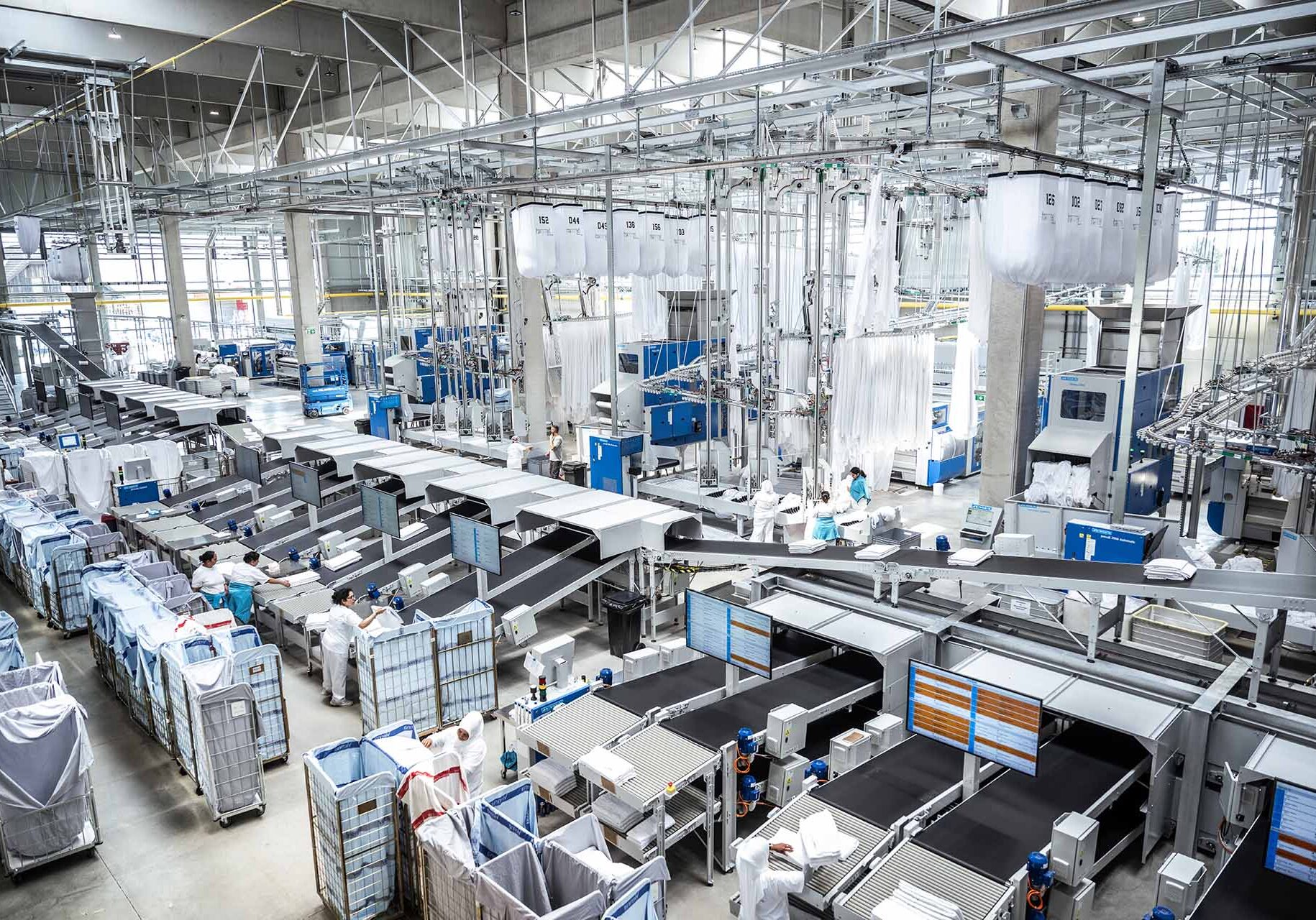
But laundry consultant Gerard O’Neill, president and CEO of American Laundry Systems, notes that real payback for linen plants is available right now. He cites the use of automated systems from soil sort to tunnel washers and overhead rail systems, working in concert to maximize efficiency and throughput. “I have seen large corporations sort manually into carts and hand-load three large CBWs (continuous batch washers) with about 36 people in that soil-sort area (of absolute chaos) and reduce that number of FTEs to 16 by investing in an automated sort system on an elevated sort deck (or decks, actually) with an accompanying monorail system to store 2-3 hours’ worth of work (that’s the sweet spot) and then feed the washroom automatically,” O’Neill says.
He adds that the operator cited above achieved significant ROI through savings in labor costs and improved productivity. “The cost of the sort deck and storage system was approximately $1.5M-$1.6M (at the time), and FTEs were costing $32K/year. That is a 2.5-year return, based strictly on direct-labor wage cost…efficiencies gained elsewhere are a bonus in this scenario.”
O’Neill notes that while uniform processing has advanced in recent years, challenges remain that could benefit from automation, particularly on the finishing side. “Industrial uniform plants vary significantly from linen plants,” he says. “While their operations are less labor-intensive than flatwork laundries, there are areas on the finishing side of these plants that require significant manual labor.” Specifically, he says that in uniform plants, “There are still areas where the labor effort is high, (e.g., loading steam tunnel finishers, sorting garments by hand after the steam tunnel and manual loading of stockroom systems). These can all be automated now, but at a substantial cost. Is there an ROI (not in the 2-3 year level) but maybe in the 5-6 year or 6-8 year level… Does this count?” He adds, “Honestly, it is up to the operator: Does it have a legitimate ROI? Will it last 10 years? Maybe yes, with good maintenance. With bad maintenance, absolutely no way.”
Saving Water & Energy
Upgrading water and energy systems offers operators a relatively prompt ROI. What’s more, there are various options that you can consider implementing, including those that incorporate artificial intelligence (AI) components. “Energy and water systems represent an area where we believe additional ROI is achievable, even though it may currently be our least-automated major category,” says Thornbury. “While we already invest meaningfully in this space with water recycling/reuse, heat reclamation and smart-energy control systems, there remains an opportunity to further leverage technology through smarter, AI-connected system controls—such as motion detection, automated on/off sequencing and peak-load management—to better align utility consumption with production demand.”
Thornbury adds that opportunities also exist to tap alternative energy strategies. One example is co-generation (combined heat and power, aka, ‘co-gen’). This option is drawing interest from operators, amid rising utility costs and sustainability expectations, he says. Co-gen technology features an energy-efficient system that burns fuel such as natural gas to produce electricity and thermal energy. Unlike power plants, co-gen systems capture excess heat to boost water temperatures. Co-gen allows operators to achieve 60%-80% efficiency by utilizing waste heat. This also saves fuel while reducing emissions.
Thornbury says his company’s approach to energy savings includes considering co-gen and solar power as part of a “resilience strategy.” The goal is to achieve long-term operational and financial stability while advancing environmental stewardship.
One company that adopted co-gen several years ago is Bates Troy Healthcare Linen Services, Binghamton, NY. They are pleased with the results. However, Ed Arzouian, compliance and special projects coordinator, cautioned that maintaining the co-gen system is difficult due to the limited availability of skilled personnel to service it. “The problem is a serious lack of qualified and experienced maintenance technicians, especially in our smaller market,” he says. “We do not have a large pool to draw from, and we are up against healthcare, big universities and the defense industry, all of whom can out-pay us (i.e., the laundry industry). I would say that is the greatest threat to our industry today. We either cannot or will not pay the dollars required to get the level of expertise we need.”
Tim Stuewer, director of operations for Alsco Uniforms, Salt Lake City, called for a cautious approach to investing in co-gen and similar technologies. “The alternative-energy area provides a great opportunity as the technologies emerge,” he says. “But they must be performed with diligent financial analyses. Do not rely on an ROI from the vendor or supplier. Use your organization’s financial models, tax structures, cost of capital and depreciation methods to truly get an accurate ROI.”
He adds that solar power also has great potential, as well as challenges. “In the solar (power) arena, if material and infrastructure costs can stabilize and decrease, the opportunities will grow immensely,” Stuewer says. “However, at this time, utility- or government-incentive programs are almost a must to be able to generate any type of semi-attractive ROI. Also, think about how your organization will keep the panels free from lint, dirt and dust. The reduced efficiency of the panels will kill the ROI on your project.”
Another energy/water resource-management issue is the need to work with a chemical vendor that will collaborate effectively with the operator to boost efficiency and savings in this area, says Stuewer. “The biggest key is having a wash-chemical provider who will partner with you to maximize your system,” he says. “Most facilities have some facet of water-recycling or reuse capability, or could easily add it. But if your wash-chemical provider will not partner with you, the equipment and investment can be meaningless.”
Teaming up with the right wash-aisle machinery supplier can also make a difference in managing water and energy resources, says Sharpe. “Water-reuse systems have proven successful for UHS prior to investing in Milnor PulseFlow® tunnel technology,” he says. “This has provided the greatest opportunity for water conservation. Currently, UHS runs under .4 gallons per pound washed.”
Reclaiming heat from wastewater to raise the temperature of incoming water from a local utility is a proven way to conserve resources and achieve a timely ROI on your investment, says Kwasnick. “Heat reclamation is a tried-and-true technology that has been around the laundry industry for at least 60 years,” he says. “So, why has this technology been around for so long? Because it works and provides one of the quickest ROIs in a typical laundry facility. Using the latent heat in your outgoing wastewater to preheat your incoming fresh water is a proven way to reduce your natural gas bill immediately. I know heat reclamation isn’t as exciting as automated soil sorting or water recycling. But it’s a proven technology with a solid ROI that should be installed in every laundry facility.”
Water recycling may require a larger investment, depending on the level of recovery you want, but it too can generate significant ROI, says O’Neill. “Starting with the basics of water reuse, most facilities can get 20%-30% water reuse for a modest investment (split trenches) and use this ‘semi-dirty water’ for pre-rinses on new loads in a washer,” he says. “To get to higher percentages of reuse, you enter the ‘water recycle’ area. This is where you can save a lot of money. But you need to spend a lot of money to achieve this. The payback is there for sure. But it can be expensive to achieve those high double-digit recycling capabilities, as you need to spend more money for more equipment when reaching above the 50%-60% level.” O’Neill also cautioned that at higher levels of water recycling, operators need to consider what loads they’re processing with this water. “You need to be careful what you use this recycled water for and on what color of goods,” he says. “The graying of whites and soil redeposition can occur at this level unless you are strict and follow the vendor’s operating instructions, cleaning and maintenance instructions, operating temperatures and the list goes on.”
While we’re on the subject of managing heat in a laundry, what about the ambient heat—especially in warm-weather months—that makes life difficult for staff? Kwasnick says that in an age of high employee turnover, investing in cooling equipment for the finishing area is a common-sense move. It can boost morale, productivity and compliance with indoor air-quality rules issued by the Occupational Safety and Health Administration (OSHA). “More and more laundry facilities are installing either spot cooling or air conditioning in their plants,” says Kwasnick. While these systems don’t lower costs, “They improve working conditions on the plant floor and help companies win the battle for recruiting and retaining production staff. Providing a temperature-controlled work environment can help keep staffing at optimal levels.”
After washing/finishing and resource-conservation upgrades, a third area where operators can boost efficiency, save labor and get ROI is in material handling, i.e., transporting goods around the plant.
Material Handling Transformation
O’Neill described a common-sense approach to upgrading your material-handling systems. He recommends moving from carts on the floor to slings in the air. It’s all about using vertical space. “Any time you can install monorail, even if it is a simple loop, all the way to fully automated soil sorting and loading of washers, etc., ‘use the cube,’” he says. “As I have been preaching for 30-plus years, it’s a good idea. Use the cube to store all of your soiled or clean goods and get rid of the ‘death wish’ of cart traffic in laundry operations. Cart traffic can and will choke even the best-run operations. Efficiencies of 25% or more can be seen when eliminating cart traffic.”
Operators are taking this advice seriously, says Thornbury. He summarized his thoughts on upgrading material-handling systems, saying, “At Miller’s Textile Services, we see material handling as our second-largest opportunity for ROI and transformation. The future is fewer carts, less floor congestion and more intelligent, overhead movement of goods through vertical space and guided by data. Advances in conveyor and rail systems—combined with RFID-driven visibility, especially at key handoff points—allow material handling to become an active driver of production flow, not just a means of transport. As data and automation converge, material handling will play a central role in optimizing throughput, safety and plant-wide decision-making.”
Sharpe notes that his company is implementing high-tech material-handling improvements at its plant in suburban Atlanta. “UHS is in the process of installing fully automated soil-rail systems with a new sort deck with anticipated labor savings of up to six FTEs per day,” he says. “We look forward to realizing this improvement.”
O’Neill adds that suppliers also have made significant strides in textile identification using RFID and production-tracking technology. These systems enable operators to boost efficiency and complete order fulfillment, i.e., no shortages. “Enhancements and advances in software tracking of the goods through a plant are light years ahead of where they were just a few years ago,” he says. “This technology, while not getting big press or accolades, has made huge differences to plant operations. Tracking the goods, tracking the operators at their stations, tracking maintenance time on equipment, tracking pounds or pieces per operator, tracking bathroom breaks, standard breaks, and the list goes on. …”
‘Dark Factory’ Dawning?
As the use of automation advances worldwide, it’s inspired a vision of fully automated production facilities, aka “dark factories.” These plants can operate with essentially zero human intervention.
O’Neill sketches what an all-automated laundry could look like. “We are not that far from a drone dropping off soiled linen and/or uniforms or mats, etc., into a designated hopper in the soil-side area of a facility. Then, in turn, this same drone goes to the clean side and loads from a designated conveyor or similar system, delivering all the goods to a particular customer/client.”
Naturally, these technologies will require maintenance specialists to service them. That need is already evident today. It will only intensify going forward, O’Neill says. “What will come in the same time frame is a huge increase in demand for qualified techs to service these AI-operated stand-alone drone-driven laundry facilities, as it has now started in present-day facilities,” he says. “I predict that within 20 years, the automated laundry described above will be a reality—as long as we can find the skilled workforce to service this type of equipment.”
That brings us back to how far and fast laundry operators should move on automation. While there are risks with such innovations, resisting change strikes us as at least as risky given competitive pressures.
Every operator must decide which changes will save labor, boost throughput, provide outstanding customer service (e.g., no shortages) and maximize the efficient use of natural resources. Tackling these challenges comes with risks. A fire or a “black swan” event, like COVID-19, could threaten your company’s survival. But ignoring these issues poses risks too—especially in today’s competitive, rapidly consolidating commercial laundry industry.
Bottom line? If you’re in the game to stay, a future of fewer FTEs and faster throughput is coming. TS
JACK MORGAN is senior editor of Textile Services. Contact him at 540.613.5070 or jmorgan@trsa.org.