

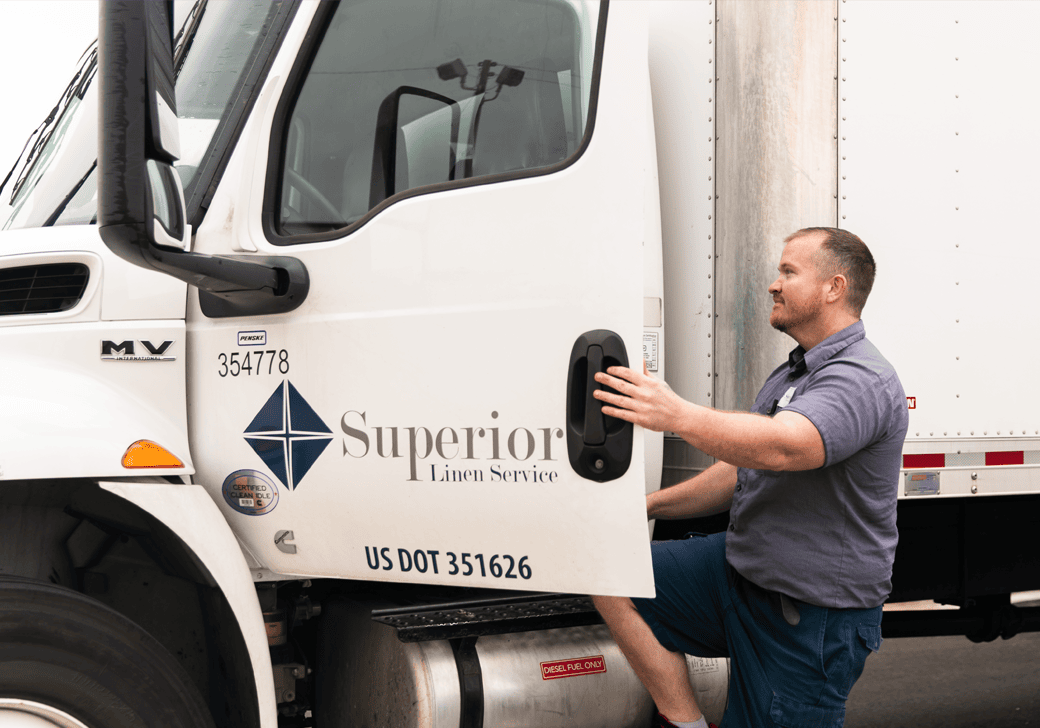
April’s Textile Services will feature an article highlighting a critical fleet safety message: the legal and practical risks of installing front- and driver-facing dashcams without regularly monitoring the footage.
The article, titled “Beyond Installation: Why Active Management Makes or Breaks an In-Cab Camera Program,” was written by two managers from Tulsa, OK-based Superior Linen Service, Chief Compliance Officer Russell Holt and Safety Manager Rusty Thomas.
They argue that in today’s litigious society, while many may see the need for dashcams in fleet vehicles, they tend not to follow up by consistently reviewing the videos. This “set it and forget it” approach can make a company’s situation worse than if it had no dashcams at all. Specifically, if the dashcam records unsafe behavior, such as cell phone use while driving, and the company takes no action to correct it, the company could face negligence charges for compliance failures among fleet drivers. Holt and Thomas write that they grappled with this issue early on in the process. “Before we decided to add both front- and driver-facing cameras to our fleet at Superior Linen Service, we spent significant time researching the pros and cons. Our primary concern wasn’t the technology itself, but the risk of having a program and failing to manage it properly.”
Insurance officials and attorneys view in-cab video as a “double-edged sword,” they write, noting that, “While video can exonerate a driver after an incident, it becomes a primary piece of evidence for plaintiffs if it reveals a history of unaddressed risk. When a fleet owner installs a camera, they create a digital ‘paper trail’ of driver behavior. If that camera records unsafe acts – such as distracted driving or fatigue – and the owner fails to coach or discipline the driver before an accident occurs, the company faces high exposure for negligent supervision.”
In light of this potential liability, Superior Linen Service has adopted a detailed approach that isn’t aimed at “spying” on drivers, but rather at working with them to resolve problems that arise in the video. “I believe it is important to have a hands-on approach with our in-cab camera program because it’s like with anything: ‘Inspect what you expect,’” says Brandon Scantlen, regional service manager for Superior Linen’s Western Division, who’s quoted as saying that, “If you want results, you must be consistent. We don’t micromanage the system, but we do monitor consistently, which creates accountability at every level.”
The company focuses on monitoring unsafe behaviors and then reaching out to help drivers address the problem before an incident occurs. One issue that Holt and Thomas discuss centers on several route service reps (RSRs) that they determined were struggling with drowsiness. “By approaching these individuals in a supportive manner, many openly acknowledged their challenges with staying awake,” Holt and Thomas write. “We discussed sleep patterns and nightly routines, and with small adjustments, these drivers saw noticeable improvements. One driver, who previously received multiple fatigue alerts, now receives none. He expressed appreciation for the way the situation was handled.”
The bottom line is to build trust as well as accountability with the RSRs. The article quotes Regional Service Manager Austin Price of the company’s Eastern Division, who said the program’s goal is to protect staff, the company and other motorists. “For me, it is all about keeping our employees as safe as possible and ensuring they get home safely to their families after their shift,” Price said. Click here to read a PDF version of the article.



Sign Up For Our Newsletter
Receive the latest updates on the linen, uniform and facility services industry from TRSA delivered straight to your inbox.