
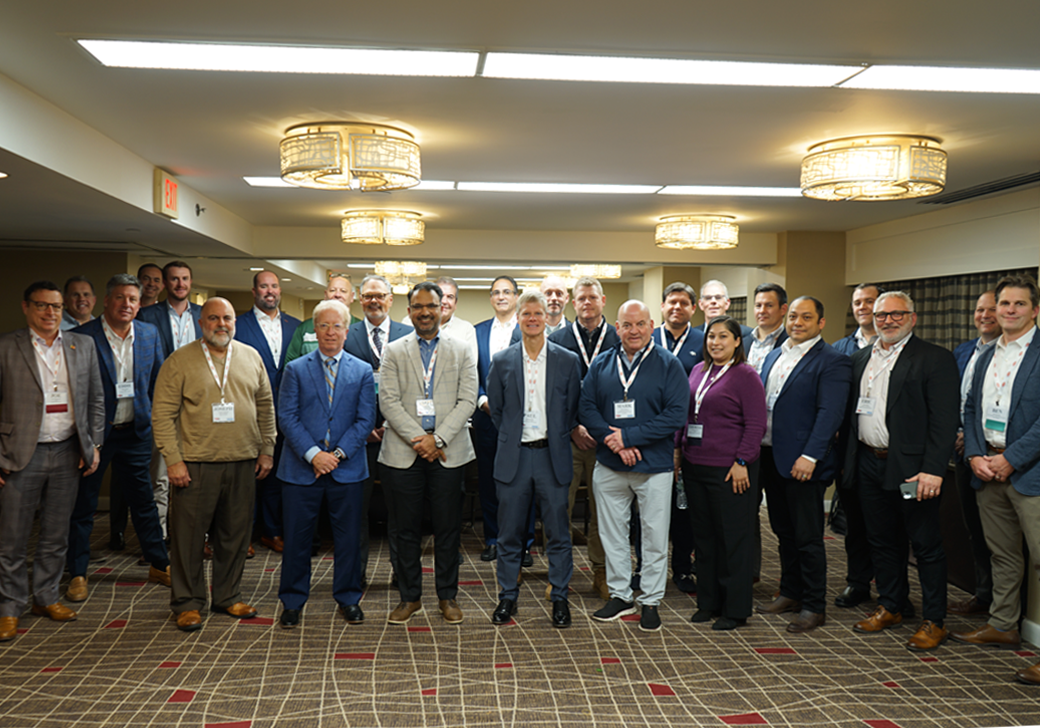
The TRSA Healthcare CEO/Executive Roundtable united more than 30 industry leaders serving North America’s acute and nonacute sectors. TRSA President & CEO Joseph Ricci and Government Relations VP Kevin Schwalb facilitated the Nov. 18 meeting at TRSA’s 14th Annual Healthcare Conference in Boston.
Among other issues, the wide-ranging discussion covered advocacy, operational challenges, workforce development, client engagement and technology adoption.
Advocacy for Reusable Healthcare Textiles
Roundtable participants noted some progress in TRSA’s ongoing federal efforts, including urging the U.S. Centers for Disease Control and Prevention (CDC) to complete a study that could lead to regulatory action to increase reusables’ market penetration. The CDC has signaled renewed interest for 2026. At the state level, significant strides include New York’s introduced legislation requiring 50% reusable textiles in healthcare facilities, supported by Gov. Nancy Hochul’s (D) office. Similar initiatives are advancing in Ohio and California, with environmental groups joining the effort. Plant tours, such as those hosted by Unitex, proved instrumental in educating legislators on job creation and sustainability benefits, reinforcing TRSA’s state-by-state strategy.
Coalition Building and Industry Engagement
TRSA is broadening its advocacy coalition by partnering with the American Reusable Textile Association (ARTA), Association for Linen Management (ALM), CSCNetwork, Independent Textile Rental Association (ITRA) and Textile Care Allied Trades Association (TCATA). Events such as the annual Laundry Hill Day (next Feb. 19, 2026, in Washington, DC) aim to unify the industry’s voice and strengthen legislative outreach.
Operational and Financial Pressures
Participants discussed ongoing supply-chain disruptions, tariff impacts, and inflation in material and energy costs. Section 232 tariffs on certain healthcare textiles classified as medical devices have increased costs for some operators. Building materials and equipment costs have surged up to 70%, while energy prices – especially electricity – have doubled in some regions. Strategies like fixed-rate energy contracts and time-of-use production shifts were explored. Labor-cost inflation and shortages of skilled maintenance and engineering staff continue to challenge operations.
Workforce Development and Succession Planning
The aging workforce and difficulty attracting younger talent were highlighted. Companies are promoting internal mobility and implementing formal mentoring and succession programs, sometimes linking management bonuses to successor identification. Outreach to trade schools and military transition programs was recommended to address recruitment gaps.
Client Education and Engagement
Educating healthcare clients on the benefits of reusable textiles and reducing linen loss remains critical. Strategies include trash audits with visual data, frequent on-site training, and engaging both frontline staff and C-suite leaders. Resistance to change and complex decision-making processes in healthcare organizations require identifying influential champions.
Technology Adoption: AI and Automation
While AI is being used for administrative tasks like data analysis and customer management, production automation faces hurdles due to technical limitations and plant layout constraints. Robotics for tasks like linen folding are not yet cost-effective. Data integration challenges persist, but participants agreed on the need to stay engaged with technological developments.
Macro Trends in Healthcare
The group noted financial pressures on healthcare clients, including Medicaid reductions, consolidation and a shift toward outpatient care. Rural hospital closures and the rise of urgent care centers also were discussed.
Participants included:
- Michael Barner, CEO, CORE Linen Services
- Randy Bartsch, executive chair, Ecotex Healthcare Linen Service
- Ben Berstein, vice president, corporate development, Nixon Medical
- Chris Corcoran, executive vice president, HHS-FMA
- J. Dempsey, president, Dempsey Uniform & Linen Supply Inc.
- Bruce Feldman, president, Economy Linen & Towel Service Inc.
- Jason Feldman, co-president, Economy Linen & Towel Service Inc.
- Karl Fillip, CEO, NOVO Health Services
- Theresa Garcia, COO, Division Laundry
- Patrick Garcia, CFO & ESQ., Division Laundry
- Asit Goel, vice president of marketing, UniFirst Corp.
- Bob Hager, CEO & Chairman of the Board, Miller’s Textile Services Inc.
- Brian Kradjian, president, Bates Troy Inc.
- Rich Kramer, president, City Uniforms and Linen
- Paul Lavallee, market manager, Environ Energy, APPI Energy
- Eddie Lefeaux, owner & CEO, Westport Linen Services
- Joseph Liparulo, general manager, Bates Troy Inc.
- Jason McCoy, CFO, NOVO Health Services
- Joe McKeown, COO, HandCraft Services
- Bill Moyer, vice president, marketing and service, Hospital Central Services (HCSC)
- Curtis Nichols, CEO, HandCraft Services Inc.
- Sean O’Connell, SVP of strategy & corporate development, ImageFirst
- David Potack, president, Unitex Healthcare Laundry Services
- Britton Smith, president, Century Linen & Uniform
- Mark Spence, operations executive, ImageFirst
- Plato Spilios II, co-president, Crown Uniform and Linen Service
- Eric Yeakel, senior vice president, Hospital Central Services (HCSC)
TRSA’s 15th Annual Healthcare Conference will take place in San Diego on Oct. 14-15, 2026. Click here for more information on next year’s event. Furthermore, TRSA has scheduled a series of Regional CEO/Executive Dinners across North America starting on the West Coast on Jan. 20, 2026, in Pasadena, CA. Click here for details.



Sign Up For Our Newsletter
Receive the latest updates on the linen, uniform and facility services industry from TRSA delivered straight to your inbox.