
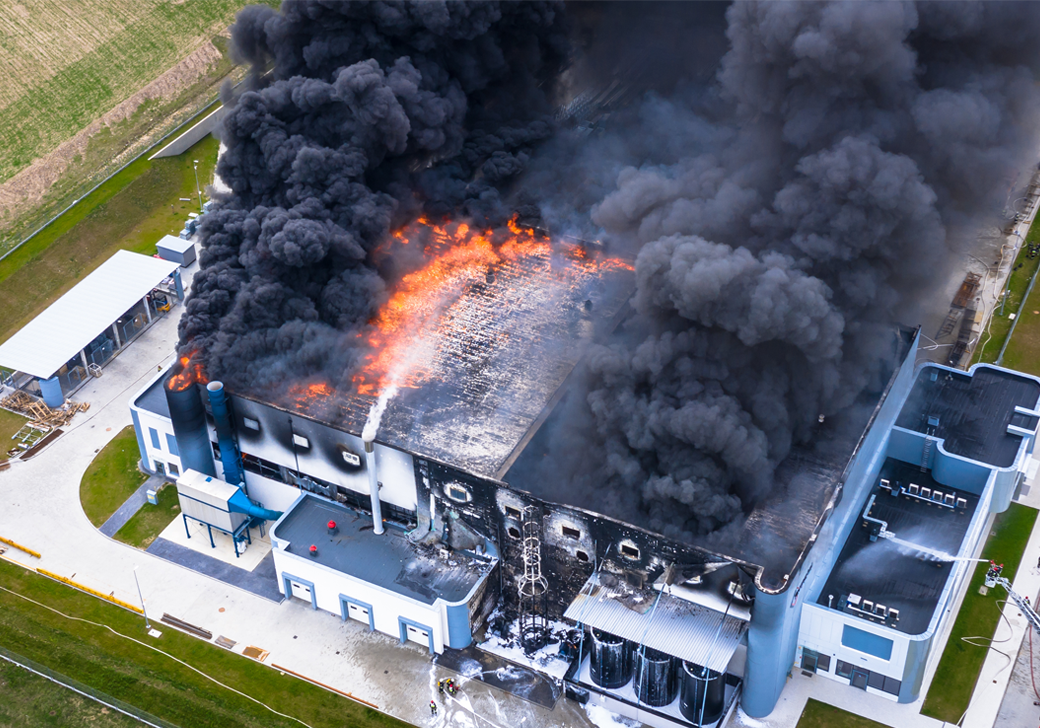
This month’s Textile Services, which recently landed in most subscribers’ mailboxes, has an important message that could save your company thousands in losses and rebuilding efforts by preventing plant fires.
The article, titled “Laundry Fires: Prevention and Mitigation Strategies,” was written by safety consultant and laundry veteran Don Bock. He outlines several cost-effective measures operators can take to reduce fire risk, which is typically higher during the warm-weather months we’re now entering.
For starters, most fires occur after hours, when no one is around to see the blaze begin and take steps to extinguish it before it gets out of control. That reality should inform your company’s approach to risk factors, such as lint accumulation on equipment, building rafters and pipes. Most laundries address this hazard by conducting regular “blow downs” to remove lint from various surfaces and dispose of it. These efforts help, but they aren’t always enough, says Bock, who is the principal of Seabright Safety Solutions Inc. “While helpful, these methods are reactive and labor-intensive,” he writes. “They often fail to control lint that settles overhead.”
Bock suggests alternatives, including filtration equipment that removes lint from the surrounding air in a plant. He notes that, “Filtration systems are local and must be placed immediately above the equipment that the laundry is trying to protect from lint. In most applications, the filtration systems are placed over flatwork ironers or towel folders. This helps limit the amount of lint that reaches the overhead structures.” Another option is continuous overhead lint control with high-velocity fan systems. “These fans operate continuously to prevent lint from rising and circulating throughout the plant,” Bock writes. “By controlling airflow and limiting lint movement, the system reduces the accumulation of lint on pipes, rails, catwalks and slings. This provides a cleaner environment and a lower fire risk because the lint, which acts as fuel, is substantially reduced. What’s more, it won’t clog smoke detectors. The system can also be integrated with the fire alarm system, allowing it to shut down in case of a fire.”
A second issue that Bock addresses is the use of sensor systems from companies such as YoLink and Quanturi. Operators can place these sensors in carts of clean or soiled linens to track temperatures. They then alert staff via text or email if the temperature reaches a set point, such as 130℉. “These sensors report to a central hub or base station, where staff can review the temperatures of the affected product at any time,” Bock writes. “YoLink and Quanturi both manufacture heat sensors that operators can insert into products and provide programs to help operators best utilize the technology. Depending on the manufacturer, the probes are inserted into slings or carts that may undergo an exothermic reaction (i.e., a chemical reaction that releases heat). Several laundry organizations are using this technology. The real value of the heat sensors is that the system is programmed to send alerts to critical personnel if the temperature at a probe location exceeds preset limits. The operators set the limit points at which the system issues alerts.” (Click here for an operator’s experience with this technology).
A third topic that Bock emphasizes is the need to train wash aisle and finishing staff on fire hazards and the importance of following best practices for unloading and related processes. “Production employees may be aware of fire risks but may not be adequately trained in their role in preventing fires,” Bock writes. “Dryer operators must follow established programs to ensure that the product isn’t removed from the dryer too early. Pressure to produce textiles can affect the dryer operator and cause them to discharge a load before the cooling cycle is complete.”
For details on training and tech tactics for preventing plant fires, turn to pg. 32 of this month’s Textile Services magazine, or click here (TRSA member login required) to access an online version of the article.



Sign Up For Our Newsletter
Receive the latest updates on the linen, uniform and facility services industry from TRSA delivered straight to your inbox.