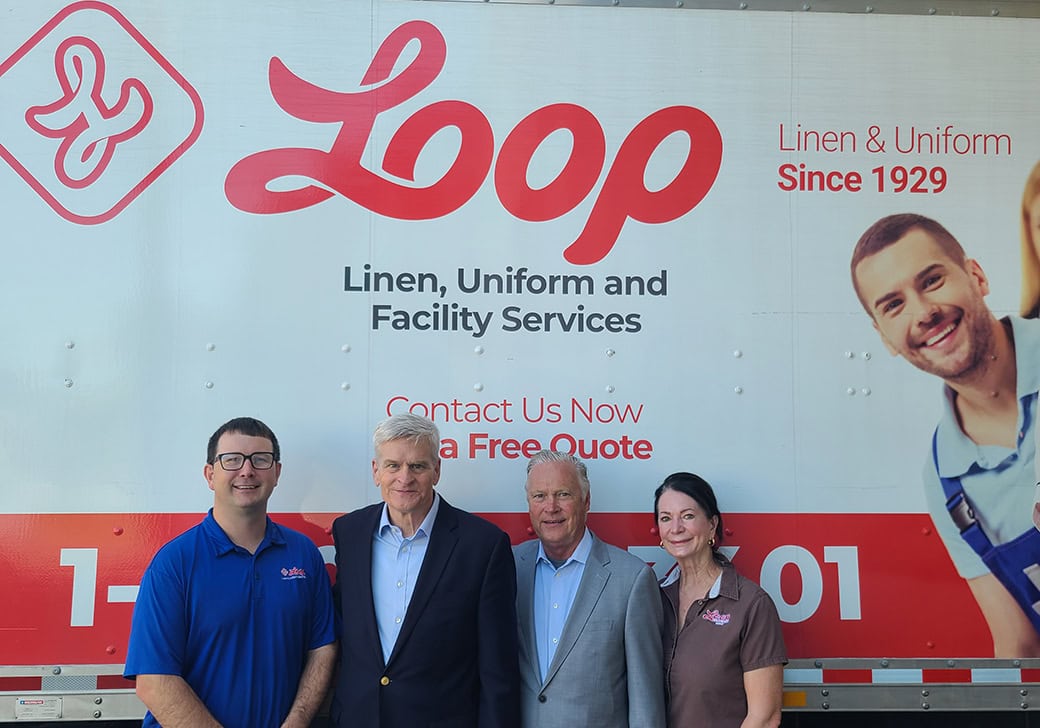

Loop Linen Services hosted U.S. Senator Bill Cassidy (R‑LA) for a tour of its plant in Westwego, LA, to highlight the substantial transformative nature of the linen, uniform and facility services industry.
During the tour the Senator witnessed a technology‑driven operation that transforms soiled, unusable textiles into hygienically clean, reusable marketable products that businesses depend on every day. The visit offered a practical, on-the-floor view of why the linen, uniform and facility services sector argues it should be treated as a Qualified Production Activity (QPA) under federal tax policy—because its work looks and functions far more like production than a conventional service.
Loop Linen Service is a nearly century‑old enterprise founded in 1929 and still owned and operated by the Burke family, now in its fourth generation. The company has expanded from a small neighborhood laundry into a full‑service textile rental provider serving nearly 1,400 customers across Louisiana and Mississippi, including hospital services, while employing more than 120 people. In 2023, Loop Linen announced plans to invest $15 million to build a new 55,000‑square‑foot, state‑of‑the‑art commercial laundry facility in Jefferson Parish—an expansion that underscores how capital‑intensive and industrial today’s textile processing has become.
Cassidy’s interest in the sector is reinforced by his unique background. In addition to serving as Louisiana’s senior U.S. Senator, he is a practicing physician by training—a gastroenterologist—and has spent decades engaged in healthcare delivery and policy. That blend of legislative leadership and clinical experience matters when the discussion turns to how hospitals secure critical supplies such as gowns, scrubs and linens, and how those supplies affect infection prevention, staff protection and continuity of care.
Inside the plant, Cassidy observed the multi‑step process that commercial textile processors perform every day: controlled collection, sorting and segregation; carefully engineered wash chemistry; thermal disinfection; drying and finishing; inspection and repair; and packaging and delivery back to healthcare customers. This cycle restores textiles from an unusable, contaminated state to hygienically clean, marketable and functional products—often with third‑party certification and documented quality controls. For the industry, this is the essence of “substantial transformation,” the concept at the heart of QPA eligibility.
Cassidy’s tour also drew attention to a second, related priority: increasing the use of reusable healthcare textiles in hospitals and other medical facilities.
For Louisiana, the visit also reinforced the role of family-owned businesses like Loop Linen in anchoring local jobs, while supplying critical services to healthcare and other industries.
For federal policymakers, Cassidy’s firsthand look at industrial-scale textile processing adds tangible context to an often-misunderstood point: commercial laundry is a production process.
As Congress and federal agencies continue to refine domestic production incentives and preparedness policy, the key takeaway from Cassidy’s Loop Linen tour is straightforward: recognizing hygienically clean textile processing as a Qualified Production Activity would better reflect the sector’s production-like reality and help drive investment in modern facilities. At the same time, promoting a more balanced mix of reusable healthcare textiles would strengthen hospital supply chains and reduce waste—creating a safer, more sustainable healthcare infrastructure for the next crisis and for everyday patient care.


Sign Up For Our Newsletter
Receive the latest updates on the linen, uniform and facility services industry from TRSA delivered straight to your inbox.