
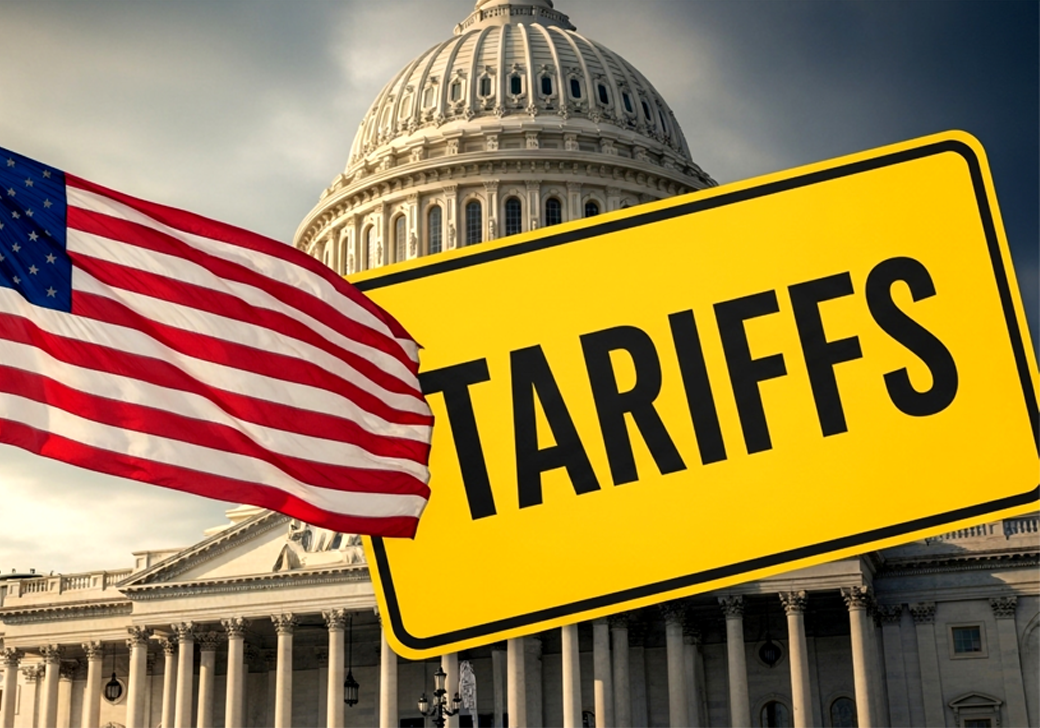
The U.S. Supreme Court’s Feb. 20 ruling on President Donald Trump’s trade policies has refocused national attention on tariffs and renewed questions about what comes next for businesses in the linen, uniform and facility services industry.
Trump’s response to the Supreme Court’s actions includes the recent imposition of 10% across-the-board tariffs based on Section 122 of the U.S. Trade Act of 1974. Most observers expect additional challenges and counter-moves as tariffs continue. This, in turn, will influence the cost of imported textiles, machinery and replacement parts sourced from East Asia and Europe. These actions will add complexity to pricing, sourcing and capital-planning decisions.
Joy Nott, a partner in national tax, trade and customs at KPMG Canada in Toronto, spoke with Textile Services Weekly about the tariff issue and its impact on laundry operators across North America. She also addressed the effects on suppliers to the industry, including machinery and textile manufacturers worldwide. The instability and unpredictability of costs that U.S. tariff policy has provoked is likely to hurt the economy, she said. “It’s definitely going to put a chill on economic growth,” said Nott, whose colleague, fellow KPMG Partner Angelos Xilinas, will address this topic during a March 10 webinar. “I don’t know that it’s going to kill (economic growth),” Nott said. She added that the tariffs have encouraged Canadian laundry operators and other businesses to diversify their supply chains away from transiting goods through the U.S. to avoid duties.
Several international suppliers we contacted declined to comment publicly on the tariff situation. However, one likened the instability and unpredictability of this policy to a “black swan event” comparable to the COVID-19 pandemic. Nott noted the controversy now swirling around U.S. companies seeking refunds for duties paid before the recent Supreme Court decision is similarly fraught with uncertainty. “There is this question of ‘What is the legislative path that people are supposed to follow to get their refunds?’” she said. “It’s not clear. This is all unprecedented stuff.”
One operator we contacted said that in some cases tariffs have spurred suppliers to impose strict deadlines on equipment purchases. This laundry manager said that last December, he’d discussed purchasing a piece of finishing equipment from an international supplier. He was told that unless he bought the machine promptly, the price would go up significantly. “If we didn’t buy it by Jan. 1, it was $32,000 more,” he said. “Wow. So we got a PO (purchase order), and we got it done and put the terms down.” A second operator we spoke with downplayed the issue, saying that tariffs have “slightly affected our pricing” for equipment purchases.
TRSA’s March 10 webinar “Tariffs and Supply Chain” will air as part of the KPMG Webinar Series. This session will examine the application of U.S. tariffs and Canadian surtaxes on textile goods and their impact on cross-border trade. Participants will gain practical insights into duty drawback, tariff classification, customs valuation, and origin considerations, such as United States-Mexico-Canada Agreement (USMCA) eligibility, as well as short-term cost mitigation tactics and longer-term compliance strategies. Xilinas, the webinar speaker, is a partner in KPMG’s trade and customs practice in Canada. He brings more than two decades of experience advising clients on import and export requirements, compliance reviews and duty-relief strategies.
Registration includes all three sessions in the KPMG Webinar Series and access to recordings. Click here to register today to stay informed and prepared.



Sign Up For Our Newsletter
Receive the latest updates on the linen, uniform and facility services industry from TRSA delivered straight to your inbox.