



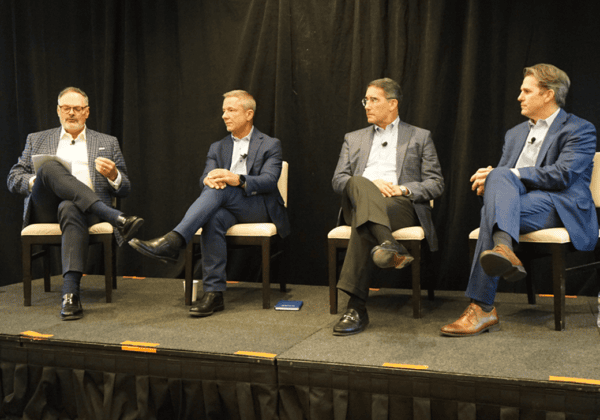
 At the 14th Annual Healthcare Conference in Boston, TRSA Chair Randy Bartsch, the executive chair of Ecotex Healthcare Linen Service, moderated a panel discussion featuring a dynamic group of industry leaders discussing the evolving landscape of the healthcare market sector. Panelists included Michael Barner, the CEO of CORE Linen Services; Ben Berstein, vice president of corporate development at Nixon Medical; and Phillip Foussard, president at HHS-FMA Laundry. For information on TRSA’s 15th Annual Healthcare Conference, scheduled for Oct. 14-15, 2026, in San Diego, visit www.trsa.org/healthcare.
Jason Risley: Thanks for tuning in to another episode of the Linen, Uniform and Facility Services Podcast, Interviews and Insights by TRSA. I’m your host, Jason Risley. TRSA recently held one of its signature in-person events, the 14th Annual Healthcare Conference in Boston, MA. The event was held at the same venue as the Eighth Annual Marketing, Sales and Service Summit. Thanks again to all of our members that joined us for both events. For those that were unable to make the trip to the Northeast, we have some good news for you. Today’s episode features highlights from a panel presentation with several leading executives in the healthcare sector, including Michael Barner, the CEO of Core Linen Services; Ben Berstein, the vice president of corporate development at Nixon Medical; and Phillip Foussard, president at HHS-FMA Laundry. The panel was moderated by TRSA chair, Randy Bartsch of Ecotex.
Randy Bartsch: Let’s begin by talking a little bit about the industry landscape, kind of where we are and talk a little bit about growth strategy. So first of all, I’ll have all you weigh in on this. How do you see the shift from a hospital-based care, which is kind of what we grew up with, to more towards outpatient, ambulatory settings, and obviously, you know, we have to adapt and it makes changes within our plant environment. So the move toward the patient side. Mike, why don’t you lead us off?
Michael Barner: Yeah, thank you. No, it’s interesting. I think we’ve been talking about the move from the big box acute facilities into the clinical retail space for some time. It does continue to grow. In the business that I operate, you know, we generally are big box providers. And so for us, it is a shift. Different for Ben, right, this is what these guys are providing today. But we are designed to put out in mass quantity as fast as we can, as many sheets and pillowcases and blankets as possible. And the delivery model, primarily in the fleet is what the ship is for us. I think the goods are the same. So we’re aware of it and we continue to look for opportunities to go out and expand with the customer base as they continue to expand. Now, again, interestingly enough, we’re seeing a lot of new towers go up still in the space. So we talk about everything’s leaving the traditional hospital setting but yet I’ve got five, six, seven new towers in multiple states that have gone up and more that are planned. So we’re seeing a little bit of both as the systems continue to compete for footprint.
Phillip Foussard: Yeah, I’ll just pick up where Mike left off is that on the acute-care side and the big box model is, as he aptly calls it. We’ve actually been seeing growth of two to three percent for the last five years in most major metropolitan areas. So while there is a movement into the sub-acute market, the acute-care plants have been seeing growth. We’re seeing going into 2026 some guidance that that growth is going to temper, and recently somebody gave the anecdotal explanation that a lot of these places are full and they won’t be experienced at that 3%. And on the transition from acute to subacute for those of us that, once again, are big box providers, it’s really coming to understand that subacute delivery model. And I think we’ve been the poster child of how not to do it at some times, where, you know, you’ve got a Teamster in a box truck going out to deliver 500 clinics. It doesn’t work very well. There’s much higher expectation, a personal touch. So we’ve had to learn it because as the healthcare industry wants to consolidate their vendor base and get everything under one roof, whether it’s right for them or not, we’ve found that we really have to understand that model and try and duplicate what Ben does in a more effective fashion.
Randy Bartsch: And of course, that creates a great opportunity, and you guys have capitalized on it, Ben. Tell us about that.
Ben Berstein: Sure, it’s a great opportunity, and we were providing services to medical practices, doctors practices, dental offices, going back to the the 1980s. And the world was very different then. We didn’t even think about while we were in the medical space, we weren’t thinking ever about kind of interacting with supply chain, more professionalized kind of purchase and buying groups. So, you know, for us, it’s gotten much more complicated. You know, it was a different world when we were able to just kind of ramp up by putting sales reps in the market and calling on individual doctor’s practices selling into a health system now and explaining to them kind of how the models are different. To continue to grow the business is a pretty complicated task. They want to reduce the laundry and linen down to a really simple, you know, it’s laundry. Yes, not linen management across the enterprise. The enterprise has gotten more complicated.
Randy Bartsch: So, Ben, you’re G2 or G3?
Ben Berstein: G2.
Randy Bartsch: So, I mean, your family background was in route -based industrial work at one point, right? Now, I mean, obviously, our experience in our business is in the Midwest markets, underserved market, more rural markets. We’re seeing certainly some of the health systems reduce the medical programs in the more rural hospitals and then feed to more urban centers. So we see our urban hospitals within the health system grow and just less care available kind of sucks because you still have to go there. You just don’t take as much. You don’t get to monetize the delivery. So we see the transportation piece being affected by this general shift in where healthcare is provided. So anyways, that gives you a bit of a sense. Let’s talk a moment about the change in margin or cost structure as you shift between the two pieces. We’ll call it big box and we’ll call it, you know, obviously the subacute or the clinic model. You touched Mike on the delivery differences and Phil you did as well. But there are other things that as the outpatient or subacute business grows that will affect, you know, the big box model because we’re counting on, you know, lots of products being processed the same. Now, all of a sudden, there’s specialization that’s injected. How does that affect things?
Michael Barner: To piggyback upon what Phil said, we don’t see it as that different from a processing perspective. Generally, the SKU sets not that materially different. Your packaging of it is different. Your delivery is different. And what is materially different is the economics. And partially that’s the result of, you know, Stephanie talking earlier from Vizient on the GPOs. The GPOs have been much more involved in the big box acute than they had been in some of the retail clinic side. That model has been a little less infiltrated by supply chain, and you’re seeing supply chain come into that space now, and I think you’ll see a change, potentially a change in the economics of that. But there are two different models, right? There’s a per pound with a surcharge or a per piece model that exists with the big box. There’s more of an inventory power billing that’ll exist when you’re doing the route-based business, and it’s a lot more high touch, but they certainly generate some different economics.
Randy Bartsch: Yeah, for sure. And Phil, I mean, what are you seeing around that shift?
Phillip Foussard: The supply chain influence, they’re trying to consolidate and get in fewer number of vendors and in their mind, laundry is laundry. And to pick up on what Mike said some of the differences within these operations is that you may have a big box that has 20 clients, but then you’re going to add the subacute. You may be adding 500 new clients. And so very low unit of measure, high administrative cost, different packaging. And so that’s a, that’s an operational shift. And on the pricing, I think that on the acute-care side, we probably haven’t done as good a job on the pricing models. We’ve tried to take the bulk approach and have it come to be a break-even operation. And most people, when they start to get into the business without treating it as a specialized business. We’re not going to make any money on it.
Randy Bartsch: Well, you go back 50 or 60 years and you went to a hospital, everything was cotton, 100% cotton, you know, it was starch pressed and, you know, shipped. So doing things by weight seemed like a good way to attribute costs. A lot of the laundry itself was obviously done in the basement of a hospital. And so the accountability is different. So the historic evolution is some of those problems are still with us today in terms of how laundry is looked at. Ben, I’m curious, obviously, it’s a different set of expectations. Everybody in this room has interaction with route -based delivery. It’s called Amazon Prime. The set of expectations on route-based delivery is a lot different today than it was five, 10 years ago. How does that affect your business?
Ben Berstein: Yeah, so we were working really hard to improve how we’re connecting and communicating with our customers. And it’s, you know, one of the things that I think differentiates the need in terms of the service model. We are contracting a large percentage of our business with health systems. The supply chain doesn’t want to kind of have to manage the communications, you know, in a system with 300, 400 locations. Dron’s here with us today, and he works within our marketing department and helped develop a delivery confirmation email. So very much the way that, you know, when you get an Amazon package that I know because it’s on my phone that it arrived and it’s sitting in my side porch, after every delivery, we’re sending a picture of what we did, some contact information about who made the delivery and asking for how they would rate us on a day. So, you know, those expectations coming from the consumer side and the business side are interesting.
Randy Bartsch: Yeah, no doubt. All of us, regardless of what spectrum we’re serving customers, are ultimately providing a support service to clinicians providing patient care. You know, what do you see as the most significant operational challenges that we’re having to overcome these days. Phil, I’ll start with you. I mean, what are the operational issues that you’re dealing with? What keeps you up at night or is the first thing you have to deal with on Monday morning?
Phillip Foussard: Well, I think in the last, since COVID, the full circle of service has really been broken. So there’s a high need to educate your customers, go back to the basic, teach them how to order, teach them how the system works. They’re very reactionary. Frankly, the healthcare systems lost their minds since COVID. As a vendor, you’re taking on more responsibility to make sure that the goods are getting there on time and in a condition that’s in the amount that they want and in a certain condition. You also have to work with them to keep the flow going as the managerial structures within big healthcare systems have flattened, linen’s been lost. And so linen is kind of in many places a byproduct and also ran department that’s being managed by EVS, sort of, or supply chain, sort of. So what keeps you up at night is how do you meet customers’ expectation when they don’t know what the expectations are and they don’t know what their responsibilities are.
Randy Bartsch: Mike, is that similar to what you are experiencing?
Michael Barner: I think that’s fair, when you look at it. It’s important that in this industry that you’re not being seen as a commodity. Unfortunately, in a lot of cases, we’re seen as a commodity and I think you heard some of that today when you talk about getting the lowest price. We don’t want to be in the washing sheets and towels business. We want to be in the linen-management business. Linen management is about full spectrum education. It’s a challenging education task to take on, right? Because as you said, healthcare is a little crazy these days. But do you want to make the sure that you’re involved from all aspects with your customer out there and talking about getting the right products, the right SKUs? Is it cotton? Is it cotton polyester blends? What are you bringing in for patient care, and then how are you managing the right amount of linen in the right place at the right time? That’s not about washing, and that’s not about how I can get 98 % fill rates, right? That’s about ordering the right amount of product, handling the distribution of that product, handling the quality-assurance audits, the trash audits
and everything around linen management. That’s what we should be doing in order to provide a full service. Now with that full service, I think it’s important that people understand that the linen industry and textiles and what we provide has an impact on patient care. Because we certainly hear about it when we’re not there. If the textiles aren’t there, who gets a phone call? That would be your number one operational concern on Monday, right? No one’s given you a pat on the back for being there on time at 98% fill rates. Right? But when they’re not there like electricity, or today with my kids, like the internet, people go berserk. And I think we need to, as an industry, and we talked about this yesterday in the CEO Roundtable, we need to do a better job educating about the importance of the industry and taking the industry up to a higher level in elevating it within healthcare so that it is an actual important service, but elevating it ourselves in terms of what we do, right? This is a heavy logistics, chemistry, manufacturing business, right? It’s not sexy, but it’s a great business. And we’re going to talk, I think, a question later on succession planning and how do we bring youth into it, right? Getting people interested in the industry is changing our own perspective and how we communicate about what we do. And I think that’s an important thing. And again, then you have to educate that within the healthcare systems. Unfortunately, if you’re in a supply chain 101 conversation, it’s negotiation 101. And it’s a race to the bottom. And that’s where it does get dangerous.
Randy Bartsch: Yeah, absolutely. Operational challenges. What are the things, Ben, that really grind you there?
Ben Berstein: I’ll just say just generally, just in asking everyone’s opinion on this on this one. When we came out of COVID operationally, one of the best things you can have is your equipment operating. And we talked yesterday also about shortages of engineering talent. And what COVID did is it took a lot of volume out and it took a lot of margin out, which then made it challenging to go out and continue to invest the needed capital into the facilities to operate as effectively as you can. And we see that as an operational challenge. Now, we’ve recovered, Fortunately, with a lot of support from a number of people in this room with investment post-COVID, but it did cause a lot of pain coming out, supply chain shortages, lack of capital to invest. We’ve come through all of that. There was a period there where, you know, getting parts and getting trucks and getting materials was really a challenge, but that’s largely smooth, though.
Randy Bartsch: Yeah, for sure. Ben, do you think customer expectations are rising faster than our industry can respond?
Ben Berstein: I don’t think that they’re rising faster than we can respond. I think we have an obligation to respond and to ensure that we’re taking the time to listen and ask questions and deliver what the industry needs from us so they can take great care of patients.
Randy Bartsch: Any thoughts around that?
Phillip Foussard: No, the whole concept of accountability is that as an industry, we really haven’t evolved key performance indicators very well that provide the accountability. It’s more reactionary than it is. Many operators don’t have the standard accountability measures. We’ve kicked around a couple here, but I think a lot in the healthcare world, they’re looking for more.
Randy Bartsch: It’s interesting I think, and, you know, we had the panel earlier with Liz and Stephanie around the GPO involvement in the space. And one of the things that was referenced was the magnitude, like, you know, Vizient is one of several group purchasing organizations, but they represent a massive swath of the acute care space, not so much, I’m sure, thankfully, for the, for the route-based business, because it’s a lot more bespoke in terms of locations and size and the type of work that you do there, Ben. But so most industries are disintermediating. So you order direct, you basically cut out the middleman, you reduce the cost structure. The thing that’s interesting is that we’re providing services to hospitals to users on a daily basis to help them do their work. But the decisions are no longer made. Like a supplier-customer relationship is intermediated by decisions that aren’t impacted by the work that we do on a daily basis. And that, you know, in terms of responding to customer expectations, the buyer expectations are a whole lot different than the user expectations. And that’s, I think, been a fundamental change, especially since COVID.
Michael Barner: Yeah, I couldn’t agree more. And that’s really been, goodness, I’m going to say, 10-plus years. It used to be interacting with the CNO in a facility. You’d be interacting with directors, department heads. Now we still interact with them. They are the users of the goods and we’re having discussions on quality with them, availability of linen with them, proper management of linen. But the decisions on the buying sides coming through supply chain, in a lot of cases, somebody in supply chain, a buyer who doesn’t have, may not have the technical expertise and they’re not the ones that are actually using the product in the end, right, to deliver goods so there’s definitely a disconnect. I think GPOs have a place in all industries. My background before this was in technology and I ran a $40 billion GPO technology set for food buying. If anybody knows food buy some of the stuff we ran and there was a lot of good things that you can do for the members you know if it’s taken too far where they just beat the cost out of out of it, it just, it takes it too far and you cannot deliver a quality model. But there is a disconnect. A really successful relationship with our customers is not through supply chain. It’s not a contract with supply chain. It’s a conversation with the CNOs or the vice president of facilities or somebody who is at a higher level who’s responsible for the operational delivery and not simply responsible for I saved three cents a pound. Because otherwise you kind of race yourself to the toilet?
Phillip Foussard: The other phenomena that I hear a lot of people in this room bringing up is the role that consultants are coming into play and assisting in the tendering process. And it creates another complexity within the sales cycle is that you’re one more step removed from the actual customer. And, you know, it may be, as Mike said, the case where you have a supply chain person that may or may not be equipped, so go get a consultant. And it creates a lot of problems because there’s a lot of generalizations that go on. So it’s created a new dynamic for a lot of us.
Ben Berstein: I’ll just add to it. It was nice to hear from Stephanie. She really understands the healthcare linen space. I mean, she’s working in it full time. GPO or not, I’d prefer to work with someone that does that versus some of the RFPs that we’ve had to deal with. They’ve never run a linen RFP. It will probably be the only linen RFP they’ll ever run, after they get through it one time. This idea that you could reduce this category to a single supplier when the work that Michael does and, Chad, what your team needs to do for the hospital. We’re all doing very different things in there, and they want to lump us all into a single-source provider, and it’s just, it’s not going to be a good outcome for anyone.
Michael Barner: Yeah, I think the consultants are difficult. Their motive, right, and how they’re going to be compensated is generally about going to be on savings, right? So they’re not going to be interested in the operational delivery success of the outcome there. And so they’re going to go drive for savings, which it puts you sort of at odds, unfortunately, then.
Randy Bartsch: Building on that a little bit, we’ve been talking a lot today about AI and data and, you know, the analytics and this type of thing. You know, how important do you think real-time data, of transparency and sharing that with your customer is? I mean, you come from that space?
Michael Barner: For me, it’s everything. It’s really the backbone of the organization. So we pride ourselves on being transparent. We will give the customers access to the systems to see exactly what they’re wearing. We’ll be very transparent on exactly how we’re billing. Here’s our quality-assurance system. You want to see how we’re scoring, good or bad. The only way to have a relationship with the customer is to be transparent. Now, I came into this role back in 2015. I got fired from a large customer in California on the first day. And I asked, hey, where’s my quality scores from the, from the president or the director? He’s like, oh, we don’t have any quality information. And so we built a quality system to collect to get leading information so that we know if we have a problem. I need to know in real time as much as possible, are we filling the orders because if you’re not filling you run into trouble. Do you have quality issues on what’s on the floor? Do you have quality issues of what’s running through your plant? And then AI, I think more broadly speaking, we’re fortunate. We have a lot of real-time information in the organization. We had the good and bad of being sold in 2020 by Compass Group, a multinational. We had a foundation of business and got to set up a new ERP and a new HRIS system and then brand new infrastructure so you could kind of set the data up as we want to, so our data access and visibility is tremendous. Where AI is coming in, it’s more, and we talked a little bit about this yesterday, is on the safety front, on the fleet, using real-time camera footage, doing a bunch of those things to try to drive a safer environment as well as make some better decisions with the data.
Phillip Foussard: I think AI will also have a fairly big impact on data management. A lot of operators within the industry are dealing with pretty parochial shipping billing systems and the advent of some tools to be able to query and provide the data in the format that the customer’s looking for without it being the burden of having 20 different data sets within operation.
Randy Bartsch: And Ben, in your case, I have a feeling that information, data and transparency with the customer are a big part of your business. You talked about having delivery confirmation and obviously you’re collecting data and collecting experience at the user level. Tell me a little bit more about where you see that today and where do you see it going?
Ben Berstein: Yes, we’re fortunate to have really good data. I think lots of us do. We’re at a point where we’ve probably been asking like many of us have to have more analysts or more people with good analytical skills to kind of harness that data. I wouldn’t say we’re hopeful. We’re on the path of leveraging, call it AI, or call it just enhanced data mining and tools to make that data very actionable for our service teams and our account management teams. We’ve, you know, we’ve made the investment and brought on, and he does a lot of work with the TRSA, our director of IT, Zach, you know, taking all the data, organizing in a way that’s accessible and actionable for our teams. So that’s just on the delivery confirmation, the utilization of product. While we don’t deliver by pound, we are tracking piece and how much each customer is turning in so we can make recommendations to get to a predictive point where you’re turning in a lot. We’ve been slow to do this. You need to increase your inventory to avoid the shortage. So that’s a place that I think’s kind of interesting and exciting. To do that effectively, we’ve got to make sure that we’re getting the inventory off the street. So making sure that we’re delivering to the point of care what they’re paying for.
Randy Bartsch: Well, let’s pivot a little bit. Let’s shift toward workforce and culture. If you were here a year ago, there had been a lot more talk about that. Now it seems to be taken over by tariffs and AI. But it’s still the foundation of what we do. Tell me, Mike, about building talent, safety and building future leadership within your business?
Michael Barner: It’s good timing. We just finished our annual review cycle. In fact, they’re delivering reviews and merit information and stuff in the next couple weeks. We recently hired a new senior vice president of human resources. I think my organization needed to have a greater focus on the HR function. And so we upgraded that role. They have a seat at the table as a senior executive within the organization. And we talk again, and where are we going with our people? So they’ve brought in for the first time a student calibration studies. I don’t know if you guys are familiar with it. I wasn’t. But we did the full review and then they’ve done calibration studies and followed by nine box review. And we’re going through a complete succession planning exercise right now. There’s no a-has, right? If I look at my organization, you know, I’m gray. My organization’s gray. There’s not a ton of talent coming behind it. But it does put a formal process into place to start to think about what do you want to do for succession and how are you going to go handle that? And in my organization, it’s different what I’m going to go bring in from operational support needs from a succession planning out in the California market versus the Southeast, right? They play a little bit different. I need somebody who’s sort of embedded in those cultures. We’re starting to have more in-depth conversations and lining up and making sure people understand exactly what we’re trying to do and bring people in. I had mentioned earlier that the industry, though, we have a challenge, right? I mean, no disrespect to everybody in this room, but we’re not the youngest group when it comes to an industry, and we need to bring some youth in. And when I tell people what I do, they think, and we talked about this yesterday, they think that we run laundromats, right? This is not a laundromat business. This is not a business we should be ashamed of. This is a business we should be proud of, and we’ve got to get out there and we’ve got to trumpet and cheer it on more because we’ve got to get some youth into the business, right? It’s not an easy industry by any means, but it’s a fun industry. And there’s a lot of different aspects that you can go in it from an engineering side, from being a general manager, from running an operation on the finance side. We just need to bring some people into it. But you’ve got to plan for you. It happens with intention. It’s not going to happen by accident.
Randy Bartsch: Phil, under your management, roughly how many employees are in the various plants you operate?
Phillip Foussard: About 2,500.
Randy Bartsch: So are you finding recruitment getting harder or easier?
Phillip Foussard: Recruitment is, in some respects, on the line level, you know, the job market has softened up. As you get into the supervisory and the management level, Mike hit on a very important part there is you really need the support of HR to make the good hire, to put in the time. Historically, our industry has been, you’ve got a pulse, you’ve got a job. You can eliminate a lot of unnecessary turnover, and then when you get into, you know, managerial roles, you don’t want to be having to hire three people for one role. That involvement of, we’re seeing you know, where are the holes? And hopefully look at where can we move checkers around the board and where do we have real needs.
Randy Bartsch: How are you dealing with kind of ensuring that the knowledge transfer takes place as the experienced management team retires? How are you dealing with that?
Phillip Foussard: We’re trying to put people in training in a mentorship program. We’ve talked a lot about the engineering side. We’re exploring a number of different ways, the apprentice program that some states will help you fund. We’ve had some success there, rolling out some incentives for engineering staff to participate in the TRSA certification plan. So we’re trying to find different avenues to get people interested in being around in five years. Because on the engineering side, everybody that’s making $30, $40 an hour, they can walk down the street and make $40, $50 an hour. We’ve got to do a better job getting people interested in the career trajectory. Where can you be?
Randy Bartsch: Ben, let’s talk a little bit about generational change. In the next 10 years, the people that are going to come to work are already alive, right? They’ve been born, and they’ll enter the workforce. You know, that means change, right? I mean, expectations are different. Needs are different. You’re a legacy family-owned-and-operated business; you’ve got a strong culture. You’ve even mentioned a few things today that make Nixon unique. How do you deal with culture or generational changes or how do you see dealing with that as we go forward?
Ben Berstein: Yeah, so I mean, I’m thinking about how do we transfer. So I’ll touch on that as well, but how do we transfer knowledge to future leaders or just the next person up to that? I think technology can play a really powerful role there. I think all of us can look back at times where we wish we documented standard operating procedures better. We’ve relied on institutional knowledge, but I think the tools that we have available to us today to be able to dictate those tools into a system where they can be queried and asked and really at people’s fingertips is important. I mean, simple things, like, which we’ve already done, many of you may have as well, you take an employee handbook and you upload it into your internal bot. So if someone has a question, they don’t have to go to HR, they just ask it and it reads it and it tells them the answer, right? So that’s a very simple example, but I think that doing the work today to get that knowledge into the system is important. From a cultural standpoint, we’re still a much smaller organization, so we’re operating out of 13 sites. We’ll build our sixth plant soon, but total headcounts about 650. So from a management standpoint, 40 to 60, I shouldn’t know the number, but call it one to 10, closer to 60. And second-generation business, so still family led. My brother is the president of the company. And I think the most important thing that we do is that we invite all managers to our home office once per quarter for a full-day retreat. We talk about what matters most. We talk about our goals. We’re very transparent with expectations. With our team, lots of privately-held businesses wouldn’t kind of like open their books up to their associates, but we open them up. We’re really transparent about what we’re trying to accomplish. That keeps people really highly engaged.
Randy Bartsch: Let’s shift again this time to innovation, technology and the automation. Maybe not the elephant in the room, but the elephant that everybody’s talking about, but we’re not sure what to call it. Let’s begin, Mike, in your organization, what technology investments have delivered the greatest impact, investments that you’ve made over the last year or two?
Michael Barner: We’ve had to make some technology investments. As I said, we were forced to take a company that was part of a multinational shared services model and stand that organization up. We chose some relatively sophisticated systems to bring up for ERP. So we operated, we operated the first cloud-based, truly cloud-based, HANA, S-4 system with SAP in North America. We run SAP Analytics. We run DayForce SHRAS. So those were some technologies on the back office side. We had made investments years ago, and we continued to invest on our own internal quality-assurance solution, and so that one continues out there. Spindle is one, sorry, not giving a plug for anybody, but Spindle is one that’s out there. And again, on the linen-management side, we work with LinenMaster. If you’re looking at, like, futuristically, where are you going to put the technology? Our current dollars are being spent on a combination of fleet control and fleet safety. And so we’re in a number of pilots. Verizon’s got an AI solution that they do on fleet. I think the other one starts with an M. I don’t remember the name – Moizen, I think. And we’ve ran another solution for quite a while now on the GPS, but they’re all touting AI. So, you know, we’ve got, we’re not self-driving trucks at this point, but we’ve got complete 360 camera real-time alerting and that kind of stuff that we’re working with. What we’re looking to do is really just have awareness of driver behavior and prevent something before it happens through correction. And so it’s in the fleet, I’d say, in the short term. I’ve been out and looked at automation over in Germany and, you know, there’s some things that could be in the future, but it’s in the long, you know, distant future for us in terms of what that investment would look like. I don’t think it’s ready yet.
Randy Bartsch: Phil, how about in your organization?
Phillip Foussard: On the equipment side, you know, it’s just making sure that everything is on a planned life cycle as we’re replacing equipment where there isn’t a whole lot of equipment technology that is going to materially change the industry right now, but we need to look and understand what’s in the offing. The investment on the IT side is really to have a standardized platform. Safety is huge. Transportation is huge. Just a standard operating system for all of our managers to run their business unit. So there’s been a lot of investment on our part. And I can also say that we’re critical of ourselves because while we were generally doing the same things, we weren’t doing it in a uniform fashion, plant to plant. And we’re really making a solid effort to put a platform and dashboards, safety dashboards, operating dashboards that are all the same.
Randy Bartsch: Ben, in your case, you know, you’re heavily focused on outpatient centers, does the specialization around that space give you operational advantages compared to a full spectrum acute-linen supplier?
Ben Berstein: I think if you’re specialized in any segment and the more you can kind of specialize, the more operational advantages you certainly will have. So the short answer is yes. It’s a matter of then maintaining that specialization and growing the business at the rate that you want to grow the business that becomes challenging.
Randy Bartsch: If you look at it from the customer’s standpoint, so your customers, your outpatient facilities, is there more standardization happening in terms of the SKUs and requirements, or is it becoming more bespoke and more customized in terms of their needs and wants?
Ben Berstein: It’s not getting any wider. I mean, there’s a greater desire for a higher variety of patient gowns. There was a, we’ll see what direction it goes in in terms of rental products. The need or desire for kind of scrubs, you know, outside of what we’re tending to deliver is really for, largely it’s for outpatient surgery centers. Can we bring more wearers into the rental model on the outpatient side? We’re trying. I’ll tell you if we have more success there.
Randy Bartsch: Yeah. We’ll check in.
Ben Berstein: That’s right.
Randy Bartsch: OK … Mike, you touched on it a little bit. You did a major rebranding from Crothall to CORE Linen Services. You have a big organization. How many employees?
Michael Barner: About 2,000 on payroll, about 3,000 under management.
Randy Bartsch: So that’s a big organization, a big ship to move. How did that transformation and rebranding change your strategic direction or strengthen the business?
Michael Barner: We were supposed to change the name right away when we were sold. And frankly, we just had too much to do. So I said, hey, can we keep the name for a while? You know, once we had the dust settled and labor issues weren’t quite as bad, and we had gotten to the foundation, and the organization was in a good place, we knew it was time to go change the company’s name. You know, we kept Crothall out of convenience, but it became problematic in the industry. There’s a, whether it’s good or bad, generally bad, there’s a connotation with Crothall. It’s also Crothall Healthcare, so it got confused with the customer base. We were seen as a competitor for – whether it was true or not – with an Aramark EVS account or with the Sodexo EVS account. And frankly, there was confusion in the marketplace. So we decided let’s go to market, make sure we are in this business. Laundry, linen management is core to us, hence core. And it was a pretty easy transition once we had that, honestly, to go make it. We worked with the outside company to go out there and help us do the rebranding. And we were quite happy with the way it turned out. I think it was just easier. It resonates better. People understand we’re truly a standalone laundry company. We’re not part of Compass Group. We’re not part of Crothall Healthcare anymore. Get our own identity.
Randy Bartsch: How did that affect internal culture? Did it shift or make any change?
Michael Barner: It allowed us to re-emphasize what was important. So we went and looked at our vision, what’s the vision for this organization, where do we want to be, what is the mission and what are our objectives and what are our core values, right? And so we can go back and then we could re-articulate that throughout the organization. And so it gives you another chance to go springboard and do that with the rebranding. Yeah, we were quite happy and quite proud with that and like the way it’s gone.
Randy Bartsch: So, Phil, in your case, you and Tim built quite a business filling a unique niche in terms of providing high-quality management services for the not-for-profit sector and building a network there. But recently, I think in 2022, you guys joined up with HHS, which is a housekeeping and support service business with hospitals. So obviously, there’s synergies, and you bring a different dimension to their business. I’m guessing that it’s probably changed some of your capabilities and view of growth.
Phillip Foussard: Yeah, our motivation, when we first discussed joining HHS, they were a known entity, privately-held, family-owned, and that was an attraction to us. We looked around and we were graying out. We didn’t have much wear left on our tires. And so we looked and we needed a source to partner with that would bring some resources, mostly in the human capital area. And at HHS, 20,000 line employees and 2,500 managers, we felt that there was a market there that we could tap into for the growth of the next generation. And in addition to that, having more financial resources to do some of the things that the market is demanding in today’s world. So it’s changed, but we have more or less, more resources at our fingertips, things like training. We didn’t have a training department, so there’s a lot of resources there. So it was bringing us into something that would round out our resources and recognizing the world’s changing, you can’t always do business the way we did 30 years ago.
Randy Bartsch: You’re managing a big business unit that has, you know, unique specialization in terms of the support service around laundry and linen services. But two big, you know, relatively big organizations with obviously two distinct cultures. What elements or aspects of the old Foussard-Montague culture, are you really being intentional about preserving?
Phillip Foussard: Really, it was kind of what we felt was our core philosophies that we’re managing assets for other people, but what makes us different is we really manage it as if it’s our money. So we are a true partner with our clients in looking at how is that business going to be sustained over the next 20 years? Are we doing the proper planning? Are we growing the staffing? And that’s really what we felt was a differentiating feature when we were separate. But together, we’re really trying to make sure that that’s one of the core values that we’re weaving into our everyday activity.
Randy Bartsch: As we close things up, healthcare laundry is a critical frontline support service for patient care, comfort, infection prevention, and frankly, healthcare resilience. And, you know, this conversation today, I think amplifies and reinforces, at least to me, the importance of reliability, innovation and leadership. And those are the things that TRSA works to embody.
Jason Risley: If you have any comments on today’s show or suggestions for future episodes, send an email to podcasts@trsa.org. That’s podcasts@trsa.org. Thanks again for tuning in, and if you liked what you heard on today’s show, please subscribe, rate and review us on Apple iTunes. For the latest news and information from the linen, uniform and facility services industry, subscribe to our newsletter, Textile Services Weekly, and our monthly print publication Textile Services magazine. Additionally, don’t forget to follow TRSA across our social media channels on Facebook, Instagram, LinkedIn and X.

Sign Up For Our Newsletter
Receive the latest updates on the linen, uniform and facility services industry from TRSA delivered straight to your inbox.