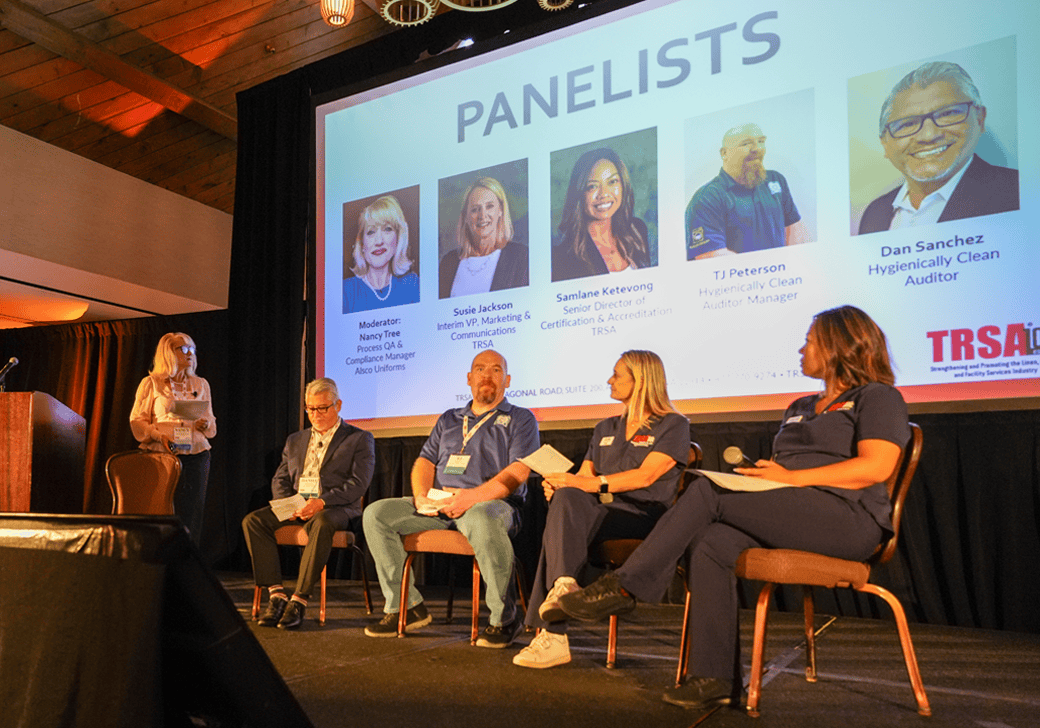


During an update at TRSA’s 15th Annual Healthcare Conference in San Diego, Kevin Schwalb, TRSA’s vice president of government relations, outlined an agenda focused on increasing the use of reusable healthcare textiles, securing favorable tax treatment for the industry, and expanding advocacy efforts at both the federal and state levels.
- TRSA is Making Significant Progress on Reusable Healthcare Textile Policy
The association’s highest-profile advocacy effort remains increasing the use of reusable healthcare textiles in hospitals and healthcare systems. TRSA successfully secured bipartisan congressional support that prompted federal agencies to study the role of reusable textiles in healthcare resilience and supply chain security. The ultimate objective is to establish policies that encourage healthcare facilities to maintain higher levels of reusable textile inventories and usage.
A key milestone is the anticipated release of a CDC-related study examining reusable healthcare textiles. TRSA views that study as a critical stepping stone toward future guidance and, eventually, broader regulatory recognition of reusable products in healthcare settings.
- The Industry is Pushing to be Recognized as Manufacturing, Not Just a Service
A major strategic initiative involves changing how government agencies classify linen, uniform and facility services operations. TRSA argues that member companies perform processing and remanufacturing functions because they transform unusable products into hygienically clean, reusable products through sophisticated mechanical processes.
If successful, this reclassification could:
- Improve access to tax incentives.
- Create more favorable regulatory treatment.
- Improve labor and economic data comparisons.
- Strengthen arguments for additional manufacturing-related benefits.
- Federal Tax Policy Could Deliver Major Savings for Member Companies
TRSA is actively advocating for inclusion under new “qualified production activity” provisions created through recent federal tax legislation. The association argues that healthcare laundries perform “significant transformation” of products and therefore should qualify for enhanced depreciation benefits. Schwalb noted that a company making a $10 million plant expansion or equipment investment could potentially realize millions of dollars in accelerated depreciation benefits if the industry is ultimately included in the program.
- Court Victories are Creating Powerful Precedents
Schwalb highlighted successful legal cases in Tennessee and Arizona where courts recognized industrial laundry operations as manufacturers or processors. These victories opened the door to tax incentives and strengthened TRSA’s broader argument that the industry provides far more than a simple service. The Arizona Supreme Court, in particular, recognized that the industry transforms unusable products into marketable ones through specialized mechanical processes, reinforcing TRSA’s policy position nationwide.
- Advocacy in Canada is Delivering Results
TRSA’s advocacy efforts now extend beyond the United States. Working with Canadian members, the association organized advocacy visits in Ottawa that contributed to discussions around capital cost allowances and accelerated depreciation opportunities. TRSA also is evaluating how Canadian tariff policies affect healthcare laundries and linen, uniform and facility services providers.
TRSA’s advocacy efforts are moving beyond defensive regulatory work and into proactive initiatives designed to reshape how policymakers view the industry. Key priorities include expanding the use of reusable healthcare textiles, securing manufacturing-related tax benefits, achieving favorable industry classification changes and advancing legislation at both the federal and state levels. As these initiatives continue to advance, member participation through advocacy visits, plant tours and grassroots engagement remains a critical factor in driving results.


Sign Up For Our Newsletter
Receive the latest updates on the linen, uniform and facility services industry from TRSA delivered straight to your inbox.