
During a recent tour of Halifax Linen Service in Roanoke Rapids, NC, President Preston McElheney cited three reasons for the company’s success as it celebrates its 80th anniversary. They include 1) consistent leadership, 2) an emphasis on innovation and 3) having the right people to carry the mission forward.
“Some people are just kind of ‘anti-change,’” said McElheney, a second-generation owner/operator of this regional provider of healthcare, industrial and food-and-beverage (F&B) linen and uniform services. “But I would say the second thing is embracing change. Not being scared of change. And that really speaks directly to our people, which is No. 3. The innovation in this industry has been extraordinary over the past 20 years. And so have our people. They understand the business. They care about the business.”
What’s more, they share the owner’s longstanding focus on innovation. McElheney sums up his approach to dealing with issues in the plant as looking for ways to improve. “Every time you have a problem, you have to find the opportunity,” he says. “Don’t look at it as a problem.” Staff need a similar attitude, he says. “You must draw in people and make it clear from the get-go that you are open to change and not rigid.” Watch for follow-up coverage of Halifax Linen in the November/December combination issue of Textile Services magazine.
McElheney credits his father, Charles Preston McElheney Jr. with providing the consistent leadership that paved the way for Halifax to invest in radio frequency identification (RFID) tracking in the early 2000s. The elder McElheney joined the business in 1974 and succeeded founders E.J. King and Thornton Wilson. One of Charles’s early moves was adding technology that was novel at the time: a computer. “It started with him putting in one of the first computers in the continental U.S. in 1984,” Preston said. “That was a great example of where changes happen.”
Halifax Linen’s emphasis on innovation continued when Preston joined the business in 1996. He advanced to president in 2004. By 2015, the plant’s entire inventory of garments and flatwork were tagged for RFID tracking, aside from napkins and bar mops. More recently, Halifax has tagged all of the company’s black and white cloth napkins. They are considering tagging other colors.
Tracking textiles via RFID has helped Halifax control losses and improve service. That, in turn, has fueled the company’s growth. Today, Halifax Linen services an area from Richmond, VA, to Savannah, GA. The plant’s 90 employees process 340,000-350,000 lbs. (154,221 kg) of textiles per week in a 75,000-square-foot (6,967-square-meter) plant.
Inside the laundry, we saw two tunnel washers: a Kannegiesser with 14, 250 lb. (113 kg) compartments and a Pellerin Milnor with eight 135 lb. (61 kg) compartments. The Kannegiesser tunnel feeds goods via conveyor to six 250 lb. pass-through dryers on the clean side of the plant. The Milnor tunnel feeds clean goods to four 250 lb. pass-through dryers.
On the clean side, the plant has four JENSEN USA ironer lines. Among these are large-piece ironers equipped with a JENSEN overhead rail system that stores sheets and tablecloths in a ceiling area and automatically feeds them into the ironer when needed. This equipment is common in Europe, but rare in the U.S.
Asked whether Halifax plans to further automate production with robotic sorting or feeding systems, Preston said the technology is promising but cautioned against moving too quickly. Today, employees present RFID-tagged textiles to a Colmac vacuum system for sorting. Preston said maintaining a “human touch” remains important to quality processing, and he favors a gradual approach to automation. “You’ve got to phase it,” he said. “You’ve got to crawl before you walk, walk before you run. I learned that through the radio frequency experience. You can’t ramrod it through. It has to be a true partnership with that vendor partner.” Halifax has long worked with Positek RFID and TEXO/Alliant on its RFID and route-accounting programs.
Looking ahead, Preston’s son Chase, a third-generation leader, is now a vice president. He has also embraced a tech-forward focus, including Halifax Asset Management (HAM), a custom-written, computer-maintenance management system.
Halifax Linen has come far since Chase’s great-grandfather Charles Preston McElheney Sr. began in the 1940s working in the laundry business in Virginia. His descendants have continued the family legacy. Watch for more on Halifax in the November/December issue of Textile Services. Click here for more information on Textile Services magazine.
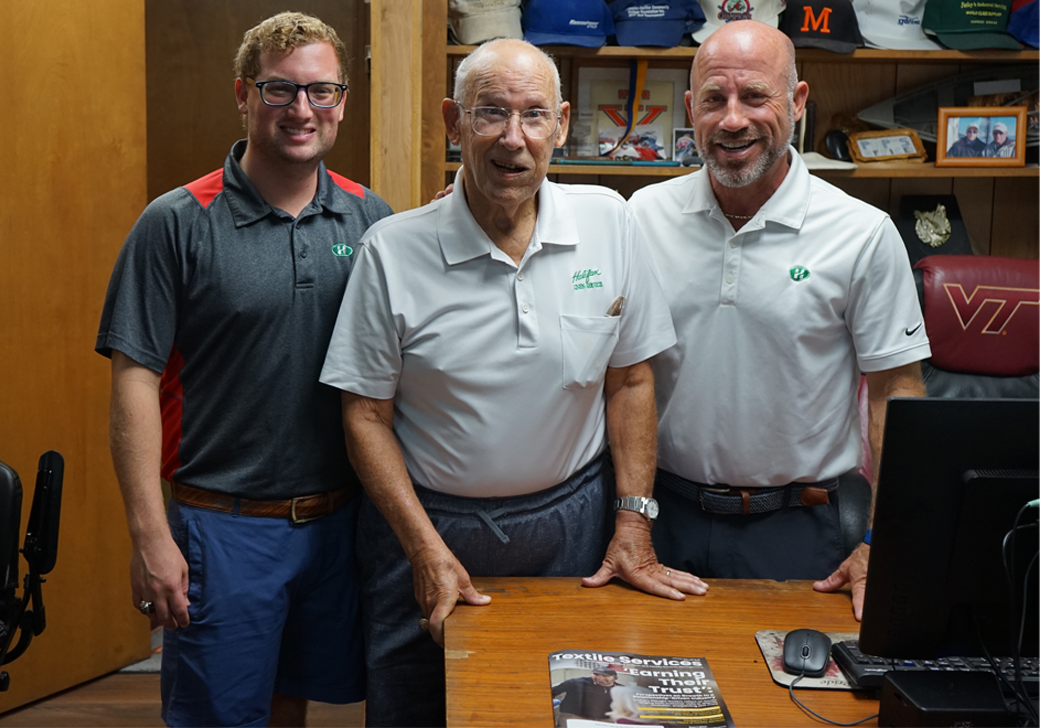
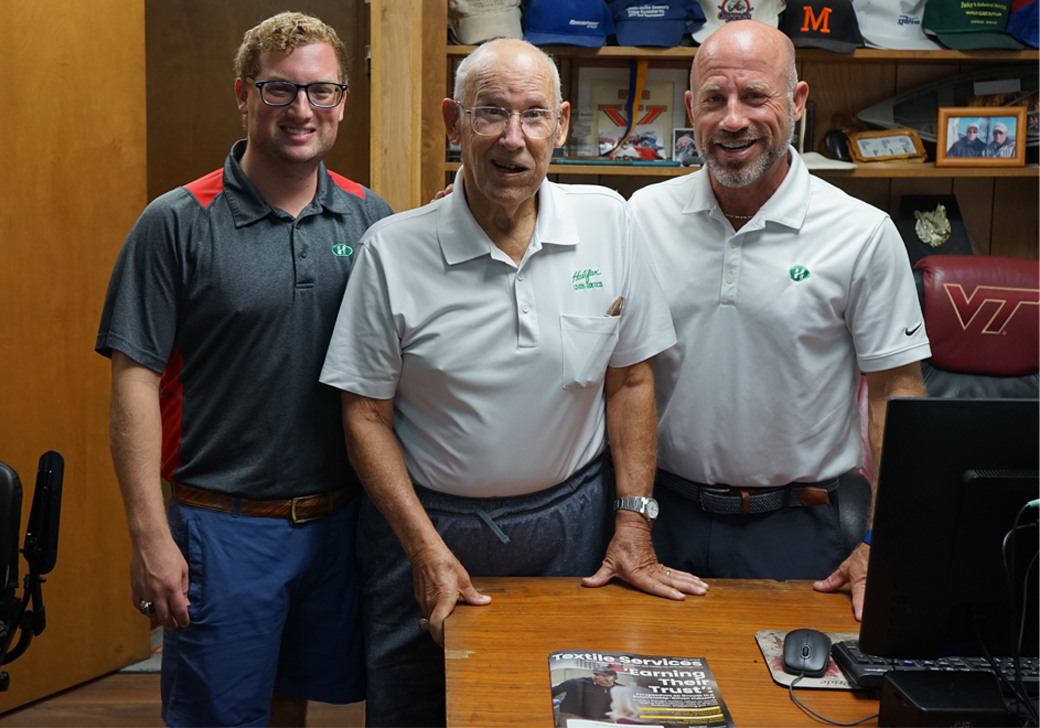
Shown above (l/r): Halifax Linen Family Ownership Team: Chase, Charles P. Jr. and Preston McElheney.



Sign Up For Our Newsletter
Receive the latest updates on the linen, uniform and facility services industry from TRSA delivered straight to your inbox.