
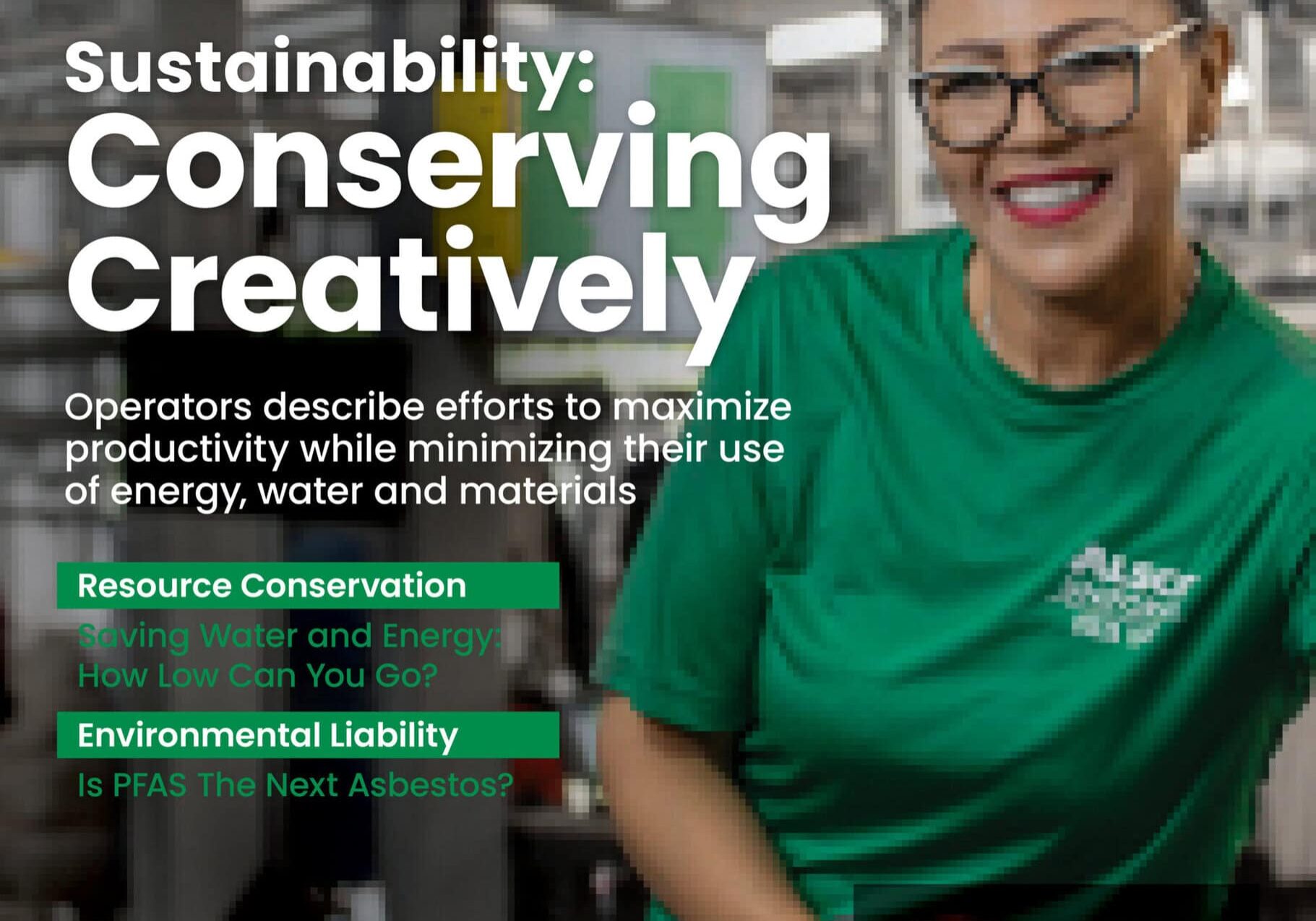
This month’s Textile Services, now reaching many office mailboxes, features a cover story on sustainability. While public attention to the issue has waned somewhat, the operators we interviewed still believe reducing a company’s carbon footprint is good for both the environment and business.
The article, titled “Sustainability: Conserving Creatively,” notes that operators are finding that boosting efficiency and saving natural resources go hand in hand to advance sustainability.
For example, although climate-change policy is receiving less attention from the current U.S. administration, laundry operators across North America and Europe continue pushing ahead to shrink their carbon footprints. The reason is less ideological than practical: saving water, energy and chemicals has become central to running a competitive linen, uniform and facility services operation in the mid-2020s.
Technology is making those gains possible. Operators say saving water and natural gas aligns directly with productivity and cost savings. As Chris Welch, president of Prudential Overall Supply, Irvine, CA, puts it, sustainability “will always be part of good firms’ stories for economic reasons, if nothing else.” Welch adds that water availability, more than climate issues, is the industry’s most urgent concern. “Reducing incoming water use and outgoing discharge means more to commercial laundries than almost any other industry,” he says.
Echoing those views are Bryan Bartsch, president and CEO of Ecotex Healthcare Linen Service, Vancouver; and his father, Randy, executive chairman of Ecotex and chair of TRSA. Operating plants in both the U.S. and Canada, the Bartsches say sustainability has become a core operational requirement. “That change is being driven by economics, regulation and customer expectations converging,” they say.
While the momentum for sustainability policies varies by jurisdiction, the overall direction is clear. Bartsch points to growing disclosure requirements, carbon reporting and heightened scrutiny of water and wastewater practices, particularly in Canada and parts of the U.S. In Europe, sustainability has grown into an essential part of doing business. Carl-Johan Björkman, CEO of Sweden-based mat processor Hr Björkmans, says reducing his company’s environmental impact is a necessity embedded in his company’s business model.
Customer attitudes toward sustainability vary, but few operators dismiss its importance. Linda McCurdy, president and CEO of K-Bro Linen, Edmonton, Alberta, Canada, says many healthcare and hospitality customers consider sustainability a high priority. However, price, quality and reliability remain decisive issues. In any event, “Embracing sustainable practices is part of who we are,” she says, citing K-Bro’s long-standing commitment to environmental stewardship.
At Shasta Linen Supply in Sacramento, CA, customer service manager Thomas Tsolakoglou gets mixed responses on environmental efforts from his company’s food-and-beverage clients. “Customers focused solely on the lowest price may resist anything that raises costs,” he says. “But most appreciate sustainability efforts, and it’s a valuable talking point in sales.”
Welch cautions that strong environmental performance doesn’t come with a price premium. Still, it enhances brand credibility. Björkman agrees, noting that reducing energy and chemical use lowers costs while strengthening customer trust. “Economy and sustainability go hand in hand,” he says.
Other issues explored in this article include:
- Recycling: Reusing end-of-life textiles shows promise but remains constrained by cost and logistics, several sources say. Björkman uses recycled yarn in floor mats, emphasizing that mat rental itself is an exercise in circularity. From the supplier side, Standard Textile’s Frank Kerley sees growing momentum around recycled fibers, take-back programs and designing products for recyclability from the outset. The Bartsches see progress, but cautiously point to the challenges of scaling fiber-to-fiber recycling for blended textiles.
- Reusable PPE: One area where sustainability and resilience clearly intersect is healthcare PPE. The COVID-19 pandemic exposed vulnerabilities in single-use disposable supply chains, renewing interest in reusable isolation gowns. McCurdy says adoption varies widely but has trended higher since the pandemic. Kerley adds that TRSA can play a key role in advocating for legislation that supports a minimum mix of reusable and disposable gowns.
- Sustainability and Staffing: Operators also see sustainability as increasingly relevant to workforce attraction and retention. Welch says employees want to feel good about where they work, even if few make employment decisions based largely on sustainability. Tsolakoglou, who describes himself as a “Zillennial,” believes millennials and Gen Z have a heightened sense of environmental responsibility. McCurdy and Bartsch both say genuine sustainability commitments resonate strongly with younger workers, provided efforts go beyond messaging.
Click here to read a PDF version of the full article. Click here to subscribe to Textile Services.


Sign Up For Our Newsletter
Receive the latest updates on the linen, uniform and facility services industry from TRSA delivered straight to your inbox.