
Cecil Lee, general manager of the co-op laundry serving Metropolitan Detroit Area Hospital Services (MDAHS), says efficiency improvements have reduced the volume of patient linens from member hospitals over the past year. The lower poundage has cut costs for both the hospitals and the laundry.
“Until this year, there was internal growth,” said Lee, a 40-year industry veteran. “But now, I sense that the efforts made by the hospitals to control costs are probably stabilized for now. For example, our poundage has been below budget year to date. And then it seems to be getting back to where it was, but I understand. My conversation at the last board meeting made it clear that this is a planned reduction. It’s by design. That was good for me to know.”
If the MDAHS hospital partners, the Henry Ford Health System, Michigan Medicine and Trinity Health, can treat and discharge patients faster, then the co-op laundry can adjust its variable costs based on laundry volume, says Lee. He notes that these costs make up 70% of the laundry’s yearly budget, while fixed costs such as labor, utilities and equipment take up about 30%. Reduced poundage makes a difference, says Lee, whose plant processes roughly 673,000 lbs. (305,267 kg) per week. “When you talk about how poundage is changing and all that, it’s a big deal,” he says. “Save what you want, but we’ve still got to pay for the 30%.”
Lee views any decline in laundry demand as temporary, given Henry Ford Health’s construction of a 20-story, $2.2 billion tower at its Detroit hospital. Hospital officials expect to complete the expansion in 2029. The 1.2 million-square-foot (111,483-square-meter) tower will add 432 patient rooms. Shortly before this article’s posting for Textile Services Weekly, Lee emailed to report a recent rise in volume. The plant now expects to process nearly 36 million lbs. (16 million kg) this year. “The fall has been busy for whatever reason,” he said. “The hospitals are still working toward shorter stays and efficiencies.”
When asked if Ford Health and the other co-op partners are pressuring the co-op laundry to lower costs, Lee said no, because they’re invariably focused on maximizing the productivity of their laundry operation. “We’re a co-op,” he said. “We’re always efficient, and we’re a nonprofit. We don’t exist to make money. So, we’re always trying to control costs. In the two years that I’ve been here, we’ve lowered the costs for them, and we’ve done that through efficiencies.”
An upcoming Textile Services magazine profile will explore how MDAHS improves efficiency at its 115,000-square-foot (10,683-square-meter) co-op laundry in Detroit.
For example, you’ll learn how MDAHS is implementing an RFID system from Positek to manage its scrub inventory and reduce losses for hospital clients. The plant, which opened in 2020, already has other innovative systems in place. Examples include:
- An automated soil sorting system equipped with “Autopilot” from Kannegiesser. The system helps manage the flow of sorted goods from soil to the wash aisle and on to finishing. This software system reduces bottlenecks that can occur with manually controlled material-handling systems. The Autopilot program also includes ETECH tracking of goods through washing and finishing.
- Two Lavatec tunnel washers. Each tunnel has 12, 200 lb. (90 kg) modules. After washing, goods move via conveyor to any of 16, 250 lb. Lavatec dryers, adjacent to each tunnel. Next, the goods move through a pass-through opening to the clean side. The facility processes light and heavily soiled flatwork and garments at an average of 0.7 gallons per lb., Lee said.
- An EllisLudell heat exchange system that helps conserve natural gas by using heated water to pre-heat incoming water from the local utility.
Watch for the full profile article on the MDAHS co-op laundry in the January 2027 issue of Textile Services. Click here for details on TRSA’s monthly magazine.
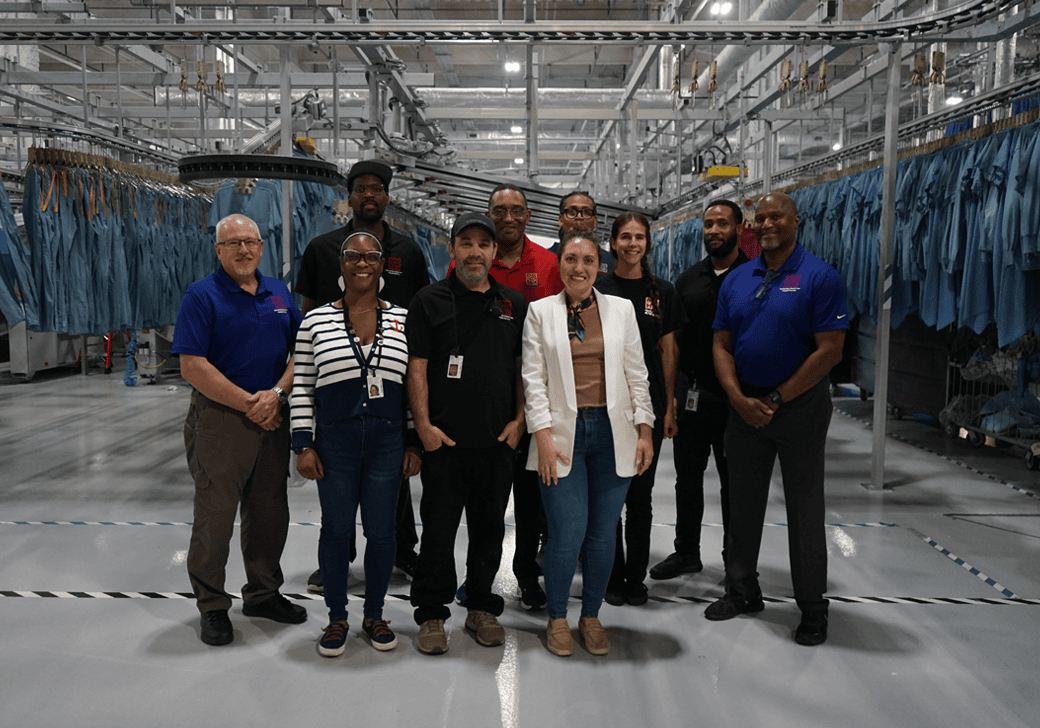
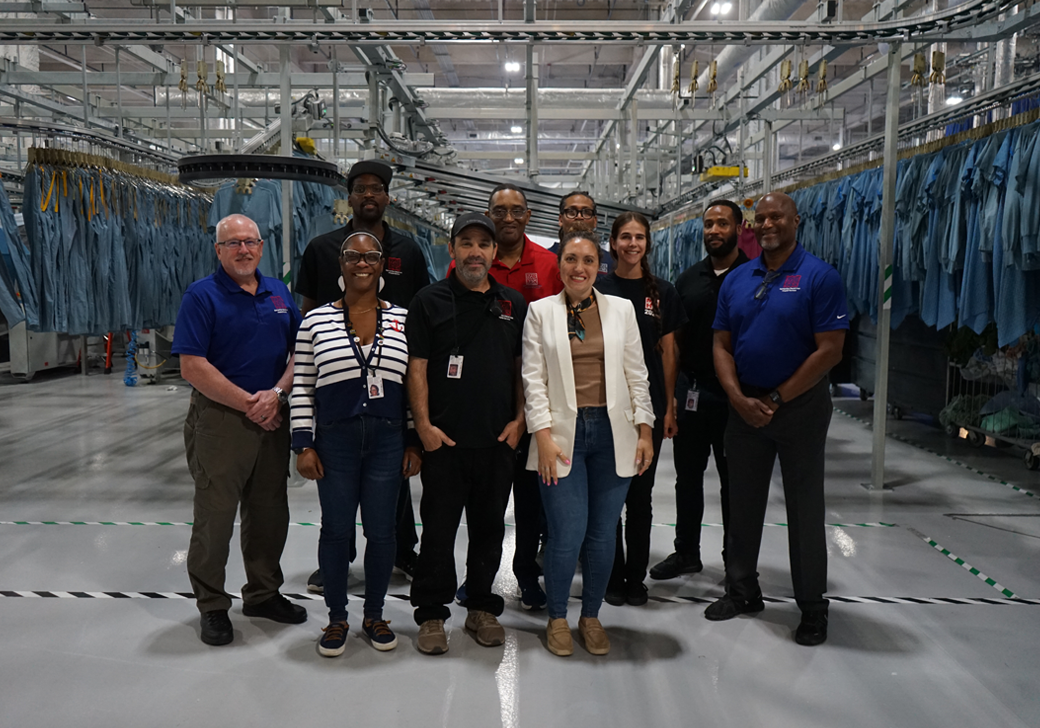
Pictured above (l/r) Front Row: Lauren Weatherspoon, accounting clerk; Christopher Slowlinksi, maintenance manager; Vanya Jelezarova, controller; Back Row: Dave Donnon, continuous improvement manager; Laurence Kidd, production supervisor; Nathaniel Adams, plant manager; Edsall Ellison, production supervisor; Emily Brown, member service coordinator; Melvyn Gathers, production supervisor; and Cecil Lee, general manager.



Sign Up For Our Newsletter
Receive the latest updates on the linen, uniform and facility services industry from TRSA delivered straight to your inbox.