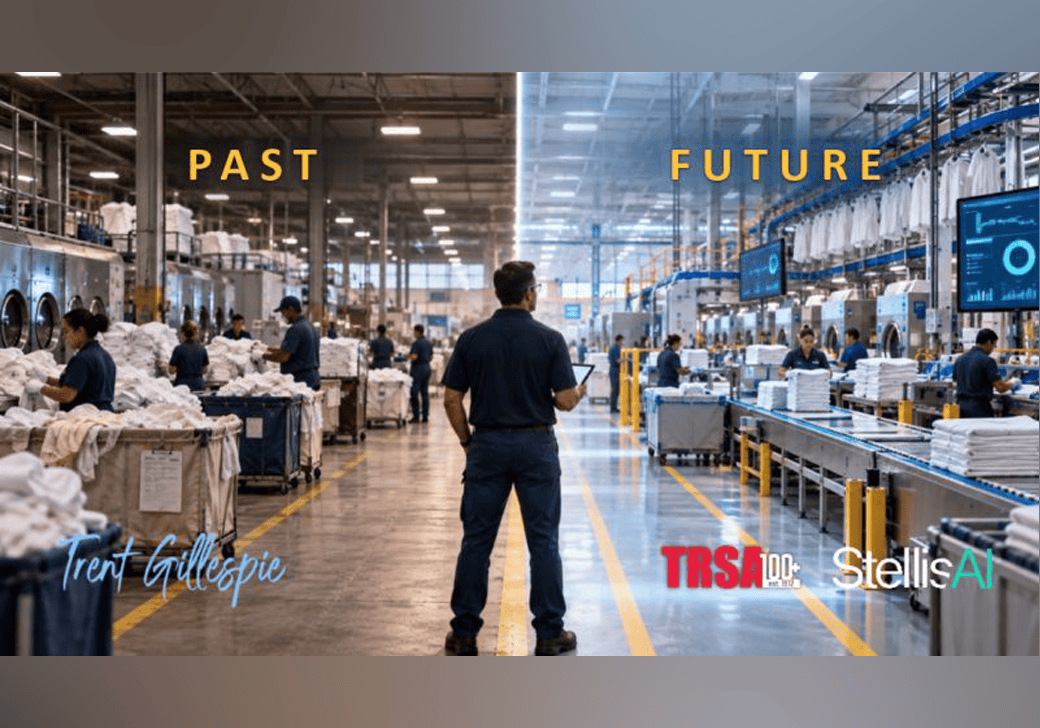

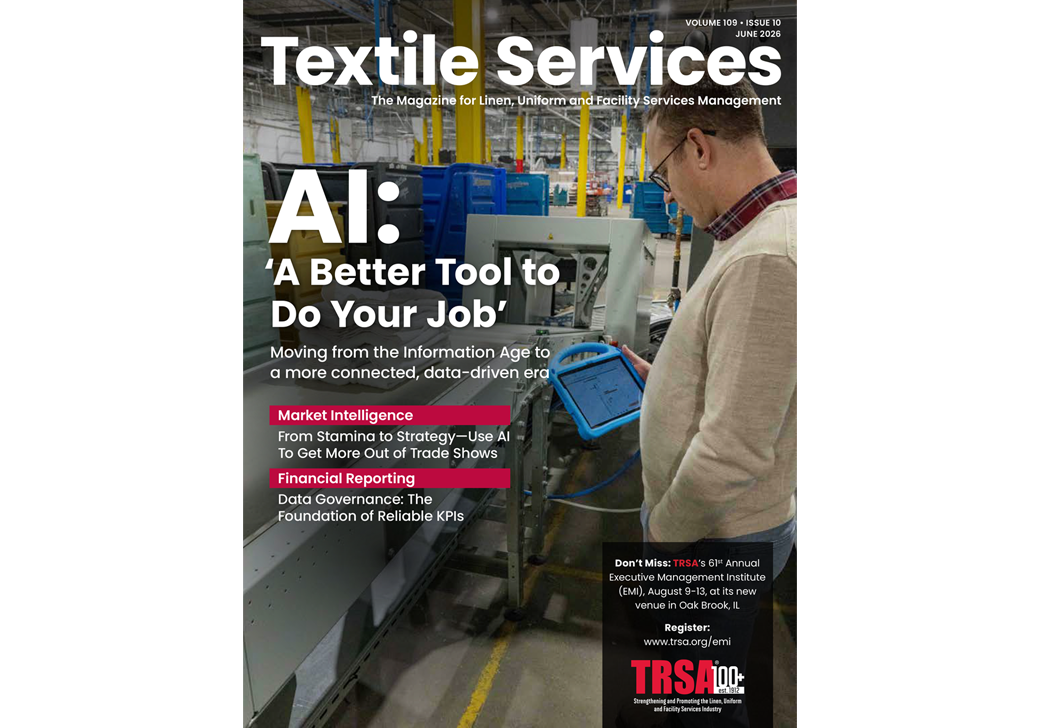
The issue of “artificial intelligence” (AI) has captured the imagination of millions worldwide, and June’s Textile Services will weigh in with a cover article on this groundbreaking technology. Titled, “AI -‘A Better Tool to Do Your Job’” – the article examines how AI is starting to impact the linen, uniform and facility services industry.
For laundry operators, AI isn’t a distant concept, but rather a practical, near-term operational tool. The article frames AI as the latest technological inflection point, comparable to the rise of the internet. The irony is that while operators recognize its importance, they may struggle to determine how to implement it effectively.
The article tracks a shift from curiosity to execution among leading companies. Early adopters are no longer simply evaluating AI; they are embedding it into day-to-day workflows across plant operations, route management and administrative functions. One executive outlines his company’s approach: Begin by identifying operational pain points, especially those tied to inefficient data use. Then apply AI to reduce time-intensive processes. Rather than treating AI as a standalone innovation, this company is integrating it into existing systems, working in tandem with both internal teams and external consultants. This hybrid approach facilitates rapid development cycles while ensuring that solutions align with operational needs.
A recurring theme is the centrality of data. Laundry operations generate vast amounts of information. Yet historically, much of it is underutilized, trapped in siloed systems or accessed through slow, manual processes. AI breaks the mold by transforming raw data into actionable insights. Companies cited in the article are already using AI to give managers faster access to operational intelligence. This enables better decisions on the plant floor and along service routes. In one sense, AI is less about automation for its own sake and more about augmenting human decision-making and allowing leaders to respond with speed and precision.
The article highlights several use cases that illustrate AI’s broad applicability. In the plant, AI-driven systems can monitor ergonomic risks and alert supervisors before injuries occur. In route operations, predictive analytics can anticipate demand fluctuations, optimize delivery density and uncover usage patterns among customers. In the back office, AI is streamlining documentation, compliance reporting and the development of training materials – tasks that once required days of effort but can now be completed in minutes. These efficiencies translate into cost savings, reduced downtime and more consistent service delivery.
A key asset noted in the article is AI’s role in “predictive and prescriptive operations.” Rather than reacting to issues after they arise, operators can use AI to anticipate maintenance needs, forecast labor requirements and optimize wash formulas before problems emerge. This proactive approach represents a major shift for an industry often characterized by reactive decision-making. The promise is straightforward: fewer disruptions, lower variability and smoother performance.
Another insight detailed in the article is AI’s growing role in sales and customer engagement. Tools that can instantly gather intelligence on potential clients – ranging from company details to key decision-makers – are already enhancing the effectiveness of sales calls. By shortening research time and enabling more informed conversations, AI is raising the baseline for competitiveness in business development. The implication is clear: companies that fail to adopt these tools risk falling behind peers who do.
Despite these opportunities, the article acknowledges the challenges of implementation. Chief among them is defining clear objectives and aligning AI initiatives with business priorities. Unlike earlier technological shifts that followed a more standardized adoption path, AI strategies are expected to vary widely, depending on each company’s goals, data capabilities and willingness to build in-house solutions vs. relying on off-the-shelf products. This variability makes leadership and strategic planning critical to success.
The article also addresses the human element. Amid fears of job losses, industry leaders frame AI as a complement to human labor rather than a replacement. The technology is portrayed as a “better hammer” – a tool that eliminates repetitive, low-value tasks and lets employees focus on higher-level responsibilities. Transparent communication and early employee involvement are key factors in easing employee concerns. By presenting AI as a way to make work safer, more efficient and less monotonous, companies can turn resistance into support.
Click here to see a draft PDF version of the full article.
Click here for information on subscribing to Textile Services magazine.



Sign Up For Our Newsletter
Receive the latest updates on the linen, uniform and facility services industry from TRSA delivered straight to your inbox.