
As commercial laundries adopt automation, some operators are wary of losing the “human touch” that safeguards the quality of the textiles they provide to clients. When Textile Services Weekly recently toured Morgan Services’ Chicago plant, we asked managers for their take on this trend, including robotic soil- and clean-side sorting and feeding systems.
General Manager Frank Schaefer answered that while he’s intrigued by the prospect of improving efficiency by automating the plant’s textile-handling capabilities, it may be some time before he’s ready to adopt these innovations. “I am genuinely interested and want to pursue those systems,” said Schaefer during our visit earlier this month. Some operators are resistant to this type of technology due to concerns that it could undermine quality control. “We like that quality check that comes with that human touch,” Schaefer said. “Once the systems get to the level where they can meet our quality standards, I’m all for it. We don’t want to sacrifice quality for automation.”
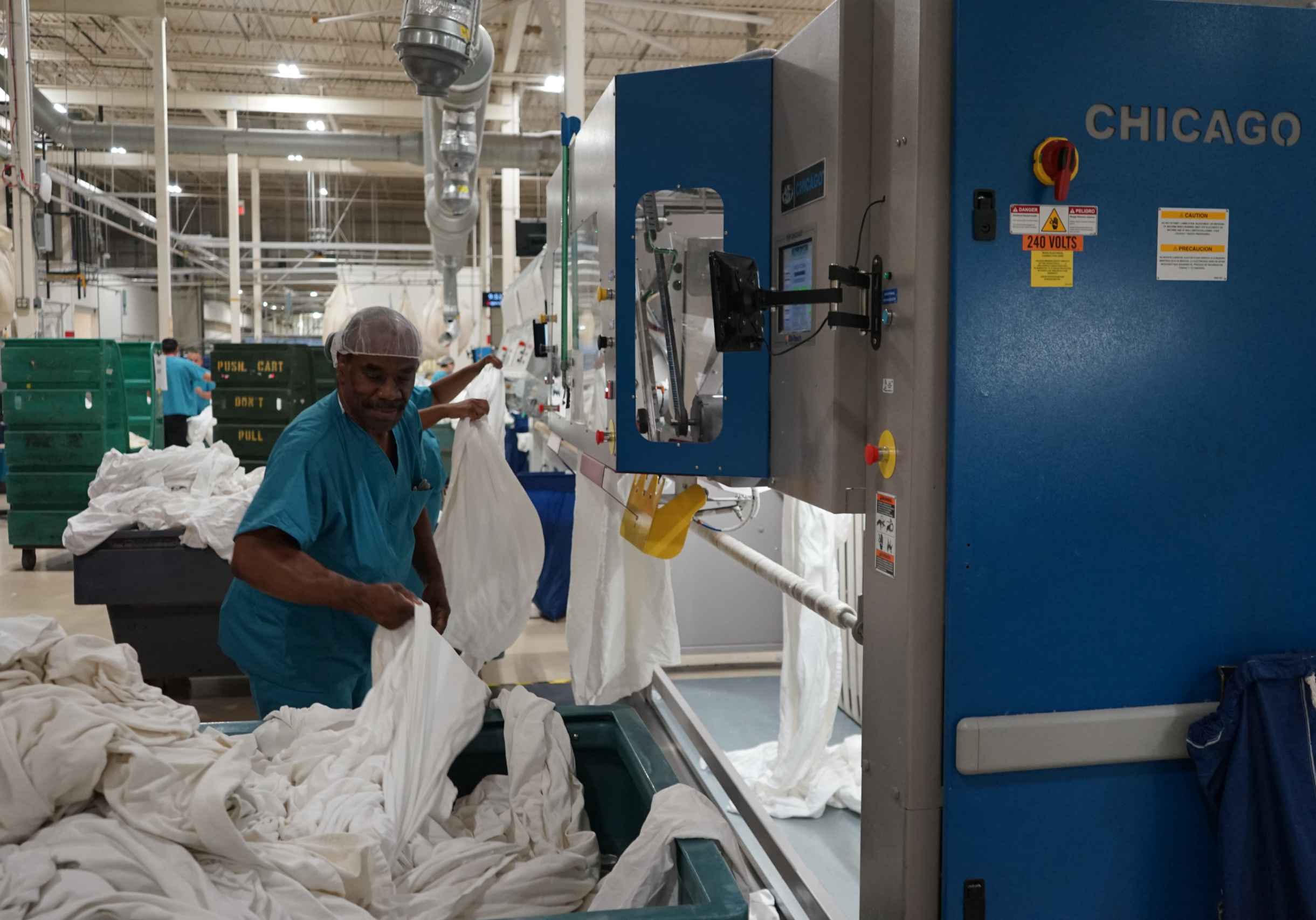
That focus on quality was a recurring theme during our visit to Morgan Services’ 100,000-square-foot (9,290-square-meter) plant in the “Back of the Yards” section of the city’s southwest side. The plant processes roughly 120,000 lbs. (54,431 kg.) per week for distribution via eight routes to a 60-40 mix of food-and-beverage (F&B) and healthcare customers. The plant’s throughput includes 80,000 radio-frequency identification (RFID)-tagged items for restaurants, hotels, hospitals and clinics across ‘Chicagoland’ and the surrounding region, including northwest Indiana.
Brant Bowen, who oversees all eight Morgan Services plants as national plant operations manager, credits Schaefer and Chicago Operations Manager Oscar Ponce with setting the example a decade ago to enhance the company’s services with RFID. “They’re the ones that really took the bull by the horns and have been our leaders in RFID technology across the whole company,” Bowen said.
Tagging textiles enhances quality by ensuring 100% order fulfillment and helping to track lost or misused items. The Morgan Services Chicago team has partnered with customers in this effort, and most clients appreciate the added attention to detail that automated textile tracking provides. “We do it with the customer, so the customer understands the power and the technology,” Schaefer said, speaking of the impact of the system from Positek. “And the customers, a lot of customers understand, they’ve heard of RFID, they know what RFID does.”
The plant itself offers another area where Morgan Services is continually improving systems and efficiency while delivering quality goods. For example, in March, Morgan Services’ Chicago team completed the installation of a new PulseFlow® tunnel washer from Pellerin Milnor Corp. The new tunnel operates alongside an older Milnor tunnel installed when the plant opened in 2003. Wash quality in both tunnels is excellent, Schaefer said; the plant’s total water use is 0.7 gallons per lb. Shaefer praised the manufacturer’s team approach during the installation earlier this year. “It was great working with Milnor,” Schaefer said. “Milnor does a real good job of collaborating with us.” The older tunnel has 12 120-lb. (54 kg.) compartments, while the new tunnel has eight 150-lb. (68 kg.) modules.
The plant is also equipped with ETECH soil and clean-side rail systems, five 450-lb. (204 kg.) EllisLudell washer/extractors and two 450-lb. EllisLudell Whisper Dryers. There are also eight 300-lb. (136 kg.) Milnor dryers. Other equipment includes a Norchem wastewater-treatment system, Ecolab chemical-injection equipment and a heat exchanger from Thermal Engineering of Arizona (TEA). The plant also has six ironer lines with equipment from JENSEN, Chicago Dryer Co. and Foltex. Productivity throughout the plant is tracked through Spindle technology.
In walking the plant floor, we were struck by the large number of employees – known here as “members”– with 10 or more years of experience. The roster of route service representatives is similarly filled with veteran members who completed a 6-8-week training program to ensure they were prepared to provide quality customer service. The Chicago plant was recently recognized for the fourth consecutive year as having the company’s top service team. Service Supervisor Bob Fitzgibbon (a nine-year company veteran) credits the team’s training efforts for preparing staff to meet customer expectations. “So, it all starts in the interview,” Fitzgibbon said. “We want to make sure we hire somebody that’s trainable, capable and reliable. And we let them know right off the bat what kind of job this is. We don’t sugarcoat anything. And then once they’re good to go, we start training. We don’t want anybody going out there feeling like they don’t know what they’re doing because then it won’t last. So that’s why it’s important to make sure they’re trained, so they know they can handle a good portion of the situations. But we’re always a phone call away.”
Watch for follow-up coverage of Morgan Services’ Chicago plant in an upcoming issue of Textile Services. Click here for more information or to subscribe to Textile Services.



Sign Up For Our Newsletter
Receive the latest updates on the linen, uniform and facility services industry from TRSA delivered straight to your inbox.