
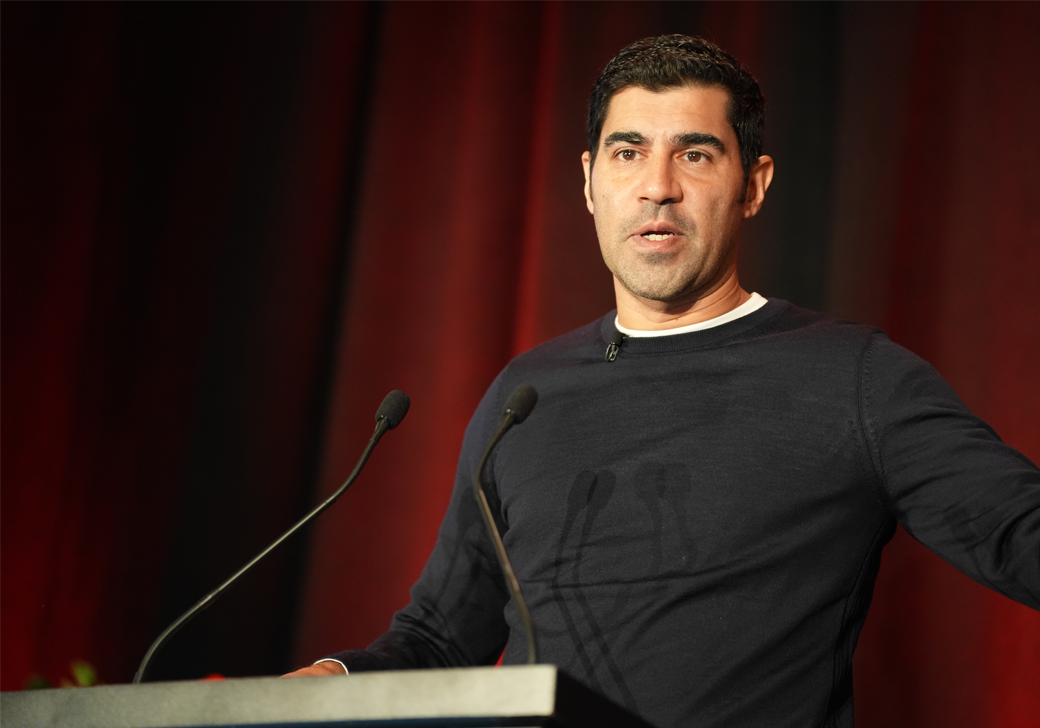
Dr. Parag Khanna’s keynote at TRSA’s 113th Annual Conference & CEO Summit outlined how global business is being reshaped by interconnected geopolitical, economic and technological forces. Dr. Khanna urged business leaders to move from reactive decision-making to proactive, data-driven strategy.
Takeaway 1: Leaders must integrate political, economic and technology insights into a single strategic view.
Khanna framed today’s environment through an “iron triangle” of geopolitics, geoeconomics and geotechnology, arguing these forces operate together and continuously reshape markets.
Rather than focusing on headline conflicts, he described the global system as a constant “tug of war” over supply chains, innovation and market share.
Takeaway 2: Supply chains should be designed for flexibility, resilience and redundancy, not just cost efficiency.
A central theme was that globalization persists, but in more complex ways.
- Companies are expanding globally through foreign investment and “tariff jumping.”
- At the same time, they are shortening supply chains through reshoring and risk reduction.
In a complex system, Khanna noted, opposing trends often occur simultaneously. “Everything is both-and, not either-or,” he said.
Takeaway 3: Resilience depends on constant monitoring and informed decision-making.
Khanna emphasized that resilience is measurable and operational. Leaders must continuously monitor:
- Suppliers and sub-suppliers
- Geopolitical and regulatory risks
- Climate exposure and emissions
This shift reflects a broader move toward real-time risk visibility and predictive planning, replacing passive approaches.
Takeaway 4: Competitive advantage increasingly comes from how effectively companies use data and AI.
Advances in AI and IoT are transforming supply chain management by delivering:
- Real-time visibility into production and logistics
- Predictive analytics to anticipate disruptions
- Low-cost tools for data integration and dashboards
Khanna emphasized that these capabilities are becoming widely accessible, giving companies new opportunities to improve foresight.
Takeaway 5: Growth opportunities are expanding across regions and require a more diversified global outlook.
Khanna pointed to Southeast Asia as a rising economic hub, citing strong population growth, investment and trade expansion. The region now plays a growing role in U.S. imports and global supply chains.
At the same time, he highlighted a “bottom-up” industrial resurgence in the United States, driven by investment in energy, manufacturing and technology.
Takeaway 6: Organizations must adapt to a workforce that prioritizes flexibility, mobility and continuous learning.
Khanna stressed a major generational shift:
- Younger workers value mobility and flexibility over long-term stability
- Traditional milestones like homeownership are declining in importance
- Skills development is replacing fixed career paths
“The greatest skill in the 21st century is to be mobile,” Khanna said.
Takeaway 7: Tracking population movements and climate exposure is critical to long-term planning.
Economic activity is increasingly concentrated in urban areas, with about 65% of the global population now living in cities.
At the same time, climate risks, from rising insurance costs to extreme weather, are reshaping where people live and where businesses invest.
The Bottom Line
Khanna’s message was clear: success in today’s environment depends on anticipating change rather than reacting to it. Organizations that invest in data, embrace complexity, and proactively map risks and opportunities will be best positioned to thrive in a world defined by constant movement and uncertainty.



Sign Up For Our Newsletter
Receive the latest updates on the linen, uniform and facility services industry from TRSA delivered straight to your inbox.