
Rising utility costs are a growing concern for many operators amid the war in the Middle East and U.S. inflation at 3.3% in March. A May article in Textile Services offers operators’ insights on saving water and energy while advancing sustainability.
One bright spot in today’s resource milieu is that investments in water reuse typically deliver energy savings as well, according to the article titled “Saving Water and Energy: How Low Can You Go?” Simply put, the less water you use, the less energy you need to heat water and dry textiles. Few operations illustrate this principle better than Hr Björkmans Entremattor in Arlöv, Sweden. The mat-laundering company has built its business around a vision of near-total resource circularity.
“We have developed our own patented water-recycling system, enabling us to reuse up to 98% of our wash water,” said founder, managing director and CEO Carl‑Johan Björkman.
That aggressive rate of reuse pays energy dividends. Mats are washed at 104°F, while recycled water returns to the system at about 86°F. That means only modest additional heating is required to reach the proper wash temperature. Just 2% of the wash water is lost to evaporation, and that loss is largely replenished with rainwater collected from the facility’s roof.
What’s more, Hr Björkmans discharges almost no wastewater to the public sewer system. Instead, wastewater is purified in-house using biotechnological detergents that rely on naturally occurring microorganisms rather than conventional chemicals. These microorganisms break down soil, remain effective at lower temperatures and allow for the reuse of recycled water across multiple wash cycles. Björkman estimates annual water savings of roughly 16 million liters, or more than 4 million gallons.
While few laundries currently are achieving 98% water reuse, meaningful progress is happening across North America through less dramatic but highly effective upgrades.
Joe McKeown, COO of HandCraft Healthcare Linen & Uniform Specialists in Richmond, VA, points to the industry’s shift to higher-pressure, wider-tunnel presses as a major turning point. Modern 55-bar, 1.3-meter-wide presses extract far more water than the 28-bar, 1-meter-wide presses common two decades ago.
The result is significantly lower moisture retention, cutting natural gas use in the dryers. “Drying the linen is one of the largest gas consumers,” McKeown said. “Removing more water before the dryer is where you save money.”
At HandCraft’s Martinsburg, WV, plant, dryers are now the largest gas user rather than water heating, thanks in part to heat-reclamation systems upstream.
Laundry consultant Gerard O’Neill, president and CEO of American Laundry Systems, emphasizes that conservation starts with plant design. His go-to strategy is simple: split trench and pit systems that facilitate water and heat reuse.
“With the correct choices of what water to reuse and what to send to sewer after heat reclamation, you can typically reuse around 20% of your water,” O’Neill said. Cleaner operations can reach 30% with modest additional equipment, such as shaker screens, tanks and pumps. In many cases, ROI can be measured in months, he said.
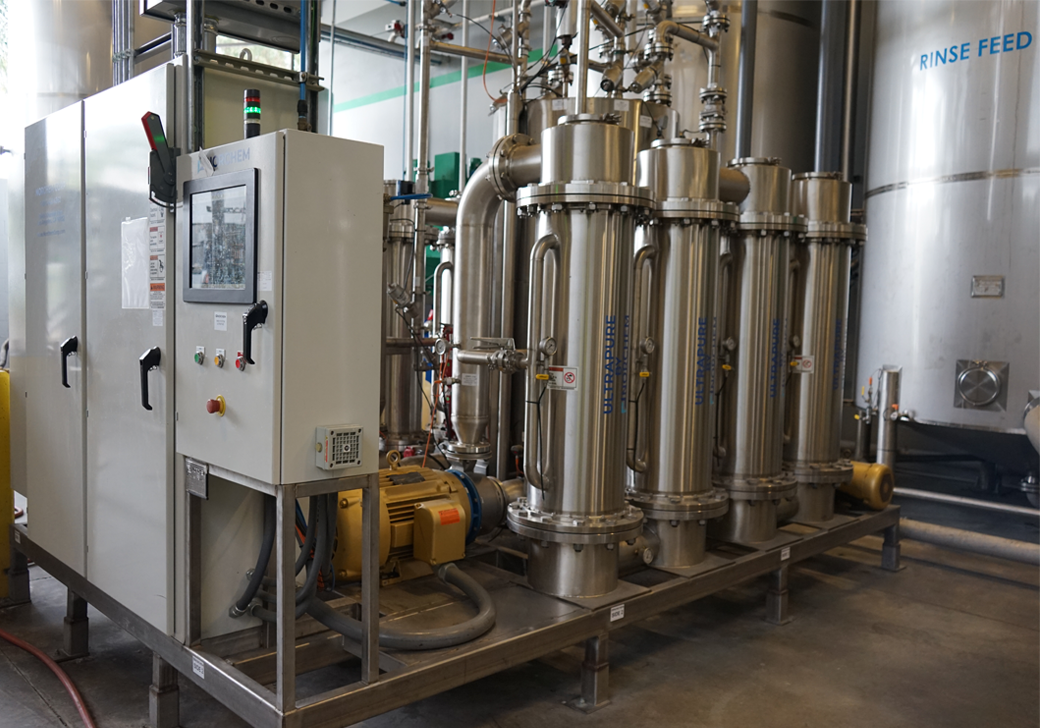
Beyond that, advanced filtration systems take conservation even further. Ceramic microfiltration and ultrafiltration can push reuse rates above 50%. To move past 75%, reverse osmosis or multiple-filtration stages are required. These systems deliver major savings but come with high upfront costs. “Get your checkbook ready at this level,” O’Neill said, noting that membrane technology has improved substantially over the past decade.
Other improvements cited in the article include:
- Quintex Services Ltd., Winnipeg, Manitoba, Canada, has paired water recycling with targeted energy upgrades. A steam audit conducted with Efficiency Manitoba led to repaired traps, eliminated inefficiencies and reduced natural gas use. Additional projects included upgrading to a high-efficiency air compressor and converting more than 280 lights to LEDs, all supported by provincial incentives.
- Superior Linen Service in Tulsa, OK, has seen similarly strong results. After installing a ceramic filtration system, the company cut water usage nearly in half, from 1.78 gallons per pound to 0.93 gallons per pound. Energy usage also dropped from 2,205 BTUs per pound to about 1,700 BTUs. Additional wash-aisle upgrades planned for 2027 are expected to drive further reductions.
Click here for a sneak peek at the full article appearing in May’s Textiles Services.



Sign Up For Our Newsletter
Receive the latest updates on the linen, uniform and facility services industry from TRSA delivered straight to your inbox.