




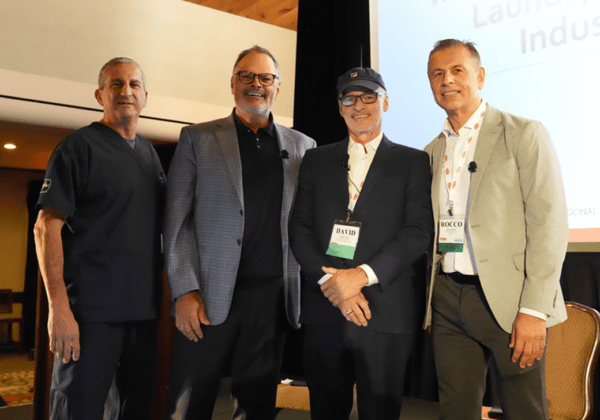
 What will define the next era of healthcare laundry and textile services? In this episode, recorded live from TRSA’s 15th Annual Healthcare Conference in San Diego, industry leaders Randy Bartsch, Rocco Romeo and David Stern join TRSA President & CEO Joseph Ricci for a wide-ranging discussion on the forces reshaping the healthcare market. The panel explores consolidation and scale, AI and automation, changing customer expectations, workforce challenges, opportunities in outpatient and long-term care, business valuations, and the growing importance of technology and data. They also share where healthcare laundry executives should be investing today to prepare their organizations for the future.
Pictured (Left to Right): Joseph Ricci, Randy Bartsch, David Stern and Rocco Romeo
This episode is sponsored by:
Jason Risley: Welcome to TRSA’s Linen, Uniform & Facility Services Podcast. Today, we’ll attempt to answer the question: What’s next for healthcare laundry and textile services? In this episode, recorded live from TRSA’s 15th Annual Healthcare Conference in San Diego, TRSA President & CEO Joseph Ricci moderates a discussion with industry leaders Randy Bartsch, Rocco Romeo and David Stern for a forward-looking conversation on consolidation, AI and automation, workforce challenges, changing customer needs and opportunities for growth. First, a word from our sponsor: A good textile should make a laundry operator’s job easier, not harder. This episode is brought to you by Merrytex. Their engineered healthcare textiles are designed to streamline processing, reduce replacement costs and perform relentlessly. Let’s get into the conversation.
Joseph Ricci: So I want to welcome you to our CEO panel discussion, What’s Next? Healthcare Laundry Leaders on the Industry’s Future. And we’ve quite a good panel in front of us. Randy Barch, Rocco Romeo, and David Stern. Randy Barch is founder, chairman, and CEO of EcoTex Healthcare Living Services, a leading provider of healthcare textile services across Canada and the United States. Under his leadership, the family-owned company has grown to serve more than 400 healthcare facilities and process over 155 million pounds of hygenically clean linens annually. Barch currently serves as chair of TRSA’s board of directors and has held numerous industry leadership positions. He received the Queen Elizabeth II Diamond Jewel Billy Medal for Community Service in Philanthropy. Please welcome Randy Barch. Rocco Remu is CEO of HLS Linen Services, a leading healthcare and hospitality textile services provider serving customers across Ontario and Western Quebec. For more than 30 years in the laundry industry, he has advanced from CFO to CEO while helping grow HLS into a major regional laundry provider. Rocco has held leadership roles with HLAC, IADAM, and the Association for Linen Management, ALM, and is an active member of TRSA and ARDA. He’s a frequent speaker at industry conferences, including this conference previously, and across North America and Europe. Thank you for joining us, Rocco. Dave Stern is CEO and President of Stern Asset Management and retired textile services industry leader with more than 40 years of experience. A self-proclaimed serial entrepreneur, he founded Paris Uniform Rental in 1978. He grew into one of the nation’s largest independently-owned textile services companies. He also established a health care division, serving more than 100 hospitals across five states. Former chair of TRSA’s health care committee, he’s now focusing on consulting and philanthropy. And I’m pleased to have him here with us and bringing him out of retirement. David, thanks for being with us. This first question is going to go to Dave. Companies serving the acute and non-acute healthcare sector are experiencing significant change. What do you believe are the three most important trends shaping the industry over the next five years?
David Stern: Good question. I think probably the biggest thing is the change in our customer base. You know, a lot of it’s moving to acute care to retail. That’s going to be continuing. I think the consolidation of the industry, our customer base’s industry, not our industry, this huge, you know, I see Probably in five years, probably some of the states will have two or three providers, maybe 5 in some of the larger states. some of these smaller health systems are going to be merging and it’s going to change many of the people we serve. That’s going to be extremely significant. Probably the last thing is the change in technology is happening so rapidly that it’s hard to keep up and if you’re not in that game, you need to get in that game because it’s going to help compete. It’s going to be what you need to compete. And so learn the technology, spend money on technology, have your people understand the technology in so many different ways. And I’d say, you know, help my head, that’s probably the three things that I think are extremely important.
Joseph Ricci: Thanks, Dave. Rocco, same question.
Rocco Romeo: So I think similar with the technology is key, particularly with AI. We talk a lot about AI. We have to be able to use AI to our advantage, both from internally in our plant operations to get better information so that we can react quicker and to get more efficiency out of our operations. I think it can also be used very much so to provide for better customer service. Our customers are asking for more data. And they want to be able to get that data more frequently. And I think there’s a huge value add to be able to service customers through that. The use of other technologies like RFID as well. Consolidation, we know we discussed about that. I know we’re going to discuss that even more. That I think is becoming key. And I agree with what David said about the number of laundries. We’re going to start to see more and more of that happening. That’s just on a scale issue on top of everything else. And I think labor and robotics and watching that automated sort systems. Those are just some of the trends I think we’re going to start to see more of as we move forward. And the change in the type of skill set you need to run these plants, I think, is going to change. As you start getting into more sophisticated systems, the importance of the type of skill set you have in your maintenance departments will change. In order to be able to keep up with that, I think that’s a matter of the plant industry, you’re going to have to support it, but that’s going to be another big change.
Joseph Ricci: Thank you, Rocco. Randy, same question.
Randy Bartsch: Yeah, I mean, I guess I would add a couple of things. One, I think we’ve seen our customers, the hospitals and medical facilities that we service as customers, they’re becoming larger. There’s consolidation. They themselves are adjusting to a changing reality. And I think they’re also becoming more sophisticated. The people that we have been used to transacting with or the users at the local level are often not the people today that are making those decisions in the future, five years from now. They won’t have as much say in what’s going on. So there is kind of a bifurcation, I think, that’s taking place with the customer. The business, I think, is also becoming much more capital intensive. You think of the investments, you think of the impacts of tariffs, and even the new technologies are all increasing the cost of capital replacement. And I don’t think that’s going to change and that’s not even layering in the new technologies that have to be onboarded. I mean, we hear about the amount of money that’s being invested in data centers and in technology and how companies like Anthropic and ChatGPT and OpenAI are running billion dollar spends and not generating sufficient revenue to cover them. I mean, you think of it as quite incredible. That’s not going to happen in our industry, but those costs of the products and the technologies that they’re developing ultimately have to be absorbed by clients. And we are a client. As an industry, we’re a customer that’s going to adopt those new technologies. And then I think the other thing is that information is really becoming part of the product. We’ve heard that theme today. We’re also going to have the power. Who in here used one of the LLMs, like one of the chatbots, AI chatbots? Okay, almost everybody. So you know what it’ll do for you. So I mean, we’re just getting a glimpse of what the potential is. The ability to monitor and regulate and manage scoras basically for our service outcomes and our service performance will ramp up dramatically. We talk about the fact that a lot of times customers hope to get to a state with the services that they don’t have to drill down on all the reports. They’re not going to be drilling down reports. It’s going to be AI that’s going to drill down a report and give them whatever scorecard or whatever way they want to measure some sort of rating, contract compliance, all of these things are going to be automated. Society is going through a major structural transition. But I think, Joe, at the same time, we are an important support service to clinical activity, taking care of patients. And I don’t think that’s going to change. And within the need of infrastructure that we supply the medical system, That’s real things that have to be touched by real people that have to be shipped on time and reprocessed. Those fundamentals aren’t going to change.
Joseph Ricci: Thank you, Randy. I’m going to start with Rocco on this question. How important will scale be over the next decade? Can different ownership models, family-owned regional companies, investment-backed companies, and hospital-owned and shared service organizations all remain successful?
Rocco Romeo: Yeah, I’m going to start off with the co-op or shared service organization. If you look at the evolution of that going back to the late 60s, early 70s, it’s probably the success story of hospitals of being able to centralize a service together in order to provide a cost-effective, capital-intensive type of a service. It’s been interesting because about 25 years later, a lot of the central co-ops, all of a sudden, if you weren’t a certain size, they wound up either being consolidated with some of the bigger ones. So for example, down here where I was, heart planted, they were 14 back in the 70s. move forward to 1996, you had about six or seven of them that wound up closing down because the economy simply weren’t there to maintain. Some of the consolidation we see today happened then and now you’re going forward another 20 years where we are now and there’s only two of the original 14 that were in Ontario. So what happened? You have now a lot of the hospitals, one of the reasons they got into that conflict, they liked the control over the quality, they wanted the control over pricing and the dependability of it being an essential service. When it hit the first stage that happened, a lot of these laundries hit that 20 year mark and what happens at 20 years, you need to invest more money in capital. You start looking at costs going up. the size of those operations when you’re dealing with a plant that’s 3 to 7 million pounds, all of a sudden it didn’t start to make a lot of sense. And so what happened is they were consolidated with some of the other co-ops. You hit now, you move forward now to about 2020 around the COVID. It started happening. All of a sudden hospitals started paying a pill. We’re really happy that they had these. co-op laundries because it was important, particularly in the laundry of the people, you need to have control over that specific area that was their laundry that they could ensure this happened. Now we’re at the point where with all of the stuff going on with private equity, you’ve got those few that are left, a lot of them are of a certain size and you’ve either got private equity going after some of the other ones or you have even the larger ones as boards change, so do priorities. And I think this is probably what you’re going to start to see with a lot of the co-op laundries. A lot of the ones that are still around are the ones that have had consistent management over a period of years and have been successful and have shown that the importance of customer service, they’ve shown the importance to their customers and quality and they’ve kept them. At the same time now, you have private equity going to some of these boards that are saying, why am I in the laundry bin? some of the offers are being made in terms of, do we get out of this business? And some of these hospitals are looking at it and some of these boards are saying, well, if I’m out of it, I’m going to get this much money. Maybe I can use that for something related to the hospital. So I think you’re seeing an evolution of even the shared service organization. which was going to start to see that in the future that there are alternatives out there. And as I said, we’re going to have those boards that want that control over that service because they consider it essential. And if other boards say, someone else can do my laundry, you know what, I might be able to get some money from selling this off and use it for alternative purposes in the health care. So I think this is interesting with all the other consolidation that’s happening. I don’t think this particular model is going to be any less unscathed than anything else that’s currently happening in the industry as we move forward.
Joseph Ricci: I’m going to come to you next here, but as a follow-up, I mean, with the consolidation, one of the things we talked about with consolidation, and as Dave mentioned earlier, maybe 2 laundries in the state or five, you know, five options in the state. Do you think the consolidation will… And it sounds like you’re, you said it basically they’re continuing to look to possibly at outsourcing, right? But do you think the consolidation and maybe the lack of choices, would that impact the decision of whether to outsource or go the laundry? Where do you see that? We’re going to start with you, Rocco, and then I’ll go to Dave.
Rocco Romeo: I think the key things is, am I going to get the same service level? Is my price going to be competitive? and we’re going to get that reliable dependable service. I think those become the key factors. And if they’re able to get that through whatever model provides them that, I think it’s something that they’re going to look at seriously, probably going to be the biggest factor, which is the right way to look at these businesses, right? And obviously volume is a volume sensitive business. Volume does drive costs. So you’re seeing a lot of these larger places and it’s going to become more and more difficult for a smaller operator to be able to compete against laundries that have consolidated their volume. It’s found much more difficult.
Joseph Ricci: David, do you have any comment on those?
David Stern: Yeah, I think scale is important. Supply chain, bigger you are, better dealers you’re going to get, that simple. Same way with our customers. I think it’s important in the customers that you serve. If you serve a healthcare system and they have 6 hospitals and you can’t serve them because you’re not big enough, you might be disqualified. And I think the other thing that’s important with scale is the backup. Customers want backup. They say, what happens if your client goes down? It’s a question you’ll get off, and I’m sure you do. So as long as you have other plants, they might not have capacity, but the customers like that assurance that you have other plants that can do that. And I think scale gives you that.
Joseph Ricci: Randy, anything to add before we move on.
Randy Bartsch: Well, on the scale topic, I mean, scale certainly matters, but I don’t think scale alone lets you win. You have to still have capability. You have to have culture. You’ve got to have service. You’ve got to have capital discipline. All those things matter as well. Again, we’re seeing a transformation. We’re seeing consolidation. There will be fewer. The answer to get in the game has gone up. Those things kind of drive certifications. All of these things drive towards a level of service that honestly is commoditized. It’s one that if you can’t achieve the standard that the market requires, you don’t get to play anymore. I think that all three ownership models that have been discussed here, family-owned businesses, private equity or venture capital-backed companies, and the not-for-profit sector are all having to adjust to those realities. And as an independent operator, and our company, we’ve made an intentional decision to remain family-owned and multi-generational. I’m fortunate because I’ve got two boys who are very competent and Brian, our CEO, is running a great business and has the ability to be in there and take this to the next level. I think with our business, like many businesses, require a new set of eyes to look at things differently than the way it was looked at in the past because that’s what our customers need and that’s what we’re driving towards. But we have to continue to reinvest. We’ve got to expand geographically so we’ve got the redundancy and backup for the clients that we serve. Our customers are emerging and changing, so we have to be responsive to that. I think this month’s Textile Services Magazine, the cover says, follow the patient, and that’s really what you have to do.
Joseph Ricci: Thanks, Randy. The next question, we’re going to start with you. So healthcare systems are consolidating and purchasing decisions are increasingly influenced by supply chain, finance, and GPOs. What does the customer value today, and are we as an industry keeping pace? What truly differents the provider beyond price?
Randy Bartsch: There’s two things here. On one hand, the people making the purchasing decision are disconnected from the relationship that we have at the site level with customers. That has been a trend over the last 10, 15 years and it will become even more apparent going forward. Again, if you look at the patients and you look at the health systems, they’re also under tremendous pressure to try and find their way forward. in this complicated world. HB1 has reduced funding transfers on healthcare. They’re trying to find a way that works. So there’s putting pressure on the companies. So how do we respond to that? In many cases, we have to consolidate so that we’ve got scale, so we’ve got the ability to get more production done in a more dense environment so that we can average our costs over and our investments over a broader base. Those are things that are incumbent upon us to be competitive so that we get the right to continue to serve these customers going forward. The customer is still looking for the right linen at the right time in the right quantities at the right place. And the business is still pretty simple. They get stuff dirty, we get it clean, we reprocess it, and we get it back to them so that they can carry on the job of patient care. And to the degree that we as an industry and as companies fulfill that, then we got to continue to provide these services.
Joseph Ricci: Do you have anything to add to that?
David Stern: Yeah, I think you started off, who is the customer? In my career, that was one of the hardest things. Believe it or not, who is my customer in this health system, which may not even be the customer. They’re not the decision maker. Do you satisfy the customer or do you satisfy the decision maker? That’s a question you guys will deal with for a long time. Once you figure out who the customer is, then you can answer this question. It’s a hard thing to know because who you’re serving has different needs and who makes the decisions. I’m curious, how many people here think our business is a commodity? We’re a commodity. I hate to say this. I know we talked a lot about service and service to customers, but our customers look at us as a commodity. And we need to understand that reality. And so we need to have a service level. We need to make sure they don’t run out of stuff. These are entries into the game. When you go in to present to a customer, Everybody says our service is the best. Everybody says, and so they differentiate us through a number of different things. And the customer that makes the decision many times is not the customer that uses our service. And so we have to look at that and in a commodity like environment, the low cost producer wins.
Rocco Romeo: I mean, the customer does use this commodity. They want that high fill rate. They want to make sure that it’s that on-time delivery. They treat them like they want all those things there. They don’t want to live, I always say, they don’t want to worry about linen on their daily thing of what goes on and off. We just want it to be there when they need it with the quantity. What differentiates this, I think at the end of the day, they’re also looking at their costs. And I always say, don’t forget about the price. Look at your overall linen spend. Like how can we help them to help through education and training and utilization and reducing hoarding and some some of the things that’s adding cost to them. That’s what I think they’re looking for where we can say, hey, we can help with this because they don’t have the expertise in this area. They’re always looking to us to provide that to them. And I think if we’re able to spend more time showing that there’s a value add to that beyond just being a commodity where we can actually help, then I believe that’s where there’s additional value that differentiates us from price because otherwise we’re always just going to go to the price and you have to make that differentiation. And even any type of accreditation or certification, they just want to make sure that the limit we’re providing, they just want that to happen, that they don’t have to worry about that again. That’s another one.
Joseph Ricci: And we’ll start with you, Rocco. What did COVID teach us about healthcare launch of capacity and resilience and have our customers actually retain that lesson? As care continues moving outside the hospital, where does the next major opportunity come?
Rocco Romeo: Yeah, I think, as I mentioned before, during COVID, I think there was all of a sudden we became a little bit more, they paid more attention to it. It’s like, he’s going to wash all this DP&E. We don’t have the disposable product. We have the laundry. Laundry’s got to turn this around and help us out. And I think they saw an element of resiliency. I think they put us under a bit more of a microscope looking at what are our contingency plans for that. And for the short term, they actually saw a lot of benefit in reusable products, particularly during a pandemic. And unfortunately, soon as COVID went over, a lot of the teams have forgotten that particular lesson. I still think it’s one that we still need to continue to drive in terms of that. And I think our customers now are from COVID. I think they’re starting to ask more questions regarding contingency plan on areas such as procurement and backup plans that we have as a laundry. So I think if anything, it’s provided some additional opportunity for us to gain some of that disposable volume back, although it will take some time. I think there’s still a huge opportunity there from a procurement perspective.
Joseph Ricci: I think the Canadian market did a better job of maintaining that, if I’m correct, Randy.
Randy Bartsch: Yeah, but you have to fundamentally understand the difference between Canadian healthcare and US healthcare. Anybody that’s operating in the US in any large city, there’s multiple health systems and they compete or at least they operate in their own silos. In the Canadian system, which is a universal payer system, hospitals are collaborative. The funding comes from a single source, which is the government or a government agency. And so there’s an incentive to share and support each other as community health care. And that helped during COVID for sure. It helped with the implementation of consistency around decisions and the pathways that were going to be implemented. Rocco serves the customers in the Toronto market and we do as well and we had some of the co-ops as the other shared service operators and we got on maybe not weekly calls but bi-weekly calls with everybody from senior Ministry of Health people down to the hospital buying groups and everybody to work collaboratively to see where we could help each other and move forward. So it’s different. It’s different. But I think the takeaways are that hospitals can’t live without clean linen. They can’t live without barrier garments. They can’t live without all the isolation products and other services that we provide. And so I think the proper framing and I think the framing today, nobody talked about supply chain before the pandemic. maybe if you’re in the transportation company. But today, everybody knows about supply chain. Everybody’s impacted, whether it’s the vegetables you buy at the grocery store or whether it’s you can’t get a new iPhone 18. I think we are, healthcare laundry is absolutely a critical piece of the medical infrastructure, healthcare infrastructure. It’s more that than a commodity. But it’s also easier if you’re a buyer that’s not intimate with the relationship on a day-to-day basis with laundry and linen to commoditize it because it just fits into a spreadsheet a whole lot easier.
Joseph Ricci: David, any thoughts on that?
David Stern: No, I think you and I talked right after the pandemic when we talk about we need legislation. I think it was Kevin to talk with the only way to force hospitals for compliance on reusable textiles is to have legislation to help force a percent of hospital usage to go to reusable. And I know the industry in DRSA has jumped on that. And I remember discussing that and I thought, you know, this will be good for the industry and it’ll be good should there ever be a pandemic. But I know we went from laundering to selling reusable textiles because nobody had reusable textiles. And so we were selling a lot of reusable isolation and processing them on an energy basis and kept us alive for a while.
Joseph Ricci: What are the future growth opportunities, right? I mean, is it in non-acute? Is it in with outpatient and ambulatory services? Is it long-term care, behavioral health? Where do we see the growth opportunities that are out there? Start with you, Randy, and then go to David.
Randy Bartsch: I mean, again, I think you have to realize that we are a support service. So we are there to create safe, comfortable environments for patients to undergo whatever kind of medical attention they require. So that will shift and change. And as that shifts and changes, we as companies and as an industry need to be able to adapt to that. I think it’s logical that the impacts of technology and AI are going to change clinical practices and may shorten up stays, there may be less intervention. All of those things will have a ripple impact on our business. I think it’s reasonable to say that there’ll be less inpatient stays, but every time a patient comes and goes, the bedding and linens and towels have to be exchanged. There will probably be an increase in the amount of outpatient services and things that take place. And so we just need to make sure that we are resilient and adapt to those changes.
Joseph Ricci: Dave, any thoughts?
David Stern: I think disposables is an area that our industry needs to learn how to compete with. It’s a David and Goliath thing. We’re competing against an industry that’s so much bigger than the textile industry. And so I think we have a competitive advantage that we just have a hard time selling. I think it’s a growth area. I think nursing homes don’t use rental laundries for whatever reason. I think there’s a growth opportunity there. I think ancillary services like pack makeup and stuff like that, you know, if you go to the hospital, everything’s in the pack now. And so I think there are ancillary services like that we can grow. And I think, of course, the outpatient market is a growth market.
Joseph Ricci: Rocco, any thoughts on that?
Rocco Romeo: Yeah, I’m long-term care for us with the aging population, and they shift towards that. I was patient facilities in Canada, we’re starting to see a spike again in and out. We use the lower again, and part of that is related to some of the stuff that happened after COVID and a realization that there are sensations. We are starting to see some potential additional growth in those areas, and we lost some of that just before COVID and we’re starting to see getting a lot of that back.
Joseph Ricci: With your model, you’re a different kind of business model, obviously, but you’re always providing different services. Are there services that you’re providing to your customers that maybe the commercial or outsourced laundries aren’t providing?
Rocco Romeo: I guess OR is one of those areas where I think there is a major opportunity there against disposal. There’s huge savings available, and I think it’s something sometimes people are afraid of getting into that specific area for numerous reasons, but I do believe that is probably one of the areas, the long-term care market is something. And you’ve got to start treating these markets slightly differently than you would the hospital market. I think that’s one of the other key components of success there is treating them differently because they do have different needs and different requirements in your regular market. So I think just splitting up your plans into different sectors to make sure that you’re properly addressing the needs of that particular area.
Randy Bartsch: The topic is really about what happens going forward, and that’s really kind of the theme of this panel. But I think what’s really important to frame is that in the developed world, so the Western world, the birth rate is below replacement. Every country, save and except Israel, it’s below replacement. So the replacement rate is 2.1 children per woman. and your population stays the same. And the United States is at 1.6, Canada is at 1.3, and it’s declining. So that means that over the next 10 years, you’re going to have fewer children born. We have both countries have reduced their immigration, both dependents and their policies. So you’re going to see less people entering the workforce. And so we’ll reach a point of stability between 2026 and 2050, because where the math is, it’s 25 years, the overall population in the United States is going to drop by 10%, from around 350 million to 330 million. Canada is going to drop from 40.1 back to around 36. So that’s 10%. But the employment, the people actually working, the working age people in the United States right now is 163 million people. And that’s going to drop over the next 25 years by more than 15%. So if your population workforce drops by 15%, your population overall is only dropping by 10. That means 5% of the population is aging beyond 65 and no longer in the workforce, but has to be cared for. So you’re going to have dynamics in terms of aging. We’ve talked for 25 years about an aging grain population. It is now coming. And not only that, there will be less people. So there’s a lot of concern about AI and it’s going to change. Get better. If we don’t have those people, then we need something else to get the work done. So I think that a lot of the fears that people have around workplace displacement, I think that’ll all sort itself out. But there is going to be transformational change. We’ve lived 50 years where the population has grown. Our children and grandchildren will live in a life where there will be declining population through their entire lifestyle. That’s a fundamental change, and that will change not only our industry, but healthcare and everything around us. And I think it’s important to put all of these things in that context.
Joseph Ricci: Technology’s coming, right? We’ve talked about it a lot today, and there’s technology coming, got automation, robotics, AI, RFID, data systems, all those types of things. So you walk into a leaving healthcare laundry 10 years from now, what fundamentally looks different. And as you said, we’re not necessarily replacing people. We get putting people out of work. We’re just replacing people because there aren’t enough people and obviously the skills change. Rocco, are you any comment on that?
Rocco Romeo: Yeah, I think, and as I mentioned earlier, you’re going to have to have a different skill set for some of the sophistication of some of these systems because you’re going to have to be able to support them. I saw a laundry in Europe, which is probably the most sophisticated line you’ve ever seen, but they have this whole control room basically running the plant. So you’re definitely going to have to have people that are more skilled in terms of being able to handle all of the things that can happen when you’re that reliant on technology. So I think that’s going to change. I think when you start to look at things like automated sorting systems, I think that’s probably one of the key things. That’s one area of our plant I think all of us are beginning to find becoming more and more difficult to staff within a plant and there’s huge advances in that specific area. You know, we’ve had a dependence on labour in that. I think that has helped offset some of the issues that many of us are having in terms of running a plant in that area. And that’s probably going to be one of the first areas I think we’re going to start to see some advances. I think that a lot of that technology is very, I think.
David Stern: David, I hope I’m here 10 years from now at one of these conferences and remember this conversation. But your plants will be so automated. Your distribution, the autonomous vehicles will be taking your merchandise to the hospitals and your distribution people inside the hospital will be autonomous. I mean, I think our industry will lag a little bit because we have low wage people. So the AI people and everything will go to where they’ll make the most money. But in 10 years, it’ll be here and it’s exciting. I think, will it? Reduce our dependence on labor, absolutely. Many of the skill sets of the labor will be exactly what Rocco was talking about. And data management will be critical to every healthcare laundry.
Randy Bartsch: I think we’ll see fewer hands touching the linen through the process in the laundry, but we’re going to see far more technically capable people supporting the systems around the laundry. And I don’t think we’re going to see a point where there’ll be no people. because there’s always going to be exceptions within all of the laundry that we have to reprocess within a 24-hour period. So there will be expediters. There will be other things. But there will be vast parts of the process that will be able to be automated. I mean, you think today, before tunnel washers, before overhead rail systems, before sorting systems, there’s very few people between the time which the laundry comes in until it gets handled and folded. So most, half of our process has already been automated over the last 30 years, 25 years. And we’re going to see the automation go deeper into the system. And it will be a systems approach. And those systems will be managed by technical people with the aid of AI or AI supported technologies.
Joseph Ricci: David, I want to start with you on this question about valuation. So Investors continue to show strong interest in our sector. And in my opinion, valuations is important no matter what you’re going to do with your business. If you’re going to continue to run it as a family-owned business, if you’re going to continue to run it in any way, valuation is really just part of how your business is being run and how you measure success. So what characteristics make this sector attractive and what separates the most valuable companies from the rest? And following on that, what are the key factors currently driving enterprise value?
David Stern: Yeah, well, I went through a couple of sales. both my healthcare division and my industrial division. There’s interesting evaluations of each one of those companies that are completely different. I encourage all of you to have an evaluation model of maybe a phantom stock model where you value your company based on certain benchmarks. And the traditional one where most private equity is the EBITDA model. And then the larger you are, the bigger multiple that gets to be. It’s just part of what private equity looks for. So once you’re at a certain point, either you get to 10 million EBITDA, maybe a little bit of it, you get a 50 million in EBITDA, more people look at you, get to 100 million EBITDA, you get a lot of the big players looking and that multiple goes up. Now on your retail, where you go once a week and you go on inventory, what I found is like a completely different valuation model. almost on a multiple of sales. I don’t think the players in the industry are there yet, but that’s what I found as I went through the process. It wasn’t as much EBITDA because people said, hey, I can take this, put it into my system, and I already have the distribution system. I already have the processing. I already have the overhead. 50% goes to the bottom line. I can pay a multiple of sales. In total, it was two different valuation models. But the primary one, I think, has family offices and private equity look at our businesses should be in that business, will be a, what is the EBITDA. That would be, and I would recommend everybody at least keep track of that and value your company on that.
Rocco Romeo: I think there’s a lot that makes our industry attractive. And first of all, we have, a lot of us have long-term contracts with a lot of customers. So that’s extremely attractive. Recurring revenue. We’re in an industry, healthcare. People get sick in good times and in bad times. We just the whole, when we were in COVID, sure a lot of us saw a drop in volume. Some of that got offset by some of the PP&E, but we were able, we were extremely resilient. industry from that perspective and attractive. And when you look at the commodity we provide, we talk a lot about AI and all the changes that technology and how we process and that. But if you look at the commodity in and of itself, sure there’s some things out there from a disposal perspective, but the main core items of like the sheets and the base cloth and whatever, there’s no real technological things happening in the near future that’s really going to rock that particular product that we act to how we process, sure and all that, but those products are still there. So I think there’s a lot of value and I think they see a lot of the, our businesses are fascinating. When you get someone who’s never been in there and you get to somebody that you look at the level of automation and what we do, it’s a fund. There’s a lot of opportunity there and I think they see the opportunity and the potential of these businesses to survive through many different cycles. And I think that’s what is driving a lot of the attractiveness. It’s probably one of the stronger businesses if you wanted something long-term to look into it.
Randy Bartsch: Dave referenced EBITDA, which is a financial term that’s used, but it’s really simply free cash flow. It’s how much cash flow a business generates. And valuations are really based on the buyer’s view of forward cash flows. Like how likely are those cash flows going to grow or are they going to decline? And we’re in a fortunate industry where generally they tend to index with inflation or cost. They’re not declining. And so that’s very attractive. I think the other thing that’s important is that scarcity drives value, right? Things that are scarce. If you wanna go to the game and it’s almost sold out, or the Uber driver. You want to get from the airport to the hotel and there’s a mad rush because two big planes came in, you get spiked pricing. Scarcity drives value. And so right now we’ve had consolidation and especially in the healthcare sector where there’s been lots of investment by private equity and they’re looking to sell and consolidate. There’s going to be fewer opportunities and fewer large scale opportunities to enter the business. And so that in itself is going to drive up value. We’ve had major players enter the market in the last number of months, and there will be more going forward. Now you’re having companies like BlackRock and Brookfield. You’re looking at companies like CBC. CBC, who’s partnered with Unitex, they owned F1. They sold it to Liberty. They sold it on a massive valuation. They’re under, if you read the newspaper, CBC is currently negotiating to buy women’s tennis, WTA. This is a whole new level of interest. Again, if you’ve got people that are interested in the model and there’s fewer opportunities, it’s going to drive up multiples. But in the end, you still have to deliver service to customers. And so your operating capacity and capabilities of your management team honestly matter more than anything else.
Joseph Ricci: Final question for me. If you’re advising every healthcare laundry executive in this room for one strategic investment over the next 24 months, what would it be? Anybody want to take that on first? I know it’s a hard question because 10 years.
David Stern: It’s an easy question for me. It’s technology. It’s just, you know, get your teams on board, learn technology, invest in the technology. It’ll drive efficiencies. It’ll drive customer satisfaction. It’ll drive so many different things. It’s probably, you know, we used to have, every year we’d do capital and everybody’d come up with their capital and we’d look at ROI. And I can’t think of a thing that will give you better ROI than some of the technologies that will be out here now, both now and in the future.
Joseph Ricci: One comment on technology, but obviously automation, they take a lot of space. So I think that’s why we’re seeing more laundries being built. I mean, can you?
David Stern: You have the efficiencies of getting, automation and machinery. I remember getting into business and they said, we have $10 million of inventory. What business has that much money inventory? We have no clue what’s going on and we don’t control it. I said, we have no. But I think with technology, we’ll be able to control our inventories better and teach our customers how to use it better. And I think it’s a huge.
Joseph Ricci: So when you’re saying technology, you’re talking about data.
David Stern: Talking about product, different factors. Yeah, I think I would highly recommend that we learn, get our ERP people to develop better programs, you know, so that it’s all automated. And, you know, it’s happening. It’s happening now. So that would be, you know, probably where we’re spending most of the capital.
Rocco Romeo: Technology and data. I mean, we have so much data in our facilities. I mean, that helps us internally with running our operations, provides for our customers information that they’re expecting from us to help them run their stuff. So without a doubt, technology and data.
Randy Bartsch: I mean, I would build on that, and I agree 100%, but you can’t be in business unless you pay the bills. One of the bills that’s coming forward is your investment in technology. And so that’s a given. But I really think that technology, while it changes the business, it’s execution that remains the differentiator. You can have all the AI and automation, but it’s not going to eliminate great operators. So the strategic investment that we will make, and I think you should make, is in people, creating the opportunities for more technical people to become involved in the process and the system, getting more young people in the game, and basically capturing the energy potential that’ll take us forward.
Joseph Ricci: Thank you, Randy, Dave, Rocco, appreciate it.
Jason Risley: Thanks for listening to TRSA’s Linen, Uniform & Facility Services Podcast. We hope you enjoyed this conversation on the trends and opportunities shaping the future of healthcare laundry and textile services. Now, a final word from our sponsor: True value in commercial laundry is measured in longevity. Merrytex engineers advanced fiber technology into every garment, delivering meaningful differentiation and superior service life. Visit merrytex.com to explore healthcare textiles built to perform. Until next time.

Publish Date
October 31, 2026
Runtime
43 min
Categories

Sign Up For Our Newsletter
Receive the latest updates on the linen, uniform and facility services industry from TRSA delivered straight to your inbox.
Recent Podcasts
Episode 86 – The Future of Laundry Operations: How Technology is Reshaping the Industry